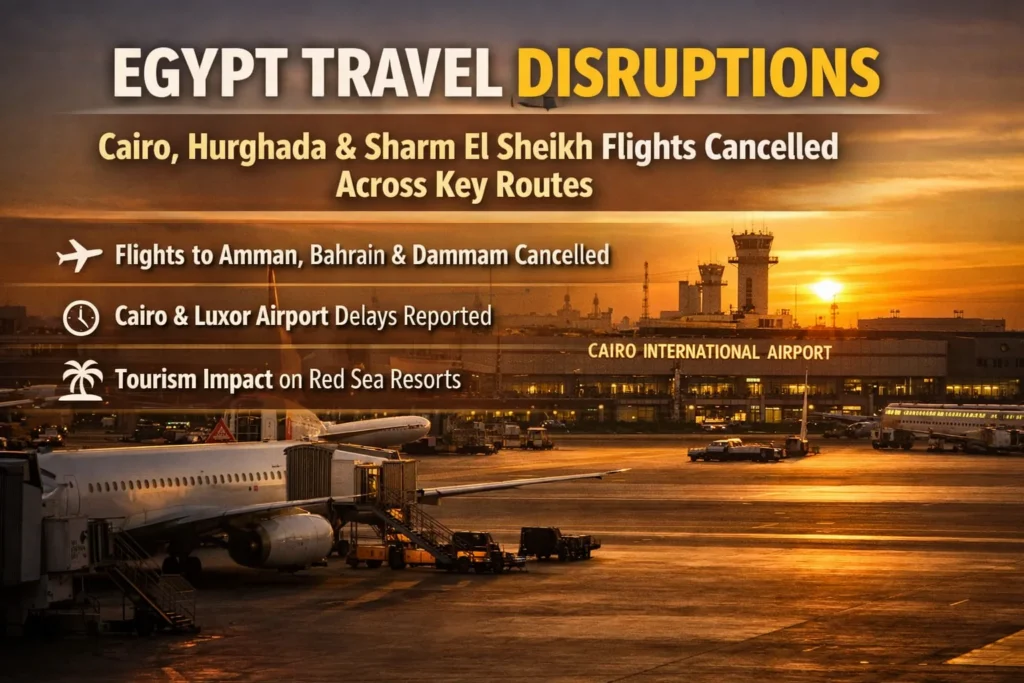
Air travel across Egypt has entered a period of disruption as multiple airlines cancel flights across major airports, affecting both domestic and international routes. The cancellations, impacting key destinations such as Cairo, Luxor, Hurghada and Sharm El Sheikh, have created uncertainty for travelers and raised concerns about operational stability in one of the Middle East’s most important tourism markets.
A total of more than a dozen flights have been cancelled over a short span, disrupting connections to regional hubs including Amman, Bahrain and Dammam, as well as domestic routes linking Egypt’s major cities. The impact has been felt across the country’s busiest airports, with Cairo International Airport emerging as the most affected location.
Cairo International Airport, a primary gateway for both international visitors and domestic travelers, recorded the highest number of cancellations. Several flights scheduled to depart for regional destinations were suspended, including services to Jordan and the Gulf region. Domestic connections to cities such as Luxor were also affected, further complicating travel plans for passengers relying on the capital as a transit hub.
The concentration of cancellations at Cairo highlights the airport’s central role in Egypt’s aviation network. As a key hub connecting Africa, the Middle East and Europe, any disruption at Cairo can quickly ripple across multiple routes and airlines. Travelers using Cairo as a connecting point have faced missed flights, extended layovers and difficulty securing alternative travel arrangements.
Luxor, one of Egypt’s most iconic tourism destinations, also experienced disruptions. A canceled flight connecting Luxor to Cairo has affected both domestic travelers and international visitors attempting to continue their journeys through the capital. Given Luxor’s importance as a cultural and historical center, reliable air connectivity is essential for maintaining steady tourism flows.
Hurghada, a major Red Sea resort destination, reported additional cancellations affecting flights to Cairo. These disruptions are particularly significant for tourism, as Hurghada attracts a large number of international visitors seeking beach holidays and leisure experiences. Interruptions in air travel can lead to delays in arrivals and departures, affecting hotel bookings, tour schedules and overall visitor satisfaction.
Sharm El Sheikh, another key tourism hub on the Red Sea, also faced disruptions with the cancellation of an international flight. This highlights how the current wave of cancellations is not limited to domestic routes but extends to international travel as well. For a destination heavily reliant on global tourism, maintaining consistent flight schedules is critical.
The involvement of multiple airlines indicates that the disruptions are not isolated to a single carrier but reflect broader operational challenges within the aviation sector. Industry experts suggest that factors such as aircraft maintenance, crew availability, scheduling complexities and air traffic management constraints may all contribute to the current situation. When several of these factors occur simultaneously, airlines may be forced to cancel flights to ensure safety and efficiency.
For passengers, the immediate impact has been significant. Travelers have reported long queues at airport counters, limited availability of alternative flights and uncertainty regarding rescheduled departures. Those with connecting flights have faced additional complications, including missed onward journeys and extended waiting times.
Tourism, a cornerstone of Egypt’s economy, is particularly sensitive to such disruptions. Cities like Cairo, Luxor, Hurghada and Sharm El Sheikh attract millions of visitors each year, drawn by Egypt’s rich cultural heritage, historical landmarks and coastal resorts. Flight cancellations can disrupt travel plans, reduce visitor numbers and affect businesses that rely on tourism revenue.
The disruption of regional routes is also noteworthy. Flights connecting Egypt with neighboring countries in the Middle East are essential for business travel and regional tourism. Cancellations on these routes can affect trade, business meetings and cross-border travel, adding to the broader economic impact.
Despite the challenges, Egypt’s aviation sector has a track record of recovering quickly from disruptions. Airport authorities and airlines are working to restore normal operations by adjusting schedules, reallocating aircraft and assisting affected passengers. Enhanced communication with travelers is also a priority, helping them stay informed and make necessary adjustments.
Passengers navigating the current situation are advised to remain proactive. Regularly checking flight statuses and staying in contact with airlines can help secure alternative arrangements more quickly. Flexibility in travel plans is essential, as schedules may continue to change in response to operational conditions.
Travel experts recommend allowing extra time at the airport, particularly when flying from major hubs like Cairo. Early arrival can help passengers manage potential delays in check-in, security and boarding processes. Keeping travel documents easily accessible and monitoring airline notifications can further streamline the experience.
The broader lesson from these disruptions is the importance of resilience and adaptability in modern air travel. As demand for flights continues to grow, airlines and airports must invest in systems that enhance reliability and improve coordination. This includes better contingency planning, real-time communication tools and stronger operational support.
In conclusion, the recent wave of flight cancellations across Egypt has disrupted travel across major cities and regional routes. With Cairo at the center of the impact and key tourism destinations affected, both domestic and international travelers are facing challenges. As airlines work to stabilize operations, passengers are encouraged to stay informed, remain flexible and plan ahead to minimize inconvenience.
Egypt’s position as a leading tourism destination means that maintaining efficient air connectivity will remain a priority. While the current disruptions present short-term challenges, ongoing efforts to improve aviation infrastructure and operations are expected to support long-term growth and stability in the country’s travel sector.