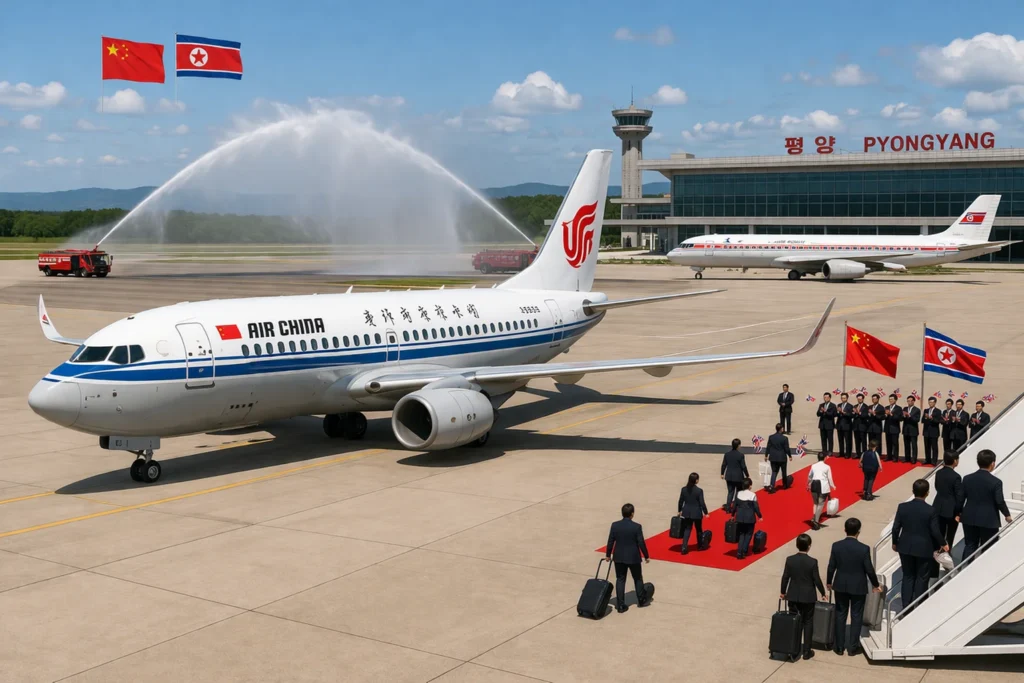
North Korea has taken a significant step toward reopening its borders by resuming direct flights from China after a six-year suspension. The restoration of air connectivity between Beijing and Pyongyang marks a new phase in the country’s carefully managed return to international travel and engagement.
The first flight on the revived route departed Beijing in the early morning and arrived in Pyongyang later the same day, signaling a controlled but meaningful restart of cross-border movement. This development reflects broader efforts to rebuild diplomatic, economic, and cultural ties, particularly with China, which has historically been North Korea’s largest source of foreign visitors.
A Symbolic Restart of International Connectivity
The relaunch of flights between Beijing and Pyongyang is not just a transportation milestone—it carries strong symbolic importance. The route had been inactive since the onset of global travel restrictions, making its return a sign of renewed cooperation and cautious optimism.
Passengers on the inaugural flight were primarily individuals traveling for official purposes, including business representatives, students, and government-linked personnel. Authorities have emphasized that the reopening is being implemented in stages, with strict controls in place to regulate who can enter the country.
The arrival of travelers at Pyongyang’s main international airport was met with official welcomes, highlighting the importance of the moment. Government representatives described the resumption of flights as part of a broader strategy to facilitate structured exchanges while maintaining national security and public health priorities.
Integration of Air and Rail Travel
In addition to the revival of flights, North Korea has also restored cross-border train services in recent weeks. The combination of air and rail links provides a more comprehensive transportation network for approved travelers.
This coordinated approach allows authorities to manage incoming visitors efficiently while maintaining oversight. By offering multiple travel options, North Korea aims to support essential travel for diplomatic, academic, and economic purposes without opening the floodgates to unrestricted tourism.
The integration of transport systems also reflects careful planning, ensuring that all entry points operate under consistent regulations and monitoring procedures.
Strict Entry Requirements Remain in Place
Despite the reopening of select routes, North Korea continues to enforce strict entry requirements. Only travelers with official approval are permitted to enter, and all visits are subject to tightly controlled itineraries.
Visitors must comply with government guidelines throughout their stay, including participation in supervised tours and adherence to designated travel routes. These measures are designed to maintain oversight while gradually reintroducing international engagement.
This cautious approach contrasts with the broader global trend of fully reopening borders, underscoring North Korea’s preference for a phased and controlled strategy.
Economic and Tourism Implications
Before international travel was halted, Chinese visitors formed the largest group of foreign tourists to North Korea, contributing significantly to the country’s tourism sector. The return of flights from China is expected to support economic activity, even if tourism remains limited in scope for now.
While leisure tourism has not fully resumed, the groundwork is being laid for future expansion. The current focus on official and organized travel allows the country to rebuild its tourism infrastructure while minimizing risk.
Industry observers believe that the gradual reopening could eventually lead to a broader revival of tourism, particularly from neighboring countries. However, any expansion is likely to remain highly regulated.
Cultural Exchange Back on the Agenda
The resumption of flights also opens the door for renewed cultural exchange between China and North Korea. Travelers on the initial flights expressed interest in reconnecting with the country’s unique cultural heritage, traditions, and cuisine.
Educational exchanges and academic collaborations are expected to benefit from improved connectivity. These interactions play a key role in strengthening bilateral relations and fostering mutual understanding.
Authorities view these exchanges as an essential component of the reopening process, helping to rebuild international ties while maintaining a structured framework.
A Measured Approach to Reopening
North Korea’s reopening strategy stands out for its emphasis on control and gradual implementation. Unlike many destinations that have rapidly reopened to international tourists, the country is prioritizing stability and oversight.
Flights are currently limited in frequency and passenger eligibility, ensuring that authorities can closely monitor all arrivals. This measured approach reduces the risk of disruptions while allowing for a steady increase in international activity.
The reopening also aligns with broader efforts to strengthen partnerships with key allies, particularly in the region.
Future Prospects for Tourism
Although full-scale tourism remains restricted, the resumption of flights is widely seen as a positive step toward eventual expansion. Travel industry experts suggest that North Korea may gradually increase access as conditions stabilize and confidence grows.
Potential future developments could include the introduction of guided tourism programs for a wider audience, particularly from neighboring countries. However, any such changes are expected to be introduced cautiously and under strict regulation.
For now, the focus remains on rebuilding essential travel links and ensuring that all operations run smoothly.
What Travelers Should Expect
For those eligible to travel, preparation is essential. Visitors must secure the necessary approvals in advance and be ready to follow detailed guidelines during their trip.
Travel within North Korea is typically organized through official channels, with itineraries planned in advance. Independent travel is not permitted, and visitors are required to remain within designated areas.
Understanding and respecting these regulations is crucial for a smooth travel experience.
A New Chapter in Regional Travel
The return of flights between China and North Korea represents a significant development in regional travel dynamics. It signals a cautious reopening that balances the need for international engagement with the importance of maintaining control.
As global travel continues to recover, North Korea’s approach highlights the diversity of reopening strategies around the world. While some destinations prioritize rapid tourism growth, others, like North Korea, are taking a more measured path.
The resumption of this route is likely to remain a key channel for official travel and cultural exchange in the near future. It also sets the stage for potential expansion, offering a glimpse into how one of the world’s most restricted destinations is gradually reconnecting with the outside world.
For more travel news like this, keep reading Global Travel Wire