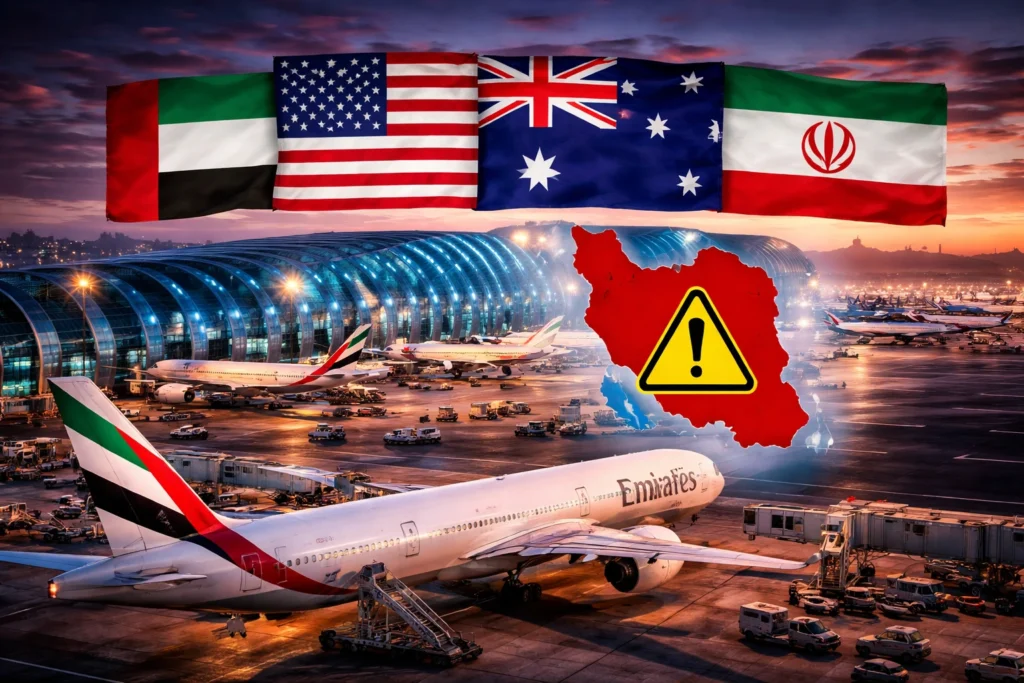
The United Arab Emirates has introduced strict travel restrictions on Iranian nationals. The policy blocks entry and transit through major airports, including Dubai.
Authorities announced the decision amid rising geopolitical tensions in the Middle East. The move reflects growing concerns over regional security and diplomatic relations.
Major UAE airlines have already updated their travel rules. The restrictions now affect a large number of international travelers.
Dubai’s Role as a Global Hub Faces Disruption
Dubai has long served as a key global transit hub. Many travelers rely on its connectivity for long haul journeys.
The new restrictions disrupt this established network. Iranian passengers can no longer use Dubai as a transit point.
This change creates challenges for both travelers and airlines. It also shifts traffic to alternative routes and hubs.
Airlines Respond with Immediate Policy Changes
Airlines based in the UAE have acted quickly. Emirates, Etihad, and Flydubai now enforce the updated travel rules.
They have suspended services for Iranian passport holders. Many passengers receive refunds or rebooking options.
International airlines are also monitoring the situation closely. Route adjustments may increase as policies evolve.
Limited Exemptions Offer Restricted Access
The travel ban includes a few exemptions for specific groups. UAE Golden Visa holders can still enter or transit.
Family members of UAE citizens also receive exceptions. Certain professionals, including investors and specialists, may qualify.
However, most Iranian nationals face complete travel restrictions. This policy significantly reduces mobility for affected travelers.
United States Maintains Long Standing Restrictions
The United States has enforced strict travel measures on Iran for years. These policies limit visas for tourism, business, and education.
Recent adjustments have not removed key barriers. Iranian travelers still face complex application processes.
The UAE decision aligns with this broader approach. It reinforces existing global travel limitations for Iranian citizens.
Australia Introduces Temporary Travel Suspension
Australia has also tightened its travel policies. The government introduced a six month suspension for Iranian visitor visas.
This decision affects tourism, business, and family visits. It reflects similar concerns about regional security.
The temporary measure adds further uncertainty for travelers. Many now face limited options for international travel.
Global Ripple Effects Across Travel Networks
The restrictions extend beyond individual countries. Other regions have already introduced stricter visa policies.
Some parts of Europe apply additional security checks for Iranian travelers. Countries in North Africa and the Middle East also enforce entry limits.
These combined measures create a complex global travel environment. Iranian nationals must navigate multiple restrictions across regions.
Aviation Industry Faces Operational Challenges
Airlines must adapt quickly to changing travel regulations. Route planning now requires constant updates.
Passenger demand may shift toward alternative transit hubs. Airlines could adjust schedules and capacity to manage changes.
These developments impact revenue and operational efficiency. The aviation industry must remain flexible in a volatile environment.
Diplomatic Tensions Shape Travel Policies
Travel restrictions reflect broader diplomatic strategies. Governments use these measures to address security concerns.
The policies also influence international relations and cooperation. Travel rules now play a key role in global diplomacy.
As tensions continue, more countries may introduce similar restrictions. This trend could reshape international mobility patterns.
Future of Global Travel Faces Uncertainty
The current situation highlights the fragile nature of global travel systems. Political decisions now directly affect mobility.
Travelers must stay informed and adapt to rapid changes. Airlines and governments will continue adjusting policies.
The UAE’s decision marks a significant shift in international travel. It signals a new phase of stricter border controls and evolving aviation dynamics.
For more travel news like this, keep reading Global Travel Wire