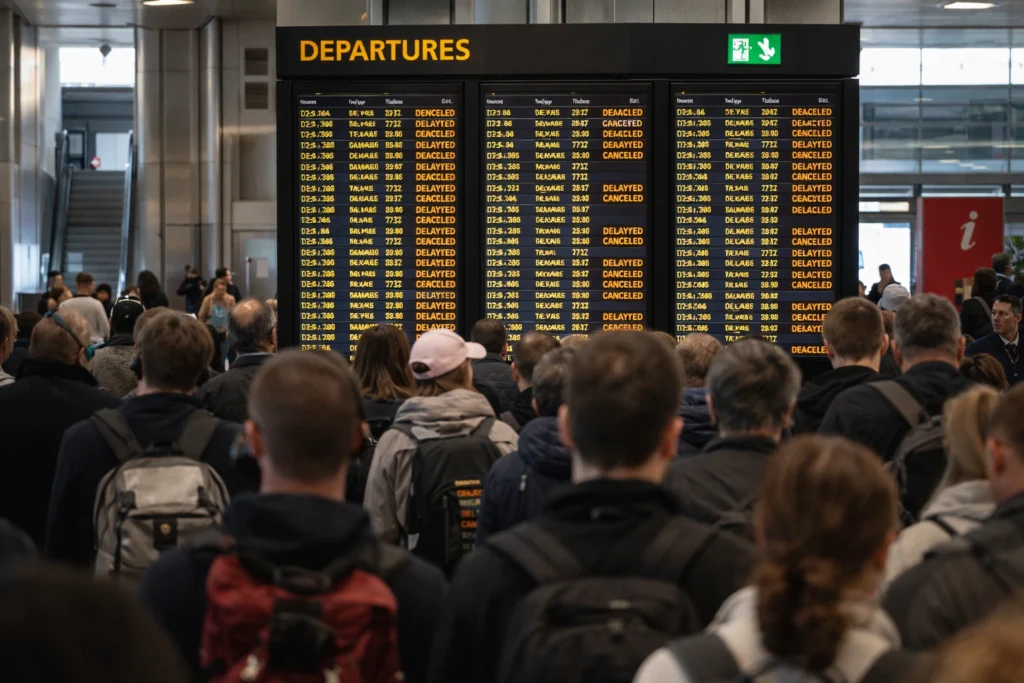
A major wave of flight disruptions has affected travel across Europe, leaving thousands of passengers stranded. Authorities reported 58 flight cancellations and 1,379 delays across key airports.
The disruption impacted major aviation hubs in France, the United Kingdom, the Netherlands, Norway, Spain, and beyond. Airlines struggled to maintain schedules as operational challenges and weather conditions intensified.
Major Airports Face Severe Disruptions
Several of Europe’s busiest airports reported significant delays and cancellations. Paris Charles de Gaulle recorded 9 cancellations and 368 delays.
London Heathrow saw 10 cancellations and 274 delayed flights. Passengers experienced long queues and extended waiting times.
London Gatwick and Luton also faced disruptions. Gatwick reported 3 cancellations and 97 delays, while Luton recorded 3 cancellations and 36 delays.
Amsterdam Schiphol experienced one of the highest impacts. The airport reported 13 cancellations and 290 delays, affecting both domestic and international routes.
Other affected airports included Oslo Gardermoen, Copenhagen, Madrid Barajas, and Stockholm Arlanda. Each reported varying levels of disruption throughout the day.
Airlines Struggle to Maintain Operations
Major European airlines faced widespread operational challenges. Carriers such as SAS, KLM, British Airways, Lufthansa, and Air France reported delays across multiple routes.
Low-cost carrier easyJet recorded the highest number of delays, with 433 flights affected. It also reported 15 cancellations.
Air France reported 175 delays, while Lufthansa recorded 156 delayed flights. British Airways and KLM also faced significant operational setbacks.
These disruptions affected both short-haul and long-haul travel. Many passengers missed connecting flights, leading to further complications.
Causes Behind the Travel Disruption
The disruption resulted from a combination of factors. Airlines cited operational issues, staffing shortages, and adverse weather conditions.
Weather-related challenges created delays in aircraft movement and airport operations. Staffing constraints added pressure on airlines and ground services.
These combined issues caused a ripple effect across the aviation network. Delays in one location quickly spread to other airports.
Impact on Passengers and Travel Plans
Thousands of passengers faced uncertainty as delays continued throughout the day. Many travelers remained stranded at airports for extended periods.
Long queues formed at check-in counters and customer service desks. Airlines worked to rebook passengers and provide updates.
The disruption affected both business and leisure travelers. It also impacted tourism flows across multiple European destinations.
Passengers traveling during peak periods experienced the greatest inconvenience. Missed connections added to the complexity of travel arrangements.
Tourism and Aviation Industry Impact
The disruption highlights ongoing challenges in Europe’s aviation sector. Airlines continue to face operational pressures as travel demand remains strong.
Airports must manage high passenger volumes while maintaining efficiency. Unexpected disruptions can quickly affect the entire network.
Tourism-dependent regions may experience short-term impacts. Delays and cancellations can reduce visitor satisfaction and spending.
However, the aviation industry continues to adapt. Airlines are improving communication systems and operational planning to handle disruptions more effectively.
What Travelers Should Do
Travelers are advised to check flight status regularly before heading to the airport. Airlines provide updates through mobile apps and official websites.
Passengers should contact airlines for rebooking options if flights are canceled. Keeping travel documents and receipts can help with compensation claims.
Exploring alternative transport options, such as trains, may help reduce delays. Travelers should also allow extra time for airport procedures.
Outlook for European Air Travel
While disruptions remain a challenge, the aviation sector continues to recover and evolve. Airlines are working to improve resilience and service reliability.
Travel demand across Europe remains strong despite operational setbacks. Airports and airlines are expected to enhance coordination to prevent future disruptions.
The recent wave of delays serves as a reminder of the complexities of modern air travel. For now, passengers are encouraged to stay informed and plan ahead.
As the situation stabilizes, Europe’s aviation network will continue to support millions of travelers. The focus remains on ensuring safe and efficient travel across the region.
For more travel news like this, keep reading Global Travel Wire