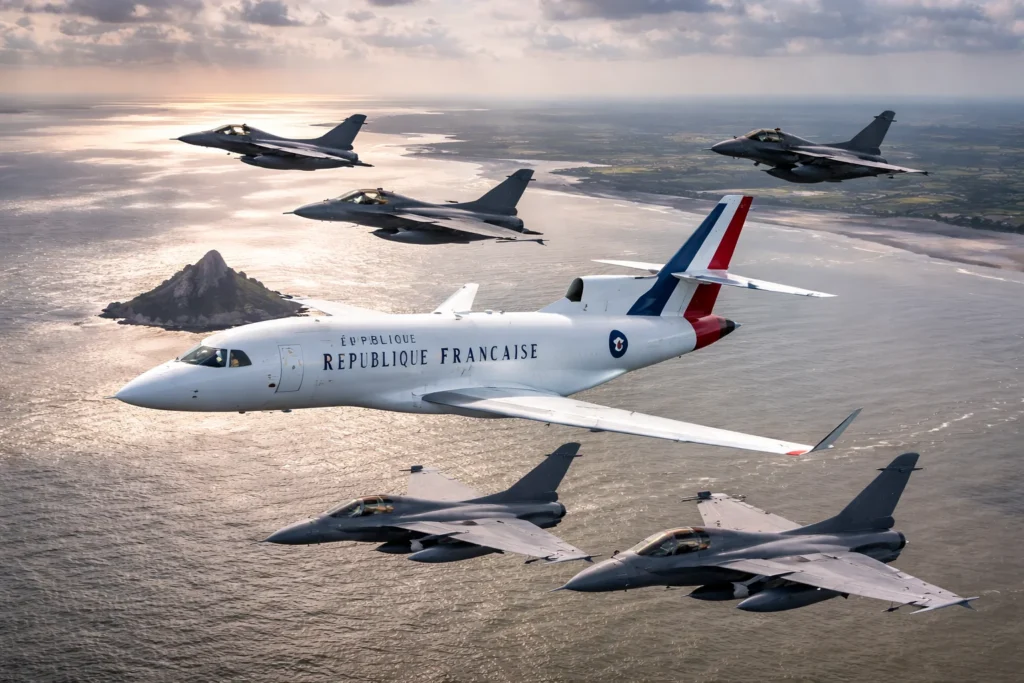
A widely shared image of French President Emmanuel Macron flying alongside multiple fighter jets has sparked global interest, not only for its dramatic visual appeal but also for what it reveals about how world leaders travel. While many assumed the aircraft in the image represented France’s primary presidential jet, official government and defense information clarify that the situation was far more nuanced.
The aircraft in question was not France’s main long-haul presidential plane but a smaller government jet used for regional travel. The striking formation of fighter jets escorting the aircraft created an impression of heightened security or emergency operations. However, according to official defense explanations, such escorts are often linked to specific missions, including visits to strategically sensitive locations or military infrastructure.
Government aviation authorities emphasize that such displays are not routine for every presidential journey. Instead, they are typically used for operational coordination, airspace management, or symbolic demonstrations tied to national security priorities. The image, captured under carefully controlled conditions, reflects a unique moment rather than standard protocol.
France’s approach to transporting its head of state highlights a broader global trend in government aviation. Rather than relying on a single, iconic aircraft, countries increasingly adopt flexible fleets tailored to different travel needs. This strategy allows leaders to move efficiently across short, medium, and long distances while maintaining high levels of security and operational readiness.
For shorter trips within Europe and nearby regions, France utilizes business-class government jets such as the Dassault Falcon series. These aircraft are designed for efficiency and adaptability, offering the ability to operate from a wide range of airports. Their size and performance make them ideal for regional missions, where speed, flexibility, and cost-effectiveness are key considerations.
The Falcon jets are configured to provide a comfortable and secure environment for official travel, accommodating a limited number of passengers while ensuring privacy and functionality. Government aviation officials highlight their ability to access smaller airports and adjust quickly to changing schedules, which is essential for diplomatic engagements and domestic travel.
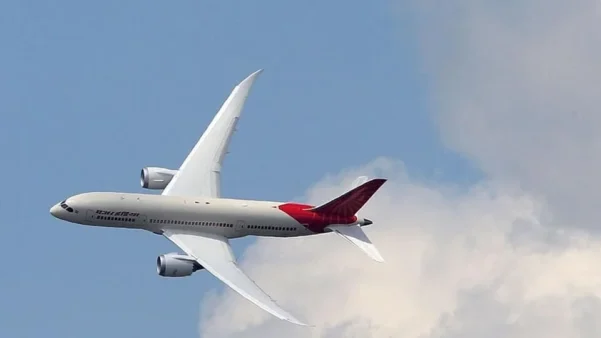
For long-haul missions, France relies on a larger widebody aircraft that serves as its primary presidential platform. This aircraft has been extensively modified to meet the demands of international travel and high-level diplomacy. Official statements confirm that it includes secure communication systems, dedicated workspaces, and meeting areas, effectively transforming it into a mobile command center.
This dual-aircraft strategy reflects a practical approach to leadership travel, where the choice of aircraft depends on the nature of the mission. Smaller jets are used for agility and efficiency, while larger aircraft are reserved for intercontinental journeys requiring greater capacity and advanced onboard capabilities.
Globally, different countries have adopted varying models for transporting their leaders, shaped by geography, security considerations, and available resources. In the United States, the system is centered around highly specialized aircraft operated by the military, commonly referred to as “Air Force One” when the president is on board. These aircraft are equipped with advanced communication systems and are designed to function under a wide range of conditions, including emergencies.
Russia follows a similar approach, using aircraft configured to serve as airborne command centers capable of maintaining national leadership operations during extended missions. These platforms prioritize endurance, security, and independence, reflecting a strategic focus on continuity of government functions.
Across Europe, however, many nations favor a more flexible and cost-conscious model. Countries often operate a combination of aircraft types or adapt existing military or commercial planes for VIP transport. This approach allows governments to balance operational requirements with budget considerations while maintaining the ability to respond to diverse travel needs.
In the United Kingdom, for example, multi-role aircraft are used for both military and official transport purposes, demonstrating a practical use of resources. Germany has also transitioned toward modernized aircraft capable of supporting long-range travel while maintaining high safety and reliability standards.
Some nations go further by maintaining dedicated fleets for official travel. These fleets are managed to support not only heads of state but also senior government officials and diplomatic missions. This allows for coordinated travel during major international events, where multiple aircraft may be deployed simultaneously.
Tourism authorities note that such high-profile aviation operations often capture public attention and influence perceptions of global travel. Images of military escorts and presidential aircraft highlight the intersection of aviation, security, and diplomacy, offering a glimpse into the complex logistics behind international leadership travel.
At the same time, officials emphasize that these operations are carefully planned and executed to ensure safety and efficiency without disrupting regular air traffic. Civil aviation authorities work closely with defense agencies to coordinate airspace usage and maintain normal operations for commercial flights.
The viral Rafale escort image serves as a reminder of how visual narratives can shape public understanding of aviation and government operations. While the image suggests extraordinary circumstances, it ultimately reflects a specific mission context rather than everyday practice.
As global travel continues to evolve, the systems used to transport world leaders demonstrate the importance of flexibility, security, and technological advancement. From compact business jets to fully equipped widebody aircraft, presidential travel is designed to adapt to a wide range of scenarios while ensuring continuity of governance.
For travelers and aviation enthusiasts alike, these insights provide a deeper understanding of how governments manage mobility at the highest level, balancing efficiency with the demands of modern diplomacy in an increasingly interconnected world.