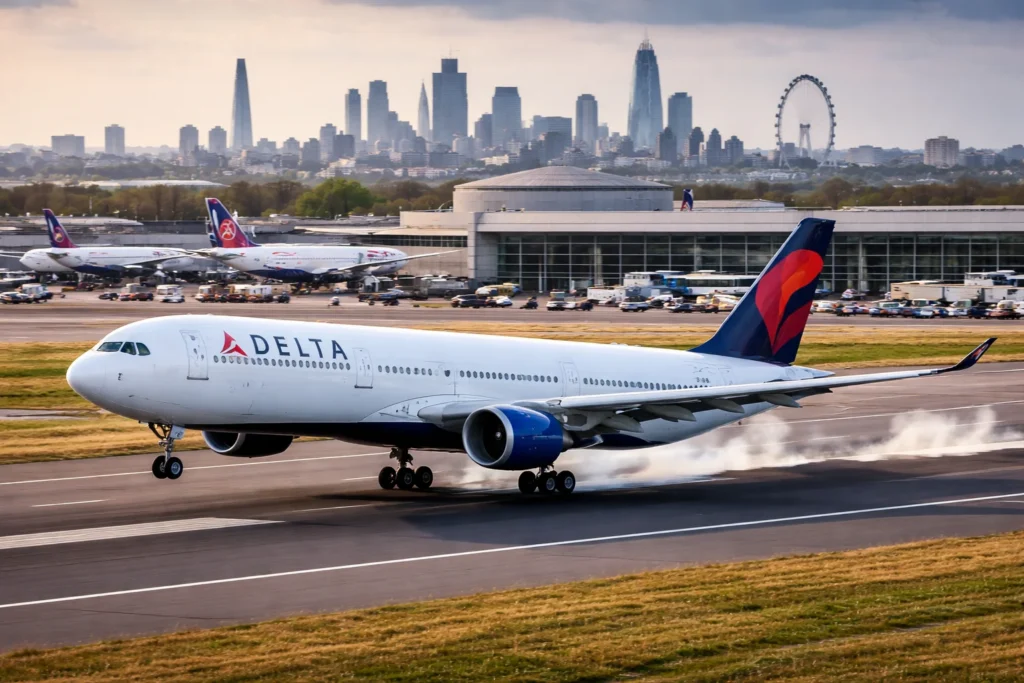
Delta Air Lines is accelerating its focus on premium air travel as part of its long-term international growth strategy, with new plans pointing toward a redesigned Airbus A330-900 configuration tailored for high-demand routes such as transatlantic services to London. Official airline statements and aviation authority updates confirm that premium travel demand continues to outperform other segments, influencing both fleet planning and tourism connectivity.
During recent corporate briefings, Delta Air Lines highlighted the increasing importance of premium cabins in driving revenue and enhancing passenger experience. According to official disclosures, premium and loyalty segments have shown strong growth, supported by rising demand from both business travelers and high-spending tourists. This trend aligns with broader tourism data indicating that travelers are increasingly prioritizing comfort, flexibility, and personalized services on long-haul journeys.
The airline has confirmed that its fleet renewal program is designed to support this shift, with newer aircraft offering more premium seating compared to older models. Aviation authorities note that modern aircraft are being configured to deliver higher efficiency while also accommodating evolving passenger expectations. This dual focus allows airlines to balance operational performance with enhanced customer experience.
One of the most notable developments is the potential introduction of a premium-heavy Airbus A330-900 on routes connecting the United States with London, one of the world’s most competitive and high-value travel corridors. London remains a key gateway for international tourism, business travel, and global connectivity, making it a strategic focus for airlines seeking to maximize premium revenue.
Delta currently operates multiple flights to London from major U.S. hubs, and official route data confirms the importance of these services in supporting transatlantic tourism. Tourism boards on both sides of the Atlantic have emphasized the role of premium travel in attracting business visitors, conference delegates, and luxury tourists who contribute significantly to local economies.
The proposed configuration for the Airbus A330-900 represents a substantial shift in cabin design. While the airline has not publicly confirmed exact seating numbers, official statements indicate a clear move toward increasing the proportion of premium seats. Current configurations already allocate a significant share of the cabin to higher-yield seating categories, including business class, premium economy, and enhanced economy options.
Industry observers note that the new layout could push the share of premium seating beyond previous levels, reflecting a strategic decision to prioritize high-value passengers. This approach is consistent with Delta’s broader objective of improving margins through premium offerings while maintaining competitive operational costs.
Tourism authorities highlight that such developments are closely linked to changing travel patterns. Premium travelers are more likely to engage in extended stays, spend more on accommodations and experiences, and contribute to the growth of luxury tourism segments. As a result, airlines are increasingly aligning their services with the expectations of this group.
In addition to increasing the number of premium seats, Delta is also refining how these seats are marketed and sold. Official airline communications indicate a growing emphasis on segmentation within premium cabins, allowing travelers to choose from different service levels based on their preferences and budgets. This approach provides greater flexibility while encouraging passengers to upgrade their travel experience.
Aviation regulators and tourism boards have noted that this trend is becoming more common across the industry. Airlines are moving beyond traditional cabin classifications to offer a range of options within premium categories, enhancing personalization and improving overall passenger satisfaction.
The Airbus A330-900 itself plays a crucial role in this strategy. Known for its long-range capability and fuel efficiency, the aircraft is well-suited for transatlantic routes. Its modern design also supports improved cabin environments, including better air quality and reduced noise levels, which contribute to passenger comfort on long-haul flights.
These features are particularly important for routes such as those linking the United States and London, where flight durations require a high level of onboard comfort. Tourism officials emphasize that the quality of the travel experience can influence destination choice, making premium airline offerings a key factor in attracting international visitors.
Delta’s investment in premium cabins also reflects a broader shift in the aviation industry, where the distinction between business and leisure travel is becoming less defined. The rise of “bleisure” travel, combining work and leisure activities, has created new opportunities for airlines to cater to diverse passenger needs.
By offering enhanced seating, improved connectivity, and flexible service options, airlines can appeal to travelers who seek both productivity and relaxation during their journey. This approach aligns with tourism strategies aimed at encouraging longer stays and higher spending among visitors.
The potential debut of a premium-focused Airbus A330-900 on London routes underscores the importance of innovation in maintaining competitiveness in the global aviation market. As airlines continue to invest in new technologies and cabin designs, passengers can expect further improvements in comfort, convenience, and overall travel experience.
Government tourism agencies and aviation authorities continue to monitor these developments, recognizing their impact on international travel flows and economic growth. Premium air travel is increasingly seen as a key driver of tourism revenue, particularly in major global destinations.
As Delta Air Lines moves forward with its premium strategy, the airline is positioning itself to meet the evolving expectations of modern travelers. The focus on high-quality service, advanced aircraft, and flexible offerings reflects a commitment to delivering a superior travel experience while supporting the growth of global tourism.
In an increasingly competitive aviation landscape, the expansion of premium cabins represents not just a business decision but a broader transformation in how airlines connect people and destinations.