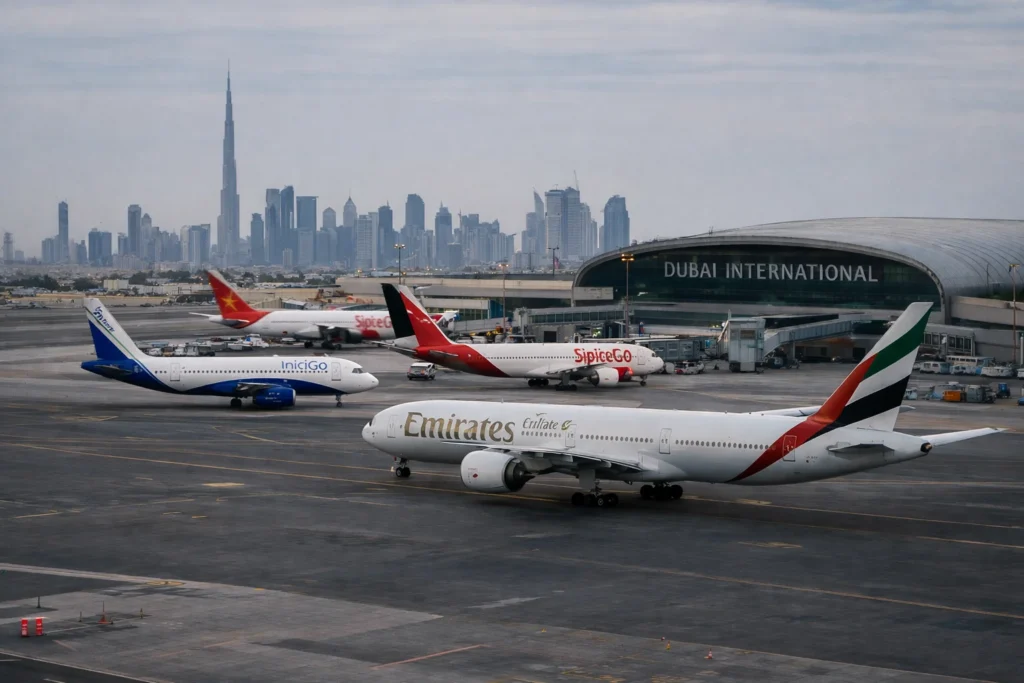
Air travel between India and Dubai, one of the world’s busiest and most significant tourism corridors, is currently operating under major constraints, reshaping travel patterns and pricing across the aviation sector. As of April–May 2026, Indian airlines are running limited services to Dubai, following operational restrictions imposed at the emirate’s airports.
The restrictions apply to both Dubai International Airport and Al Maktoum International Airport, where foreign airlines are permitted only one daily flight rotation. This measure, introduced as part of broader operational adjustments, has significantly reduced the number of flights available between India and Dubai, impacting one of the most active international travel routes.
Indian carriers including Air India, Air India Express, IndiGo, and SpiceJet are currently operating limited and, in some cases, ad hoc services to meet essential travel demand. These flights are not part of regular schedules but are arranged based on slot availability and coordination with aviation authorities.
According to official airline advisories, Indian carriers are continuously reviewing flight schedules in coordination with relevant authorities. Passengers are advised to check flight status updates before heading to the airport, as schedules remain subject to change due to operational conditions.
The impact on tourism is immediate and significant. India remains the largest source market for Dubai’s international passengers, with millions of travelers visiting the emirate each year for leisure, business, and transit purposes. Reduced flight availability is therefore affecting both outbound travel from India and inbound tourism to Dubai.
Current flight operations between India and Dubai are concentrated in select routes. From Delhi, Air India is operating a single daily flight to Dubai, with limited seat availability. Return services from Dubai to Delhi are also restricted to one daily departure. Similarly, Air India Express is running one to two flights daily from cities such as Mangaluru, depending on operational conditions.
IndiGo, India’s largest airline by passenger volume, is operating a single daily flight between Mumbai and Dubai. Meanwhile, SpiceJet is maintaining one daily service between Pune and Dubai. These limited operations highlight the scale of the capacity reduction compared to previous schedules, where multiple daily flights were common on major routes.
Ticket prices have risen sharply as a result of reduced supply and sustained demand. Economy class fares on routes such as Delhi to Dubai are currently ranging between approximately ₹43,000 and ₹68,000, depending on travel dates. Return fares from Dubai to India show similar trends, reflecting the constrained availability of seats.
On other routes, pricing varies but remains elevated. Flights from Mangaluru to Dubai are priced between ₹21,000 and ₹45,000, while return fares can reach up to ₹72,000. Mumbai to Dubai tickets with IndiGo are available within a range of ₹19,000 to ₹35,000, while SpiceJet fares from Pune range between ₹20,000 and ₹26,000.
From a tourism perspective, these higher fares may influence travel decisions, particularly for budget-conscious travelers. Dubai continues to be a top destination for Indian tourists, offering a wide range of attractions including shopping, entertainment, and cultural experiences. However, increased travel costs may lead to shifts in travel timing or destination choices.
The situation also reflects broader dynamics within the aviation sector. Indian airlines are currently managing multiple operational challenges, including rising Aviation Turbine Fuel costs and longer flight routes due to regional airspace restrictions. These factors have increased operational expenses, further contributing to higher ticket prices.
Industry stakeholders have expressed concerns about the impact of the current restrictions. The Federation of Indian Airlines has urged authorities to address the situation, highlighting the need for balanced access and fair competition. The organization has noted that limited capacity may result in financial pressures for Indian carriers and reduced travel options for passengers.
At the same time, UAE-based carriers such as Emirates and flydubai continue to operate services to India, contributing to overall connectivity between the two regions. Their operations play an important role in maintaining travel links, although demand continues to exceed available capacity.
For travelers, the current environment underscores the importance of planning ahead. Early booking, flexibility in travel dates, and monitoring official airline updates are essential strategies to navigate limited availability. Tourism authorities recommend staying informed through official channels to ensure a smooth travel experience.
Looking ahead, the restoration of regular flight schedules will depend on operational conditions and ongoing coordination between aviation authorities. The gradual increase in capacity is expected to ease pricing pressures and improve connectivity, supporting tourism recovery in both India and Dubai.
In the broader context of global tourism, the India-Dubai travel corridor remains a key link connecting two dynamic markets. While current challenges have temporarily disrupted travel patterns, the long-term outlook remains strong, supported by sustained demand and strategic importance.
As the aviation industry adapts to evolving conditions, the focus remains on balancing operational efficiency with passenger needs. The current phase of limited flights and higher fares highlights the resilience of both airlines and travelers, as the sector works toward restoring normalcy and strengthening international tourism connectivity.