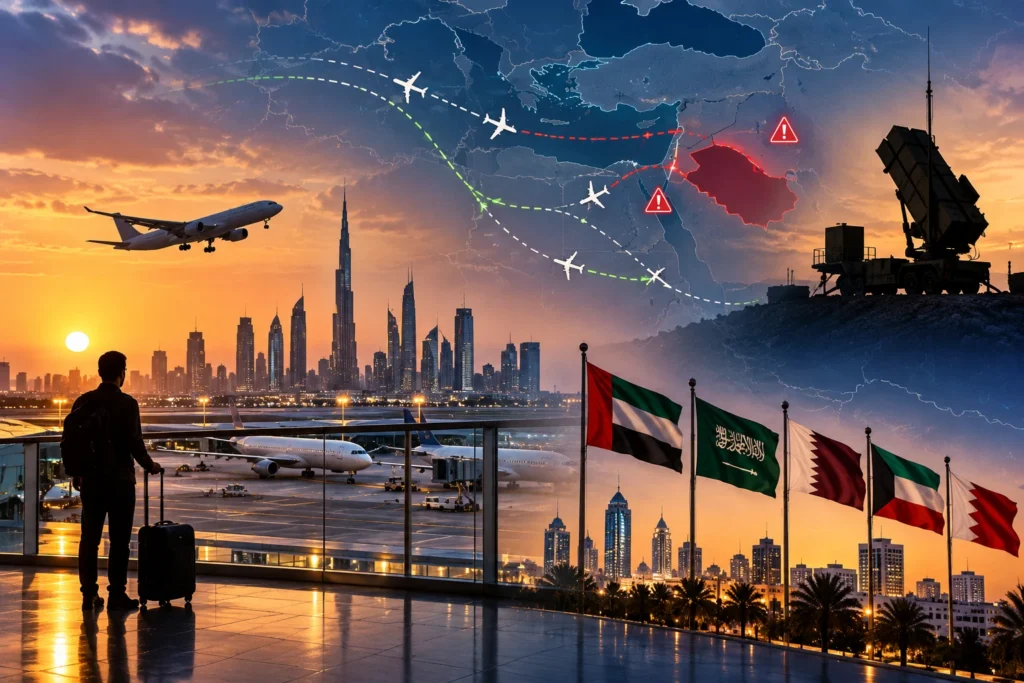
The landscape of international air travel for Indian passengers has undergone a significant shift this week as the Directorate General of Civil Aviation (DGCA) issued a comprehensive safety advisory concerning West Asian airspaces. In response to escalating regional tensions and a rapidly evolving security environment in the Middle East, India’s aviation regulator has urged national carriers to exercise extreme caution and avoid nine specific airspaces. For the millions of Indian travellers who rely on these corridors for transit to Europe, North America, and the Gulf, this directive marks a pivotal moment in 2026 travel planning, prioritizing safety above all other operational considerations.
According to official notifications from the DGCA and the Ministry of Civil Aviation, the advisory identifies nine high-risk airspaces that airlines are instructed to steer clear of at all flight levels and altitudes. These regions include Bahrain, Iran, Iraq, Israel, Jordan, Kuwait, Lebanon, Qatar, and the United Arab Emirates (UAE). This sweeping safety measure is designed to protect civil aviation from potential risks associated with the deteriorating security situation in the region, ensuring that passenger and crew safety remains the paramount objective of the Indian government.
Operational Adjustments and Altitude Restrictions
The DGCA’s directive does not merely identify “no-fly” zones; it also provides nuanced operational guidelines for airspaces that remain partially accessible. For instance, flights are permitted to operate over Saudi Arabia and Oman, but under strict conditions. Indian carriers have been instructed to maintain a minimum altitude of FL 320, or 32,000 feet, while traversing these airspaces. These altitude restrictions are a standard safety protocol used globally to keep civilian aircraft above zones where lower-level regional activity might pose a risk.
Official ministry statements emphasize that any operations to airports within the affected region—where international carriers continue to provide service—must be backed by “robust contingency planning.” The DGCA has made it clear that safety risk assessments conducted by individual airline operators must cover all eventualities. This includes real-time monitoring of Aeronautical Information Publications (AIPs) and the latest Notices to Airmen (NOTAMs) to ensure that flight crews are fully aware of shifting restrictions while airborne.
Impact on India-Europe and Global Transit Routes
For Indian travellers, the immediate consequence of these airspace restrictions is a noticeable increase in flight durations. Many of the most popular routes connecting major Indian hubs like Delhi and Mumbai to European and North American destinations traditionally pass through the airspaces of Iran and Iraq. With these corridors now flagged as high-risk, airlines are rerouting flights through more circuitous paths, which can add several hours to a journey.
Official statistics from the Ministry of Civil Aviation indicate that several Indian carriers, including the national carrier Air India and major low-cost operators like IndiGo, have already implemented calibrated adjustments to their long-haul schedules. These reroutings, while necessary for safety, also lead to higher operational costs for airlines, primarily due to increased fuel consumption. Travelers are advised to stay in close contact with their respective airlines, as these changes can lead to last-minute rescheduling or, in some cases, cancellations.
The Resilience of India’s Aviation Sector
Despite these regional challenges, the Indian government remains committed to maintaining global connectivity. The Ministry of External Affairs, in coordination with the Ministry of Civil Aviation, has established dedicated monitoring mechanisms to assist stranded passengers and ensure the orderly restoration of services. During previous phases of regional disruption in early 2026, the government successfully facilitated the return of over 52,000 Indian nationals through a combination of scheduled and non-scheduled relief operations.
Official tourism boards and embassy advisories suggest that while the current situation requires a high degree of flexibility, the essential links between India and the Gulf remain operational. Many airlines are deploying additional capacity where safe and feasible, ensuring that those traveling for essential business, employment, or family reasons can still reach their destinations. The emphasis remains on “transparent communication,” with carriers urged to keep passengers informed about refund policies, rescheduling options, and the availability of alternative routes.
A Strategic Guide for the 2026 Traveller
As the global aviation network adapts to these new realities, Indian travellers are encouraged to adopt a proactive approach to their journey. Official guidelines recommend several key steps to navigate the current advisory:
Real-Time Verification: Do not rely solely on original booking confirmations. Check the live status of your flight via official airline apps or websites before heading to the airport.
Preparedness for Delays: Factor in an additional three to five hours for long-haul flights that typically transit through West Asia. Pack essentials in your carry-on to manage longer times spent in transit.
Flexible Booking Policies: When purchasing new tickets, prioritize airlines that offer flexible rescheduling or “peace of mind” cancellation policies, as the validity of the current DGCA advisory is subject to continuous review based on regional developments.
Stay Updated on NOTAMs: While primarily for pilots, travelers can follow official government social media handles for summaries of the latest aviation alerts and travel advisories.
The 2026 travel season continues to be defined by a delicate balance between global curiosity and regional caution. By adhering to the DGCA’s expert guidance and the Ministry of Civil Aviation’s safety protocols, Indian travellers can continue to explore the world with the assurance that their security is being managed at the highest level. As the situation in West Asia evolves, the commitment of the Indian aviation regulator to passenger safety remains unwavering, ensuring that every journey—no matter the detour—reaches its destination safely.
For more travel news like this, keep reading Global Travel Wire