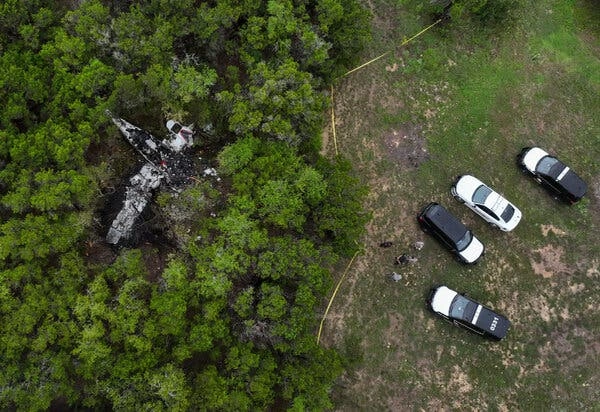
A tragic private aviation accident near Wimberley, Texas, has claimed the lives of five people, prompting an urgent investigation by federal authorities and raising renewed concerns about aviation safety. The twin-engine Cessna 421C aircraft crashed late on April 30, 2026, in a wooded area northwest of Wimberley, approximately 40 miles southwest of Austin, with no survivors reported.
The incident has triggered a joint investigation led by the Federal Aviation Administration (FAA) and the National Transportation Safety Board (NTSB), with support from the Texas Department of Public Safety, as officials work to determine the cause of the fatal crash.
Timeline of Events and Flight Details
The aircraft had departed from Rick Husband Amarillo International Airport in Amarillo, Texas, bound for New Braunfels National Airport. According to preliminary flight tracking data, the plane climbed normally after takeoff and maintained stable flight conditions for most of the journey.
However, shortly before reaching its destination, the aircraft exhibited erratic behavior and began a sudden descent. Emergency services received the first distress call around 11:03 p.m., reporting an aircraft down near Round Rock Road. First responders quickly located the wreckage, confirming the fatalities at the scene.
A second aircraft traveling on a similar route reportedly completed its journey safely, highlighting the isolated nature of the incident.
Confirmation of Fatalities and Initial Findings
Authorities confirmed that all five occupants onboard—including the pilot and four passengers—were killed in the crash. The identities of the victims were initially withheld pending notification of next of kin, with official confirmation provided later by state authorities.
Preliminary assessments suggest the aircraft was traveling at a high speed before impact. Investigators have found no early evidence of a mid-air collision or external interference, though officials emphasize that findings remain subject to further analysis.
FAA and NTSB Investigation Underway
The NTSB has dispatched a team of investigators to the crash site to conduct a comprehensive examination. The investigation will include analysis of wreckage, review of maintenance records, pilot qualifications, and evaluation of radar and flight data.
The FAA will focus on regulatory compliance and aircraft systems, while the NTSB will ultimately determine the probable cause of the crash. Investigators are also expected to interview air traffic controllers and any potential witnesses to reconstruct the sequence of events.
The process may take several months, with preliminary updates expected as evidence is analyzed.
Flight Path Analysis Points to Sudden Descent
Early data indicates that the aircraft experienced a rapid loss of altitude shortly before disappearing from radar. The abrupt descent, involving a significant drop in altitude over a short period, is a key focus of the investigation.
An emergency locator signal was reportedly activated, suggesting that the aircraft may have encountered a critical issue shortly before impact. Officials caution that these details are preliminary and require verification through detailed technical analysis.
Implications for Aviation Safety and Travel
The crash has renewed attention on safety within general aviation, particularly for private and charter flights. While commercial aviation operates under stringent safety protocols, private aircraft often operate under different conditions, including varied routes and operational environments.
The outcome of the investigation could lead to updated safety recommendations, influencing pilot training, aircraft maintenance standards, and operational guidelines across the sector.
For travelers, especially those using private or charter services, the incident highlights the importance of understanding safety practices and regulatory oversight within aviation.
Local Impact on Wimberley Community
The Wimberley community, known for its scenic landscapes and tourism appeal in Texas Hill Country, has been deeply affected by the incident. Residents reported hearing a loud noise at the time of the crash, prompting immediate emergency response.
Local officials have expressed condolences to the victims’ families and praised first responders for their swift action. While the tragedy has shaken the community, tourism authorities have indicated that the area remains safe for visitors.
Ongoing Response and Community Mourning
Tributes and memorials are being organized as families and communities mourn the loss. Organizations associated with the passengers have issued statements honoring their lives and contributions.
The emotional impact of the incident extends beyond the immediate area, resonating across the broader aviation community.
Awaiting Final Findings
As investigators continue their work, the aviation industry awaits the NTSB’s final report, which will provide definitive insights into the cause of the crash. The findings are expected to contribute to ongoing efforts to enhance safety standards and prevent similar incidents in the future.
A Sobering Reminder for Aviation Sector
The Wimberley plane crash serves as a stark reminder of the complexities and risks associated with aviation. While rare, such incidents underscore the importance of rigorous safety measures and continuous oversight.
As authorities work toward answers, the focus remains on supporting affected families and ensuring that lessons learned from this tragedy strengthen aviation safety for the future.
For more travel news like this, keep reading Global Travel Wire