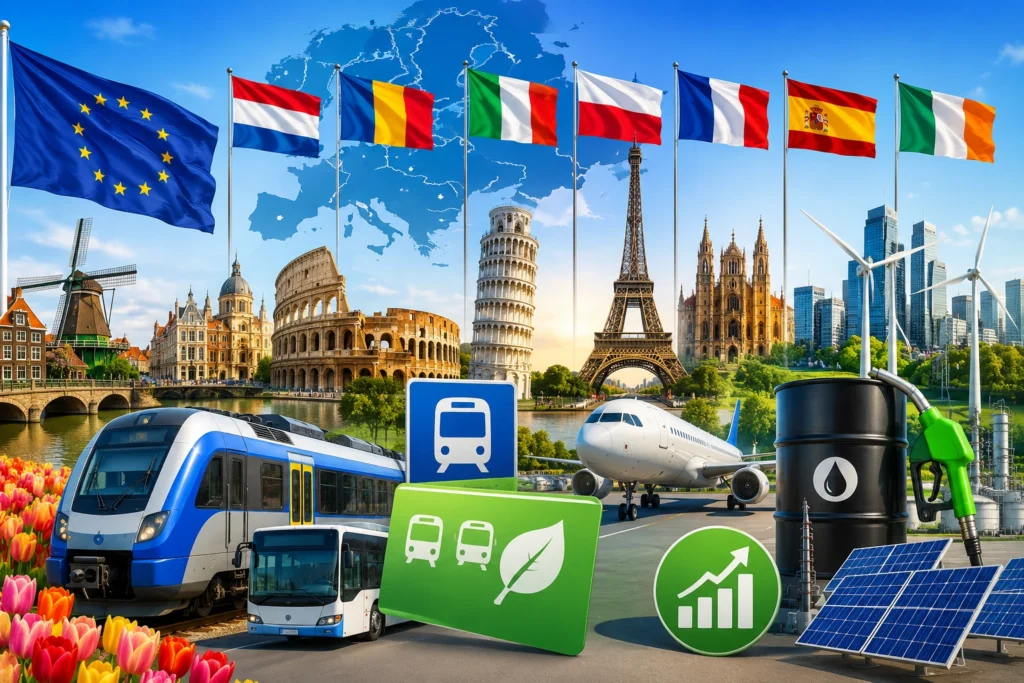
European governments are intensifying emergency efforts to combat rising jet fuel costs, crude oil shortages and mounting energy pressures as the Netherlands joins Romania, Italy, Poland, France, Spain and Ireland in launching coordinated measures designed to stabilize transportation networks, reduce consumer costs and support critical tourism and mobility sectors across the continent.
The sweeping initiatives include fuel tax reductions, energy subsidies, public transport incentives, price controls and renewable energy investments as European nations respond to one of the region’s most significant energy challenges in recent years.
The measures are expected to influence not only domestic transportation systems but also tourism flows, aviation operations, rail travel and broader travel affordability throughout Europe during 2026.
Netherlands Introduces €49 Public Transport Pass
The Netherlands has emerged as one of the most visible examples of Europe’s evolving transportation response after introducing a €49 summer public transport pass designed to encourage travelers and commuters to shift away from private vehicle use.
The pass offers unlimited off-peak travel on trains, buses, trams and metro systems during June, July and August 2026.
Dutch officials say the initiative is intended to reduce fuel consumption, ease congestion and support more sustainable mobility patterns while helping households cope with rising transportation expenses.
The pass also aligns with the country’s broader environmental goals by encouraging greater use of public transit and reducing dependence on fossil fuels during peak summer travel periods.
Tourism operators believe the program could stimulate domestic tourism by making regional travel more affordable for residents and visitors exploring destinations across the Netherlands.
Poland and Romania Focus on Fuel Price Stability
Poland has responded to the energy crisis through fuel tax reductions and proposed price caps aimed at stabilizing petrol and diesel costs for consumers and businesses.
The government is also considering windfall taxes on energy sector profits to help finance relief programs and offset rising transportation costs.
Officials say the measures are intended to protect both households and industries heavily reliant on road transport as inflationary pressures continue affecting European economies.
Romania has implemented stricter fuel price controls and export management policies designed to prioritize domestic energy supply.
The country has additionally introduced support measures for transportation and logistics sectors viewed as essential to maintaining economic activity and mobility.
Authorities hope the combined strategy will reduce exposure to global fuel volatility while preserving internal market stability during ongoing supply disruptions.
Italy and France Expand Subsidies and Tax Relief
Italy has temporarily reduced excise duties on petrol and diesel to ease pressure on motorists and transportation-dependent industries.
The Italian government is also directing targeted support toward agriculture and transportation sectors that continue facing rising operational costs linked to higher energy prices.
France has adopted a more targeted subsidy model focused on vulnerable households and strategic industries.
French authorities allocated major fuel support measures for transportation, agriculture and fisheries while also providing direct energy assistance to lower-income households affected by rising electricity and gas bills.
Officials say the goal is to protect essential economic sectors without introducing unsustainable nationwide price interventions.
The approach reflects broader European concerns about balancing immediate financial relief with long-term fiscal stability.
Spain Launches Massive Energy Support Package
Spain has introduced one of Europe’s largest emergency support programs with a multibillion-euro package targeting fuel prices, electricity costs and transportation sectors.
The measures include reduced VAT on electricity, direct fuel subsidies and financial support for industries heavily affected by energy inflation including logistics, agriculture and public transport.
Spanish officials say the package is designed to protect consumers while supporting economic activity and tourism recovery across the country.
The government is also accelerating longer-term plans aimed at reducing dependence on imported fossil fuels and expanding renewable energy infrastructure.
Spain’s tourism industry, one of the largest in Europe, is closely monitoring energy developments as rising travel costs continue influencing visitor spending and transportation demand.
Ireland Focuses on Energy Credits and Sustainability
Ireland has combined short-term consumer support with longer-term renewable energy investment strategies.
The government introduced household energy credits to help offset rising utility costs while simultaneously expanding incentives for solar power systems and battery storage technology.
Irish officials view renewable energy expansion as a key component of strengthening long-term energy security and reducing vulnerability to future supply disruptions.
The strategy also supports Ireland’s broader sustainability objectives while helping households manage immediate financial pressures.
Aviation and Tourism Industries Face Growing Challenges
The European energy crisis continues creating pressure across aviation, tourism and transportation industries.
Rising jet fuel costs have already forced several airlines to introduce surcharges, adjust route networks and reduce capacity on less profitable long-haul routes.
Tourism businesses across Europe are also facing higher operational expenses tied to transportation, logistics and energy consumption.
Rail operators and public transportation providers, meanwhile, are seeing growing demand as governments encourage travelers to shift toward lower-cost and more sustainable travel alternatives.
Industry analysts say coordinated public transport initiatives such as the Dutch summer pass could become increasingly important if fuel market volatility persists.
Europe Moves Toward Coordinated Energy Response
The collective actions taken by the Netherlands, Romania, Italy, Poland, France, Spain and Ireland represent one of the strongest examples of coordinated European crisis management in recent years.
While each country has adopted different measures tailored to national economic structures and energy needs, the broader objective remains consistent: protecting citizens, maintaining mobility and stabilizing transportation systems during a period of global uncertainty.
The crisis has also accelerated discussions surrounding long-term energy resilience, sustainable transportation and reduced dependence on volatile fossil fuel markets.
As fuel costs and energy security concerns continue reshaping Europe’s travel and transportation landscape, governments are increasingly focusing on coordinated policies designed to balance economic stability, consumer protection and environmental sustainability.
For travelers, the measures could improve access to affordable transportation alternatives while easing some of the financial pressure created by rising fuel prices. For Europe’s tourism and mobility sectors, they represent an important step toward building a more resilient and adaptable transportation future.
For more travel news like this, keep reading Global Travel Wire