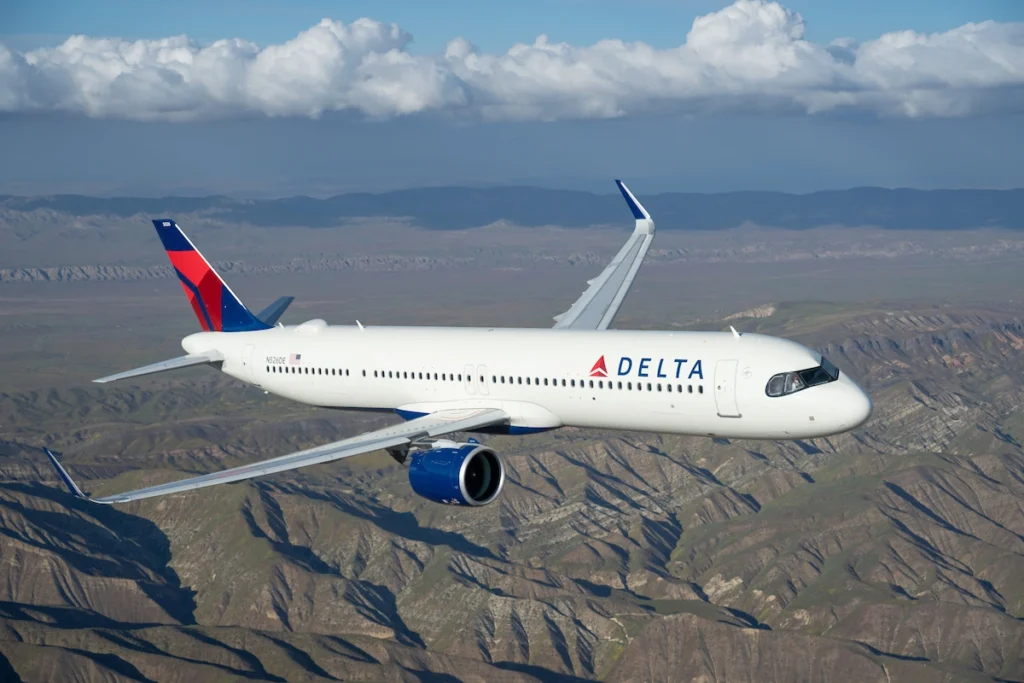
Delta Air Lines flight DL286 traveling from New York John F. Kennedy International Airport to Milan Malpensa Airport made a dramatic emergency landing at Paris Charles de Gaulle Airport after experiencing a serious mid-air engine anomaly while approaching European airspace. The incident unfolded early Tuesday, May 19, 2026, prompting the flight crew to declare an in-flight emergency and divert the Airbus A330-300 to France for immediate landing.
The transatlantic flight, carrying hundreds of passengers from the United States to Italy, departed New York on schedule and crossed much of the Atlantic Ocean without incident before the crew detected problems involving the aircraft’s port-side engine as the plane entered French airspace.
Following standard international aviation emergency procedures, pilots activated the Squawk 7700 emergency transponder code, alerting air traffic controllers to a general emergency situation and requesting priority handling toward the nearest suitable airport.
The emergency declaration immediately triggered large-scale preparedness measures at Paris Charles de Gaulle Airport, where rescue crews, firefighting units, and airport emergency personnel mobilized to support the incoming aircraft.
Flight Crew Executes Safe Emergency Diversion
The Airbus A330-300 performed a controlled descent and diversion toward Paris before safely landing at approximately 6:23 a.m. local time. Emergency response vehicles lined taxiways and runway access points while the aircraft completed its final approach into one of Europe’s busiest aviation hubs.
No injuries were reported among passengers or crew members, underscoring the effectiveness of international airline safety protocols and pilot emergency response training during high-pressure operational situations.
Paris Charles de Gaulle Airport is equipped with specialized infrastructure designed to handle wide-body aircraft emergencies, including rapid-response fire services, medical units, aircraft recovery teams, and technical inspection facilities capable of supporting major international carriers during unexpected incidents.
Airport emergency procedures remained active throughout the landing process until the aircraft safely reached a remote inspection stand for evaluation.
Passengers Describe Tense Moments Onboard
Passengers onboard DL286 described frightening moments during the flight after hearing loud noises coming from the left engine, followed by visible flashes and sparks outside the aircraft. Some travelers also reported a temporary interruption to cabin lighting as the situation unfolded.
Cabin crew members acted quickly to reassure passengers, maintain calm inside the cabin, and assist cockpit crews during emergency procedures. Despite the alarming engine irregularities, the aircraft reportedly remained stable throughout the diversion and landing process.
Aviation safety experts note that modern long-haul aircraft are engineered with multiple redundant systems designed to maintain safe operations even in the event of isolated engine or electrical anomalies. Pilots operating transatlantic routes undergo extensive recurrent emergency training specifically focused on handling technical irregularities over long-distance international sectors.
The successful diversion of DL286 highlights the importance of rapid crew decision-making and strict adherence to global aviation safety standards.
Delta Deploys Replacement Aircraft for Milan Passengers
Following the emergency landing, the aircraft was escorted to a remote stand at Charles de Gaulle Airport where engineers and maintenance specialists immediately began technical inspections involving the affected engine, electrical systems, and other critical aircraft components.
Delta Air Lines described the incident as an “operational/technical issue” pending further investigation by maintenance teams and aviation authorities.
To minimize passenger disruption, Delta arranged a replacement Airbus A330-900neo to transport travelers onward to Milan later in the day. Passengers were rebooked onto the replacement flight and eventually arrived in Italy several hours behind the original schedule.
Airline procedures during major operational disruptions typically include meal assistance, hotel accommodation when required, transportation coordination, and rebooking support in accordance with international passenger rights regulations governing long-haul travel.
The coordinated recovery effort helped reduce broader disruption across Delta’s transatlantic network while prioritizing passenger safety and operational continuity.
Aviation Authorities Launch Technical Review
Aviation regulators in both the United States and Europe are now reviewing the incident as part of standard international safety oversight procedures. The Federal Aviation Administration and the European Union Aviation Safety Agency require comprehensive reporting and technical analysis following in-flight emergencies involving major commercial aircraft.
Investigators will analyze engine performance data, cockpit communications, maintenance records, and flight system diagnostics to determine the precise cause of the anomaly.
Depending on inspection findings, authorities may issue technical recommendations, maintenance directives, or operational guidance designed to prevent similar incidents in the future.
Industry experts note that emergency diversions of this nature remain relatively rare considering the vast number of transatlantic flights operating daily between North America and Europe.
Travelers Reminded of Importance of Flexibility During Long-Haul Travel
The incident involving DL286 also highlights the importance of flexibility and preparedness during international air travel. While modern aviation remains one of the safest forms of transportation globally, unexpected technical diversions, weather disruptions, and operational irregularities can occasionally affect even highly regulated long-haul flights.
Major European airports such as Paris Charles de Gaulle and Milan Malpensa are specifically designed to manage emergency arrivals efficiently while supporting large numbers of international passengers during operational disruptions.
Travel specialists continue advising passengers to monitor airline updates closely, allow additional connection time during long-haul itineraries, and maintain flexible travel arrangements whenever possible.
For Delta Air Lines, the safe handling of flight DL286 demonstrates how coordinated international aviation systems, advanced aircraft technology, trained flight crews, and well-prepared airport infrastructure continue playing critical roles in protecting passengers during rare but serious in-flight emergencies.
For more travel news like this, keep reading Global Travel Wire