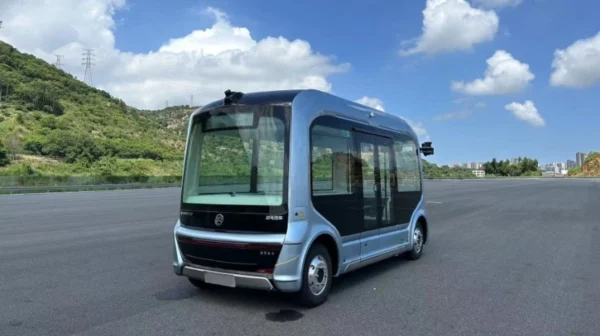
Switzerland has taken a major leap into the future of autonomous transportation after Zurich Airport officially removed the front-row safety driver from its Robobus shuttle service, marking the first fully driverless airport transit deployment of its kind in Europe. The milestone positions Zurich Airport at the center of Europe’s rapidly evolving autonomous mobility sector and signals growing confidence in remote-operated public transport systems.
The driverless shuttle, developed by autonomous mobility company WeRide Inc., now operates using remote supervision technology combined with onboard safety monitoring instead of a traditional driver seated at the front of the vehicle. Airport officials confirmed the transition was implemented in May 2026 following extensive operational testing and safety validation.
Europe Accelerates Autonomous Mobility Development
The Robobus has been operating at Zurich Airport since early 2025 as part of a controlled pilot program designed to evaluate autonomous passenger transport in real-world airport conditions. Over the past year, the shuttle completed hundreds of successful trips across airport service roads and pedestrian areas before authorities approved the latest operational upgrade.
Under the new system, the front driver seat now remains vacant while remote operations teams oversee navigation, safety systems, and shuttle performance from a dedicated control center. A trained safety observer continues traveling inside the vehicle from the rear seating area, providing an additional layer of human oversight if required.
Industry analysts describe the development as one of Europe’s most significant real-world autonomous transport breakthroughs, particularly because the shuttle now operates without a physically seated front driver. The advancement is viewed as an important step toward wider Level-4 autonomous transport deployment across airports, campuses, and urban mobility networks.
How the Driverless Airport Shuttle Operates
The Zurich Airport Robobus currently runs along predefined routes within the airport’s secure perimeter, connecting operational areas, passenger zones, and service locations. Although the routes remain separated from public road traffic, the environment still presents complex operational challenges including service vehicles, pedestrians, varying weather conditions, and changing lighting situations.
The shuttle relies on a sophisticated combination of LIDAR sensors, radar technology, high-definition cameras, and artificial intelligence-driven navigation systems to interpret surrounding conditions and make autonomous driving decisions in real time.
Remote operations teams continuously monitor vehicle performance, route conditions, and system diagnostics while maintaining the ability to intervene or stop operations if unusual circumstances arise. Airport officials emphasized that multiple redundant safety systems remain integrated into the shuttle’s daily operations.
For passengers and airport workers, the result is expected to be smoother and more efficient transportation between terminals, parking zones, and airport facilities.
Switzerland Strengthens Position in Autonomous Transport
Switzerland has emerged as one of Europe’s most progressive markets for autonomous mobility regulation and testing. In late 2025, WeRide received the country’s first fully driverless permit for autonomous passenger services operating on public roads through the “iamo” intelligent automated mobility pilot initiative.
That regulatory approval allowed driverless navigation without onboard safety drivers once operational benchmarks and testing requirements were achieved. Zurich Airport’s latest Robobus deployment is now being viewed as a continuation of Switzerland’s broader strategy to accelerate autonomous transport innovation while maintaining strict oversight and safety standards.
European regulators continue refining policies governing autonomous vehicles as governments seek to balance technological advancement with public safety requirements. Zurich Airport’s successful implementation could influence future autonomous transport regulations across the wider European aviation and mobility sectors.
Airports See Driverless Shuttles as Future Transit Solution
Airports worldwide are increasingly exploring autonomous transport systems as a solution for growing passenger volumes, operational efficiency, and labor challenges. Industry experts believe driverless shuttles could significantly reduce operational costs while improving transport frequency and passenger convenience inside large airport campuses.
Autonomous transit systems are also being positioned as valuable tools for reducing congestion and improving last-mile transportation links between parking facilities, terminals, baggage claim areas, and transportation hubs.
For travelers, autonomous airport shuttles could eventually deliver faster, more predictable, and continuously operating mobility services with reduced waiting times and optimized route efficiency. Airport operators additionally see long-term potential for integrating autonomous fleets into broader smart-airport infrastructure strategies.
Public Confidence in Autonomous Travel Continues Growing
The removal of the front safety driver is also being interpreted as a major confidence milestone for autonomous vehicle technology. Public acceptance of self-driving systems has gradually improved as pilot projects continue demonstrating reliability in controlled operational environments.
Projects such as Zurich Airport’s Robobus are helping normalize autonomous transport by exposing travelers to driverless mobility in familiar public settings. Transportation analysts note that airport environments provide ideal testing grounds due to controlled traffic patterns, predictable routes, and strong operational oversight.
However, experts also caution that challenges remain before widespread fully autonomous urban deployment becomes mainstream. Cybersecurity, AI safety validation, infrastructure compatibility, public trust, and evolving regulatory standards continue to shape the pace of expansion across the autonomous mobility industry.
Autonomous Aviation Transport Enters New Phase
Zurich Airport’s latest deployment demonstrates how autonomous mobility is moving beyond experimental testing and entering practical operational use within major transportation infrastructure. The success of the Robobus project could encourage additional airports, transport hubs, and smart-city operators across Europe to accelerate investments in driverless transit solutions.
As autonomous technology continues advancing, Switzerland’s latest milestone may become a defining moment in Europe’s transition toward fully connected, AI-powered transportation systems designed to reshape the future of passenger mobility.
For more travel news like this, keep reading Global Travel Wire