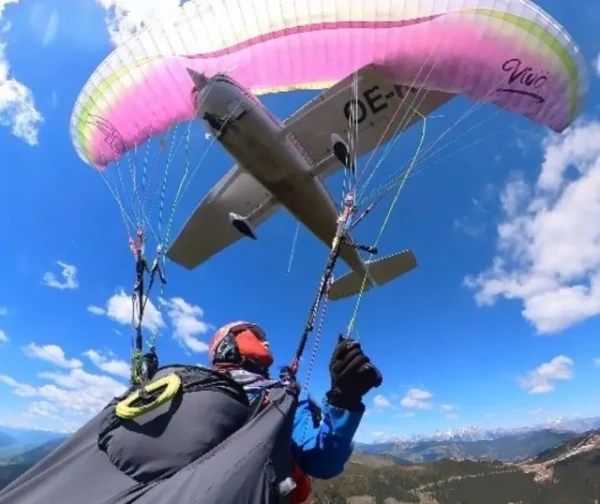
Austria’s alpine tourism sector is facing renewed aviation safety scrutiny after a mid-air collision involving a Cessna 172 and a paraglider near Zell am See triggered emergency response operations and a formal investigation by Salzburg State Police. The incident, which occurred above the Pinzgauer Hütte near Piesendorf on May 23, 2026, has intensified discussions around flight coordination, shared mountain airspace management, and adventure tourism safety protocols across the Salzburg region.
Authorities confirmed that the collision occurred in one of Austria’s busiest recreational aviation zones, where sightseeing aircraft, paragliders, and outdoor adventure operators regularly share heavily trafficked Alpine air corridors. The event immediately prompted safety reviews among local aviation stakeholders, tourism operators, and destination management companies overseeing adventure travel experiences in the region.
Despite the severity of the collision, both pilots survived after executing emergency procedures, with the paraglider pilot successfully deploying a reserve parachute before landing safely on a forest logging road.
Collision Above Piesendorf Sparks Emergency Aviation Response
According to official reports from Salzburg State Police, the accident unfolded shortly after 1:15 PM local time on Saturday afternoon.
A 44-year-old female paraglider pilot from Upper Austria had launched from the Schmittenhöhe mountain area and was flying toward Piesendorf. At the same time, a 28-year-old pilot from Tyrol was operating a Cessna 172 sightseeing aircraft traveling from the Glemm Valley toward Zell am See Airport.
Investigators stated that the paraglider maintained a stable and predictable flight path before the aircraft approached from behind. Authorities believe the Cessna pilot was unable to visually detect the paraglider in time to avoid impact.
The aircraft’s propeller and wing reportedly struck the canopy, severely damaging the paraglider and immediately destabilizing the flight system.
Video footage later showed the paraglider pilot attempting to free herself from tangled suspension lines before deploying her emergency reserve parachute moments before impact with nearby terrain.
The emergency descent ended with a successful landing on a forest service road, narrowly avoiding a heavily wooded area.
Austrian Rescue Teams Respond Rapidly
Emergency crews responded quickly following the collision alert.
The Austrian police helicopter operating under the call sign Libelle Oskar located the paraglider pilot and transported her safely to Zell am See Airport for evaluation. Authorities confirmed that she sustained only minor bruising and later pursued additional medical checks independently.
Meanwhile, the pilot of the Cessna 172 maintained control of the aircraft despite the collision and landed safely at Zell am See Airport without injury.
Officials credited modern safety equipment, pilot training, and emergency response coordination for preventing a potentially far more serious outcome.
The incident has since become one of the most closely monitored aviation safety investigations in Austria’s alpine tourism sector this year.
Salzburg Authorities Investigate Shared Alpine Airspace Risks
The Salzburg State Police investigation is focusing heavily on visual flight rules, known as VFR regulations, which place responsibility on pilots to maintain visual awareness and avoid surrounding air traffic.
Investigators are examining flight telemetry, onboard camera footage, aircraft positioning, and terrain visibility conditions to determine how the collision occurred in clear mountain airspace.
Authorities are also reviewing how sightseeing flights interact with recreational air sports such as paragliding near airport approach corridors and popular launch sites.
The Zell am See region is internationally recognized for adventure tourism and attracts large numbers of paragliders, scenic flight operators, and outdoor enthusiasts during peak travel seasons.
Tourism officials and aviation clubs are closely monitoring the investigation’s outcome because any regulatory adjustments could affect future flight operations and tourism activities in the area.
Adventure Tourism Operators Face Increased Safety Pressure
The collision has intensified focus on risk management within Austria’s fast-growing adventure tourism industry.
Destination management companies and travel operators offering scenic flights, paragliding experiences, and Alpine aviation excursions are being encouraged to reassess vendor safety procedures, insurance coverage, and operational coordination.
Industry specialists note that shared mountain airspace creates unique challenges because recreational aviation activity often overlaps with sightseeing aircraft routes during peak tourism periods.
Travel companies are now expected to place greater emphasis on verifying operator certifications, reviewing safety compliance records, and coordinating activities around weather visibility and high-traffic flight periods.
The incident also highlights the growing importance of collision-awareness practices and communication protocols in mixed-use recreational aviation zones.
Zell Am See Airport Remains Central to Regional Tourism Infrastructure
Zell am See Airport continues serving as a critical transportation and tourism gateway for Austria’s Alpine region, supporting private aviation, sightseeing flights, pilot training operations, and adventure tourism experiences.
Its close proximity to internationally recognized paragliding launch zones makes operational coordination particularly important during busy travel seasons.
Following the collision, airport authorities reinforced safety reminders for pilots operating near mountain corridors and recreational flight zones.
Tourism experts stress that maintaining strong safety standards is essential for preserving traveler confidence in Austria’s outdoor tourism market, especially as demand for experiential and adventure-based travel continues rising globally.
Investigation Expected to Shape Future Alpine Aviation Policies
The final findings from the Salzburg State Police investigation could influence future flight corridor guidelines, operational procedures, and safety briefings for recreational aviation activity throughout Austria’s mountain tourism regions.
Local paragliding clubs, sightseeing operators, and tourism organizations are expected to use the report to strengthen training programs and improve coordination between different airspace users.
While the collision raised serious concerns about Alpine flight safety, authorities emphasized that the successful emergency response demonstrated the effectiveness of current pilot training standards and modern safety equipment.
For Austria’s tourism industry, the incident serves as a reminder that maintaining rigorous aviation oversight remains essential as adventure tourism continues expanding across Europe’s mountain destinations.
The Zell am See mid-air collision may ultimately become a defining case study in how tourism regions balance growing demand for recreational aviation experiences with the operational realities of shared mountain airspace management.
For more travel news like this, keep reading Global Travel Wire