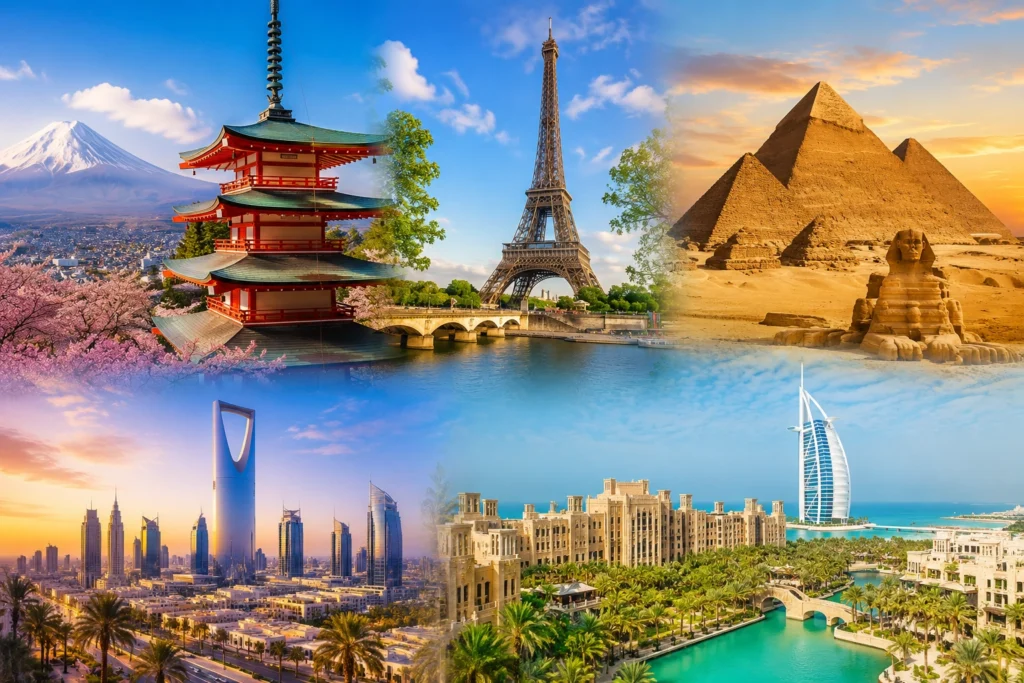
Global tourism is entering a transformative new phase in 2026 as destinations including Japan, France, Egypt, Saudi Arabia, and the United Arab Emirates reshape travel through climate-smart planning, mega-event programming, luxury experiences, and sustainable tourism strategies.
As international overnight visitor numbers surged from 1.4 billion in 2024 to 1.52 billion in 2025, governments and tourism authorities have accelerated efforts to manage overcrowding, diversify seasonal demand, and protect destination carrying capacity while maintaining strong visitor growth.
Modern travelers are increasingly prioritizing sustainability, local culture, flexible travel periods, and immersive experiences instead of traditional peak-season tourism. In response, destinations worldwide are redesigning tourism models around year-round accessibility, event-driven demand, and environmentally conscious visitor management.
The shift is rapidly transforming global tourism economies, influencing everything from hospitality investment and airline scheduling to infrastructure planning and destination marketing.
Japan Expands Climate-Smart Tourism Beyond Traditional Seasons
Japan remains one of Asia’s strongest tourism performers, with inbound travel continuing its robust post-pandemic recovery.
The country welcomed more than 25 million international visitors in 2023, while monthly arrivals in 2025 exceeded 3.9 million during peak periods. Tourism demand remains heavily concentrated around spring cherry blossom season, autumn foliage, Golden Week, Obon holidays, and New Year celebrations.
However, Japan is increasingly focusing on temporal and spatial visitor dispersal strategies designed to reduce overtourism pressure in heavily visited destinations such as Tokyo, Kyoto, and Osaka.
Authorities are promoting regional tourism initiatives including the Michinoku Coastal Trail, TOHOKU Drive Routes, and winter sports destinations such as Appi Kogen to encourage year-round travel beyond traditional hotspots.
Digital crowd-management tools and tourism comfort maps are also helping manage carrying capacity while improving visitor experiences.
Tourism spending continues to be led by travelers from Taiwan, China, South Korea, the United States, and Hong Kong, reinforcing Japan’s position as one of the world’s most influential tourism economies.
Paris Maintains Strong Year-Round Tourism Stability
Paris continues demonstrating exceptional resilience against the seasonal fluctuations commonly affecting many European destinations.
Unlike Mediterranean resort regions that experience heavy summer concentration, the French capital maintains relatively stable visitor flows throughout the year through a combination of cultural tourism, international conferences, exhibitions, and business travel.
Hotel overnight stays in Paris climbed from 38.55 million in 2024 to 41.94 million in 2025, highlighting the city’s ability to sustain year-round tourism demand.
The city’s tourism strategy increasingly promotes shoulder-season travel during months such as October, when visitors benefit from milder weather, lower accommodation costs, and reduced crowding at major attractions.
International congresses, luxury shopping tourism, culinary travel, and major cultural events continue supporting consistent demand across all seasons.
Rome Strengthens Position Through Cultural and Business Tourism
Rome is also benefiting from more stable annual tourism patterns driven by cultural tourism and MICE travel.
The Lazio region remains among Italy’s least seasonal tourism markets because exhibitions, religious tourism, conventions, and international events help maintain balanced visitor flows throughout the calendar year.
Travel analysts say Rome’s tourism resilience demonstrates how capital cities can function as anchors for sustainable year-round demand while reducing dependence on seasonal leisure tourism alone.
This approach is becoming increasingly important as climate concerns and overtourism pressures force destinations to rethink traditional tourism cycles.
Nairobi Expands Beyond Wildlife Tourism
In Africa, Nairobi continues relying heavily on the Great Wildebeest Migration, which drives major tourism peaks between July and September.
Kenya recorded nearly two million international arrivals in 2023, recovering more than 95 percent of pre-pandemic tourism levels while generating KSh 352.5 billion in revenue.
However, authorities are now working to diversify tourism beyond wildlife-focused seasonal demand by strengthening MICE tourism, coastal cruises, adventure travel, and urban experiences.
The strategy aims to improve resilience against environmental disruptions and geopolitical instability while creating more balanced year-round tourism activity.
Jomo Kenyatta International Airport also continues experiencing strong passenger growth as Kenya strengthens its role as East Africa’s aviation and tourism hub.
Egypt Uses Heritage Tourism to Stabilize Visitor Demand
Egypt’s tourism sector is also evolving through year-round cultural programming and heritage-focused development.
Cairo welcomed 14.9 million tourists in 2023, with cultural tourism accounting for approximately 55 percent of inbound demand. The Grand Egyptian Museum alone attracted two million visitors during the first quarter of 2024, highlighting growing international interest in heritage tourism experiences.
Nile River cruises, archaeological tourism, and museum visitation continue generating stable demand across multiple seasons while supporting hotel occupancy and tourism revenue growth.
Egypt’s tourism economy generated USD 14.7 billion in foreign exchange revenue, representing a major contribution to national GDP.
Authorities are increasingly using cultural assets and historical tourism to reduce pressure on seasonal demand cycles while expanding tourism beyond traditional winter peaks.
Saudi Arabia Reinvents Tourism Through Mega-Events
Saudi Arabia has emerged as one of the world’s fastest-growing tourism markets through aggressive investment in entertainment, luxury hospitality, and event-driven tourism.
The Riyadh Season festival, operating between October and March, has transformed the Saudi capital into a global destination for concerts, sports events, exhibitions, and cultural programming.
The country recorded 86.16 million domestic tourists in 2024 while airport traffic surpassed 140 million passengers in 2025.
King Khalid International Airport alone handled 40.8 million passengers as tourism infrastructure expansion accelerated across the Kingdom.
Authorities are using mega-events to counter extreme summer climate conditions while supporting year-round visitor flows and economic diversification under Saudi Arabia’s Vision 2030 strategy.
Abu Dhabi Builds Luxury Tourism Through Sustainability
Abu Dhabi continues positioning itself as a premium year-round tourism destination through luxury hospitality, cultural attractions, and sustainability-focused development.
The emirate welcomed 26.6 million visitors in 2025, while hotels hosted 5.9 million guests with average occupancy levels reaching 81 percent.
Cultural landmarks including Louvre Abu Dhabi and Qasr Al Hosn have become central pillars of the emirate’s tourism strategy, helping stabilize visitor demand beyond traditional seasonal travel periods.
Tourism Strategy 2030 also integrates sustainability principles aligned with United Nations environmental goals, reinforcing Abu Dhabi’s focus on resilient long-term tourism growth.
Luxury tourism, high-profile events, and strong GCC and Asian visitor demand continue supporting the emirate’s expanding international appeal.
Climate-Smart Tourism Shapes the Future of Global Travel
The transformation unfolding across Japan, France, Egypt, Saudi Arabia, and the UAE reflects broader global tourism trends centered on sustainability, resilience, and adaptive travel behavior.
Destinations are increasingly using mega-events, cultural programming, digital crowd-management tools, and diversified tourism products to spread visitor demand more evenly throughout the year.
Climate-smart tourism planning is rapidly becoming essential as governments seek to balance economic growth with environmental protection and community sustainability.
As traveler preferences continue evolving toward immersive and responsible experiences, destinations capable of managing seasonality while protecting infrastructure and cultural identity are expected to dominate the next era of global tourism growth.
For more travel news like this, keep reading Global Travel Wire