The expansion of high-capacity mass transit systems relies heavily on the modernization of foundational railway supply architectures. In a major move toward digital transformation, international technology groups are combining forces to integrate sensor-based real-time tracking with large-scale network assets. A major partnership has been established to merge Denmark-based Railmonitor’s sensor technology for real-time monitoring of tracks and physical structures with Progress Rail’s global infrastructure footprint.
This digital integration allows transit operators to track structural anomalies and ground movements as they happen. By shifting from traditional reactive repairs to advanced predictive maintenance, the partnership provides the precise analytics required to keep high-frequency passenger lines running smoothly, reducing unexpected network downtime and lowering long-term asset management costs worldwide.
Scaling Up Megaprojects: Strategic Track Deliveries for Fast Transits
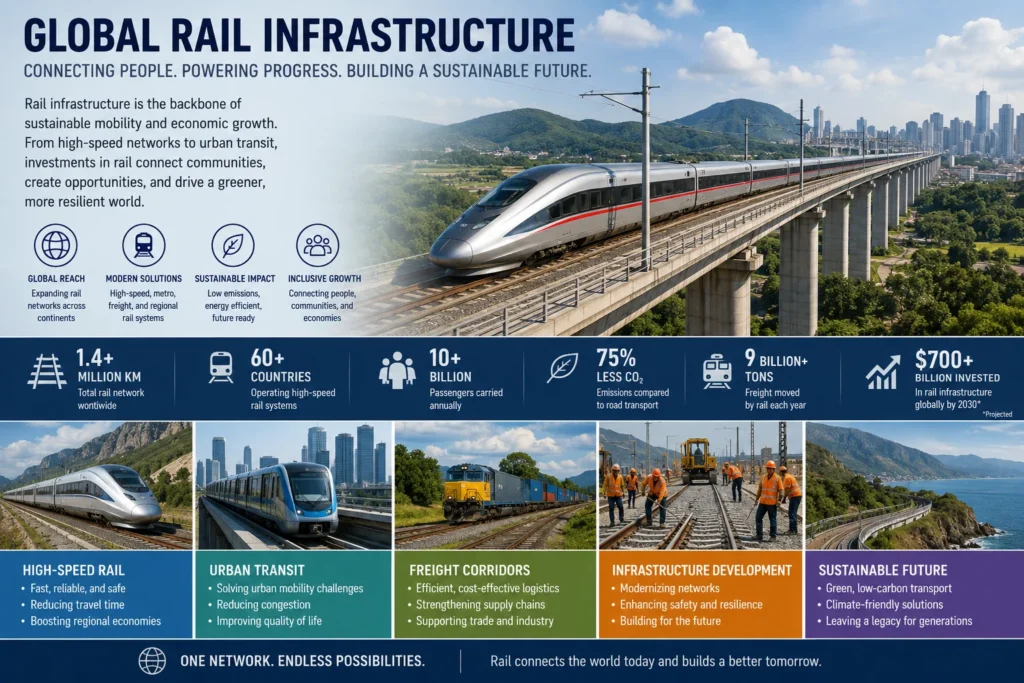
Large-scale civil works are moving forward rapidly across major international travel corridors, supported by substantial manufacturing and supply commitments. In the United States, the historic California High-Speed Rail initiative has achieved a key logistical milestone by securing a €40 million supply contract with infrastructure specialist Vossloh. The agreement covers the production and deployment of 335,000 specialized concrete sleepers alongside high-performance rail fastening systems.
These heavy-duty components are engineered to withstand the intense dynamic forces generated by trains traveling at speeds up to 350 kilometers per hour. Manufacturing will be handled locally at a dedicated facility in Pueblo, Colorado, with sequential logistics shipments scheduled to begin in the third quarter of 2026. This foundational deployment provides a highly reliable baseline for America’s first dedicated high-speed rail corridor, which aims to seamlessly link major population centers while offering an efficient, low-emission alternative to regional air travel.
Sustainable Procurement and Green Infrastructure Transitions
National railway networks are systematically updating their environmental guidelines, phasing out legacy industrial materials in favor of highly sustainable and nontoxic alternatives. Lithuania’s state-owned infrastructure manager, LTG Infra, has finalized two separate three-year environmental services contracts with specialized hazardous waste firms Žalvaris and Sanresa. The agreements cover the safe decommissioning and disposal of up to 5,000 tonnes of old creosote-impregnated wooden sleepers.
Following successful field tests with advanced composite track elements, the LTG Group has enacted a strict policy banning the use of traditional wooden ties in future infrastructure works. Similarly, in Central Europe, Austrian rail services provider DPB Rail Infra Service has launched an internal signaling manufacturing program. The company has successfully produced and delivered 24 proprietary signaling components for the Lieboch–Köflach passenger line, operated by Austria’s federal railway, ÖBB. This transition to domestic, in-house production strengthens the regional supply chain and protects vital transport lines from unpredictable international component shortages.
Capital Markets and Sovereign Financing for Modern Fleet Overhauls
To fund large-scale modernizations, national transit operators are successfully tapping into international capital markets, securing high levels of investor confidence. The Czech Republic’s national carrier, České Dráhy, has successfully issued €500 million in senior unsecured Eurobonds on the Luxembourg Stock Exchange. The bond offering saw immense demand from institutional investors across Europe, with total order books peaking above €1.8 billion.
Maturing in September 2031 with a fixed annual coupon of 3.75%, the proceeds from this capital raise are legally earmarked for extensive fleet modernization and passenger service enhancements. Concurrently, international financing institution Eurofima has closed a separate €500 million, 20-year funding transaction with Italy’s FS Group. This long-term capital allocation will completely finance the acquisition of 62 regional passenger trains, divided equally between Alstom Pop electric multiple units and double-deck Hitachi Rail Rock trainsets, drastically increasing regional travel comfort and capacity across Italian provinces.
Regional Operational Shifts and Credit Rating Adjustments
As major institutional players expand their territorial footprints, transit management models are adjusting to changing regional economic realities. Global engineering firm Alstom has restructured its Latin American executive hierarchy, naming a new Managing Director for Southern Latin America based out of Santiago, Chile. This consolidated leadership structure will oversee all product lines, engineering projects, and commercial opportunities across Argentina, Chile, Peru, and Ecuador, ensuring better project delivery across South America’s expanding urban rail networks.
Meanwhile, in Northern Europe, international credit rating agency S&P Global Ratings has affirmed its A+ long-term corporate credit rating for Finland’s VR Group. However, the agency shifted its forward-looking financial outlook from stable to negative, mirroring a broader sovereign outlook adjustment for the Finnish state driven by shifting demographic patterns and rising public service costs. Despite these macro pressures, the credit profile of the railway operator’s outstanding senior unsecured bonds remains highly secure at A+, affirming its structural stability.
Upgrading Passenger Station Experiences and Software Systems
State-owned transit enterprises are investing heavily in advanced software to maximize the scheduling efficiency of their complex networks. In Spain, Catalonia’s regional railway operator, FGC, has become the third major domestic carrier to integrate advanced operational software developed by IVU Traffic Technologies, optimizing real-time crew scheduling and vehicle management across its busy passenger networks.
Finally, in Central Asia, Kazakhstan’s national railway, KTZ, has secured US$1 billion through a benchmark bond placement, with the European Bank for Reconstruction and Development acquiring a 12.5% stake. The massive capital injection will fund the comprehensive modernization of 124 passenger railway stations. The extensive construction and upgrade program will focus on installing advanced energy-efficient lighting and heating systems, optimizing terminal safety architectures, and building modern, fully accessible platforms to maximize comfort and ease of movement for international and domestic travelers alike.
For more travel news like this, keep reading Global Travel Wire