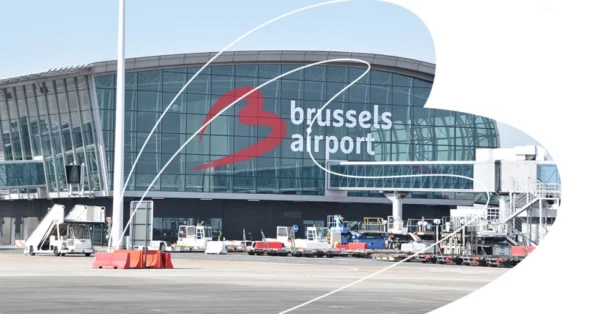
Brussels Airport will begin introducing next-generation body scanners and CT hand luggage scanners from 2028, giving passengers a faster and more convenient security experience at one of Europe’s major aviation hubs. The upgrade will allow travellers to keep liquids, laptops, tablets and other electronic devices inside their cabin bags during screening, reducing one of the most time-consuming steps in the airport journey.
The full departure security overhaul is scheduled for completion by summer 2029, when all 19 screening lanes will be equipped with the new technology. The project is designed to strengthen safety, expand passenger-processing capacity and improve the travel experience as the airport prepares for future growth.
Liquids and Electronics to Stay Inside Cabin Bags
Passengers currently pass through metal detectors while their hand luggage is checked using X-ray scanners. Electronic devices must be removed before screening. Liquids and gels are limited to individual containers of no more than 100 millilitres, packed inside a single transparent resealable bag with a maximum capacity of one litre.
The new CT scanners will simplify that process. Once the upgraded lanes become operational, passengers will be able to leave liquids and electronics in their hand luggage. Under current European regulations referenced by Brussels Airport, travellers using the new scanners may carry an unlimited total quantity of liquids in containers that do not exceed two litres each.
For holidaymakers, families and business travellers, the change could make the airport experience noticeably smoother. Fewer items will need to be unpacked and repacked at checkpoints, helping passengers move through security with less stress while reducing the risk of leaving personal belongings behind in screening trays. That could be especially valuable during busy holiday travel periods.
Phased Rollout Begins With Body Scanner Testing
Brussels Airport will introduce the system in stages to maintain security capacity throughout the transition. A first body scanner test is planned for June 2026. Preparations will continue in the coming months, followed by construction of an additional temporary screening platform in 2027.
The first new scanners are expected to enter service on that temporary platform in 2028. Once the extra screening capacity is available, the airport will replace the existing pre-departure equipment in phases. By summer 2029, all 19 departure screening lanes are due to use the advanced scanners. Transfer-passenger screening lanes will be upgraded at a later stage.
This phased approach is important for an airport that handles substantial passenger demand throughout the year. It allows Brussels Airport to modernise its facilities while keeping operations running and avoiding unnecessary disruption for departing travellers.
Hub 3.0 Investment Targets Capacity and Comfort
The security upgrade forms part of Hub 3.0, Brussels Airport’s wider investment programme focused on passenger experience and airport capacity. The airport aims to remain a convenient, comfortable and future-ready European hub while improving the efficiency of key passenger touchpoints.
The scale of the project reflects Brussels Airport’s role in Belgian and international travel. The airport welcomed 24.4 million passengers in 2025. In 2026, it offers direct connections between Belgium and 205 destinations worldwide, served by 83 airlines. Brussels Airport also supports 64,000 direct and indirect jobs, underlining its importance to tourism, aviation and the wider economy.
Improved screening capacity could benefit airlines, hotels, tour operators and destinations connected through Brussels by helping the airport handle rising visitor numbers more efficiently. Faster checkpoint flows can also improve the overall impression of a destination, particularly for international travellers beginning or ending their journey in Belgium.
Safer, Faster Travel Experience by 2029
Brussels Airport has said the investment will preserve high security standards while making the screening process easier for passengers and increasing capacity for future passenger growth. Body scanners will support passenger screening, while CT technology will provide more advanced checks for cabin baggage.
The result will be a more streamlined airport experience from the security queue to the departure gate. Travellers will spend less time removing everyday items from their bags, while airport teams will gain a more modern system designed for growing demand.
With the first scanners expected in 2028 and all 19 departure lanes scheduled for completion by summer 2029, Brussels Airport is positioning its security infrastructure for the next phase of European air travel.
For more travel news like this, keep reading Global Travel Wire