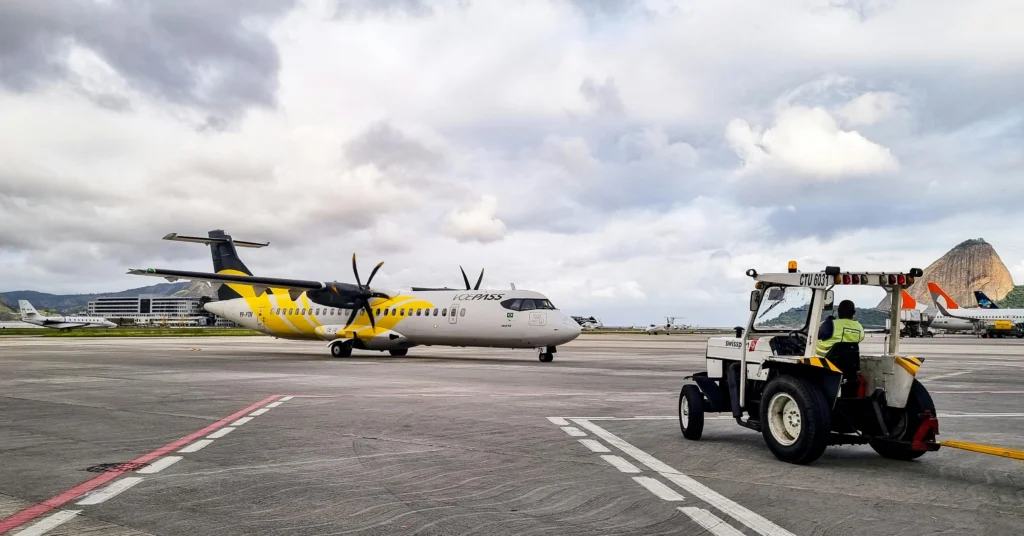
Aviation leaders, transport ministers, and regulatory executives have gathered in Rio de Janeiro for the 82nd International Air Transport Association (IATA) Annual General Meeting and World Air Transport Summit. The convention returns to the iconic Brazilian metropolis at a defining moment for global aviation history. It was in Rio in 1999 that the event was officially expanded into the World Air Transport Summit to reflect the industry’s massive influence on global commercial mobility. Today, the sector is confronting a rapid convergence of high passenger volumes, energy security challenges, and automated artificial intelligence technologies.
From Havana to Montreal: The Foundations of Standardized Flight
The institutional framework governing modern commercial aviation traces its origins back to April 19, 1945. Amidst the concluding months of the Second World War, representatives from 57 pioneering airlines representing 31 nations convened in Havana, Cuba, to establish IATA. Later that year, Montreal hosted the inaugural IATA Annual General Meeting.
During this foundational era, commercial flight passenger statistics stood at fewer than 10 million international travelers annually. Airlines operated modest fleets of piston-powered aircraft carrying just a few dozen passengers per trip, and total industry revenue was measured in millions rather than billions of dollars.
Under the leadership of Sir William Hildred, IATA’s first Director General, the organization focused on establishing standard operational rules. The body introduced uniform ticketing procedures, universal interline baggage agreements, standardized tariff settlement systems, and strict safety guidelines. These structural elements allowed separate national carriers to merge into a single, cohesive global transport network. By the conclusion of the 1950s, global passenger traffic had grown to approximately 100 million travelers annually, with industry revenues climbing to $5 billion.
Technological Revolutions and the Expansion of Mass Tourism
The 1960s accelerated global connectivity with the widespread introduction of commercial jet airliners, led by the Boeing 707 and Douglas DC-8. These faster, long-range aircraft reduced intercontinental travel times from days to hours. To support this expanding geographical reach, IATA held summits in emerging global gateways, including Sydney in 1961, Bogota in 1964, and Manila in 1967. By 1970, annual passenger traffic had tripled to approximately 300 million travelers, pushing total industry revenues toward $15 billion.
The introduction of the Boeing 747 jumbo jet in 1970 democratized international travel, launching the era of affordable mass tourism. This wide-body aircraft cut operating costs per seat, allowing airlines to lower ticket prices significantly. Passenger volumes passed 500 million annually by the close of the 1970s, despite major economic disruptions from the 1973 and 1979 global oil shocks. Under Director General Knut Hammarskjöld, IATA guided airlines through these severe fuel crises by introducing rigorous fuel-efficiency standards, establishing a historical precedent for the industry’s current focus on energy resilience.
The 1980s brought widespread economic deregulation, sparked by legislative changes in the United States that quickly influenced European and Asian markets. Airlines increasingly competed on network efficiency, customer service quality, and hub-and-spoke scheduling models. By 1990, annual passenger volumes passed the one billion mark, and industry revenues exceeded $150 billion.
The Digital Transition and the Shift to Eastern Markets
The turn of the millennium introduced sweeping security updates following September 11, alongside a major digital modernization program. Under Director General Giovanni Bisignani, IATA launched the “Simplifying the Business” initiative. This program systematically eliminated paper ticketing in favor of electronic bookings, introduced bar-coded boarding passes, and standardized self-service airport check-in kiosks, saving the global aviation industry billions of dollars while streamlining terminal processing.
The subsequent decade marked a significant eastward shift in aviation’s center of gravity. IATA selected major Asian and Middle Eastern capitals for its high-level summits, including Beijing in 2012, Doha in 2014, and Seoul in 2019. Driven by industrialization and rising discretionary incomes across the Asia-Pacific region, global passenger numbers climbed from 2.7 billion to 4.5 billion annually by 2019, with industry revenues approaching $850 billion.
Following the unprecedented disruption of the 2020–2022 global pandemic—which caused a 60% collapse in international passenger traffic—the industry executed a remarkably rapid recovery. Recent summits in Istanbul, Dubai, and New Delhi highlighted the emergence of new aviation powerhouses, particularly in India, which has grown to become the world’s third-largest domestic aviation market.
Charting the Next Era of Global Aviation
As delegates assemble in Rio de Janeiro, the modern aviation industry is managing complex structural realignments. Today, IATA represents more than 370 airlines across 120 countries. Global passenger volumes are hovering near five billion travelers annually, and total industry revenues are approaching $1 trillion.
A primary topic of discussion at the summit is the deployment of integrated artificial intelligence across core operations. Airlines are utilizing machine-learning algorithms to optimize live flight path routing, automate predictive aircraft maintenance, and manage real-time recovery schedules during severe weather disruptions.
Concurrently, international carriers are accelerating investments in Sustainable Aviation Fuel (SAF) to meet the industry’s binding commitment of net-zero carbon emissions by 2050. Originally viewed strictly as an environmental goal, SAF production is increasingly recognized as a key economic strategy to shield airlines from traditional fuel price volatility and secure independent energy pipelines. From its origins as an elite transit option overseen by 57 founding airlines, international aviation has grown into a vital global utility, continuously modifying its rules, technologies, and networks to support a highly connected world.
For more travel news like this, keep reading Global Travel Wire