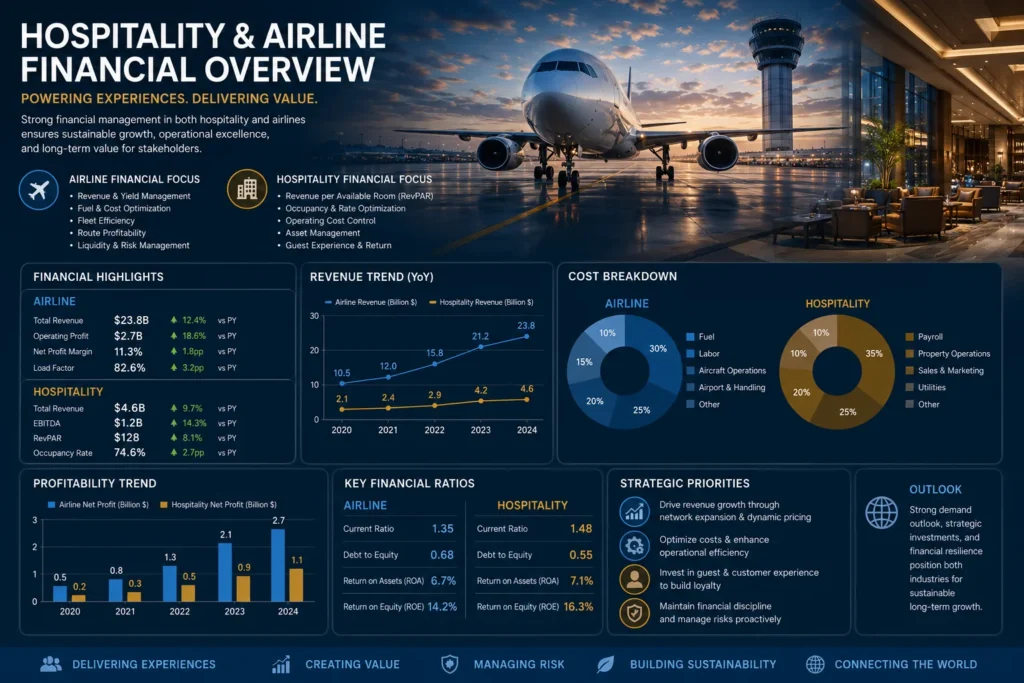
The corporate earnings period for international aviation and hospitality operators has concluded, providing a comprehensive look at how commercial airlines, travel infrastructure providers, and hotel groups are navigating the current fiscal environment. Operating within the consumer discretionary travel sector, these entities face distinct operational trade-offs, balancing resilient consumer demand for experiential leisure travel against shifting macroeconomic factors and high fuel price variables.
Compiled financial results across 19 major travel and vacation provider equities reveal a fragmented performance landscape. As a collective group, revenue figures surpassed initial marketplace consensus projections by a modest 1.6%. However, operational forward guidance for subsequent quarters pulled back, averaging 9.3% below initial market forecasts. Despite these mixed forward indicators, the broader travel tracking index recorded positive momentum, with equity valuations appreciating by an average of 11.1% following the release of their formal financial statements.
+-------------------------------------------------------------------+
|            Summary of Discretionary Travel Sector Earnings        |
+-------------------------------------------------------------------+
| Collective Revenue Beats   | 1.6% above average consensus         |
| Across Monitored Stocks    | marketplace projections.             |
+----------------------------+--------------------------------------+
| Aggregate Forward Guidance | 9.3% adjustment below initial target |
| Revisions                  | expectations.                        |
+----------------------------+--------------------------------------+
| Post-Announcement Equity   | 11.1% upward trajectory across the   |
| Performance Average        | tracking index.                      |
+-------------------------------------------------------------------+
Frontier Airlines Records Double-Digit Revenue Expansion
Frontier Group Holdings, operating as an ultra-low-cost carrier across domestic United States markets and select international destinations in the Americas, reported positive topline momentum for the first quarter. The carrier’s operational strategy, which focuses on point-to-point unbundled airfares to capture price-sensitive leisure passengers, helped insulate its network during seasonal demand shifts.
Official corporate filings confirm that Frontier generated total revenue of $1.07 billion during the quarter. This figure represents a 16.8% increase compared to the same operational period in the prior year, exceeding consensus expectations by 1.5%. The airline’s quarterly performance metrics were further supported by future earnings-per-share projections that cleared baseline market estimates. Following the publication of these metrics, the company’s common stock experienced notable market interest, advancing 43.5% post-reporting to trade near $5.87 per share.
Sabre Corporate Leads Infrastructure Efficiency While Delta Manages Varied Yields
In the travel technology and global distribution systems sector, Sabre Corporation registered steady operational gains. The company, which provides critical software architecture, data insights, and automated transaction pipelines for international travel agencies, corporate travel departments, and airlines, benefited from elevated transaction volumes.
Sabre reported total quarterly revenue of $760.3 million, marking an 8.3% year-over-year expansion. This revenue print outpaced consensus projections by 4.4%. The infrastructure provider’s internal balance sheets reflected a net beat on standard earnings-per-share metrics alongside a notable improvement in adjusted operating income margins. Following the release, the stock stabilized, moving up 2.6% to settle around $1.88 per share.
Concurrently, Delta Air Lines, one of the primary network carriers in the United States, reported substantial topline numbers but faced distinct cost headwinds. Delta’s network operations serve both global business networks and premium leisure segments via a hub-and-spoke configuration.
+-------------------------------------------------------------------+
|               Delta Air Lines Q1 Financial Summary                |
+-------------------------------------------------------------------+
| Total Revenue Generated    | $15.85 billion; a 12.9% expansion    |
|                            | year-over-year.                      |
+----------------------------+--------------------------------------+
| Marketplace Projection     | Cleared initial consensus expectations|
| Deviation                  | by a 4.0% margin.                    |
+----------------------------+--------------------------------------+
| Internal Cost Headwinds    | Missed consensus earnings-per-share  |
|                            | targets and forward guidance metrics. |
+-------------------------------------------------------------------+
Delta reported total operating revenue of $15.85 billion, up 12.9% year-over-year. While this performance beat baseline market expectations by 4.0%, higher internal operating costs and capacity adjustments led to a notable miss regarding consensus earnings-per-share numbers. Additionally, the carrier’s forward financial guidance for the subsequent operational window came in below initial consensus targets. Despite the varied internal metrics, broader market demand for premium international airline equities supported the stock, which gained 21.0% post-announcement to trade near $79.42 per share.
Hospitality Franchisors and Property Operators Record Moderate Revenue Gains
In the hospitality and lodging sector, global property managers and franchising networks reported moderate growth, reflecting a stabilization of domestic room rates and revenue per available room (RevPAR) indices.
Hyatt Hotels Corporation, which manages a global portfolio spanning 20 distinct brands across 65 nations, reported total first-quarter revenue of $1.75 billion. This corresponds to a conservative 1.7% year-over-year increase, clearing baseline expectations by 1.0%. The company’s financial summary reflected a mixed outcome, matching earnings-per-share projections but experiencing softer adjusted operating income margins. Hyatt recorded the slowest revenue expansion clip among its direct hotel operating peers, though its stock advanced 22.6% post-release to market values near $194.76 per share.
Concurrently, Choice Hotels International, which operates primarily as a lodging franchisor across diverse value brands including Comfort Inn, Quality Inn, and Clarion, reported total revenue of $340.6 million. Supported by its asset-light franchise model, Choice Hotels grew its topline by 2.3% year-over-year, beating market estimates by 2.5%. However, increased system integration costs and operational investments led to misses in both its adjusted operating income and baseline earnings-per-share targets for the quarter.
These concurrent airline and hospitality updates demonstrate that while top-line travel demand remains resilient across global transport and lodging networks, operators must maintain rigorous cost discipline to translate gross passenger revenue into consistent corporate earnings.
For more travel news like this, keep reading Global Travel Wire