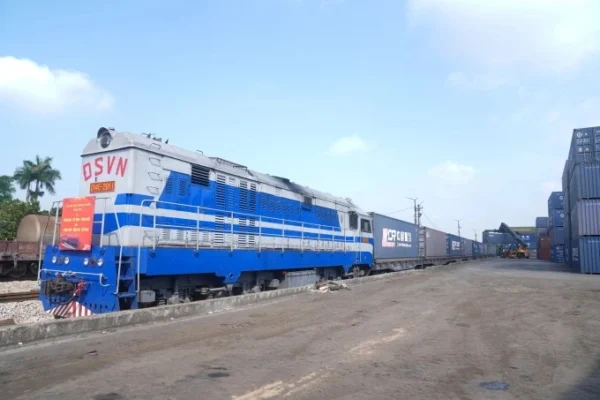
China has launched its first international intermodal container train linking Qinghai Province with Vietnam’s southern industrial province of Dong Nai, creating a new cross-border logistics corridor that strengthens rail connectivity between inland western China and Southeast Asia.
The inaugural freight service departed from Qinghai carrying nearly 1,000 tonnes of PVC plastic resin. It reached Yen Vien Station in Hanoi on June 3, 2026, where the cargo completed customs procedures before continuing toward Trang Bom Station in Dong Nai.
The journey to southern Vietnam takes just over 10 days and covers nearly 4,000 kilometers. More than 2,178 kilometers of the route run through China, while over 1,700 kilometers extend across Vietnam.
The launch marks the first time Qinghai has introduced a container rail service to Dong Nai. It also gives manufacturers, exporters and logistics providers a new option for moving goods between western China and one of Vietnam’s most important production regions.
New Train Connects Inland China With Southern Vietnam
The Qinghai–Vietnam freight train passes through the Pingxiang–Dong Dang border crossing before entering Vietnam. Cargo is cleared at Yen Vien Station in Hanoi and then transported south by rail to Trang Bom.
This connection adds a direct route between inland Chinese production centers and Vietnam’s major manufacturing and consumption markets. It also expands the role of rail freight in regional supply chains traditionally supported by sea and road transportation.
Dong Nai is a major industrial center near Ho Chi Minh City and an important location for factories, warehouses and distribution networks. The new service could support more efficient cargo movement for businesses operating across southern Vietnam while opening additional opportunities for trade with western China.
The route is also expected to help Vietnamese exporters move products more efficiently toward the Chinese market. Key categories include agricultural goods, seafood, textiles and garments.
Faster Rail Links Strengthen Supply Chain Resilience
The new freight corridor is designed to improve logistics efficiency by reducing transport delays and simplifying the movement of containerized goods across borders.
For businesses, faster rail connections can lower inventory pressure, improve delivery planning and create greater flexibility during periods of supply chain disruption. Rail transport also provides a useful alternative when sea routes face congestion or road freight capacity becomes limited.
The service demonstrates how international rail corridors are becoming increasingly important for regional trade. Rather than relying entirely on coastal ports, inland provinces can gain more direct access to Southeast Asian markets through integrated customs, railway and terminal operations.
The nearly 1,000-tonne inaugural cargo highlights the route’s potential for industrial materials. However, future services could support a broader mix of products as demand develops and operators improve frequency.
China–ASEAN Trade Gains a New Transport Link
The Qinghai–Dong Nai train strengthens a wider China–ASEAN logistics network. It allows goods from inland Chinese areas, including Qinghai, to reach Vietnam’s production and consumption centers more directly.
The corridor also supports regional integration by connecting railway systems, border stations, logistics terminals and distribution hubs across two countries.
For Vietnam, the new route could strengthen the role of Yen Vien and Trang Bom as important rail freight points. The service may also encourage additional investment in warehousing, customs facilities and inland distribution infrastructure.
For China, the launch improves access from a western inland province to Southeast Asia. This is particularly important as businesses seek diversified routes and more resilient supply chains.
The service adds to a growing number of cross-border rail links connecting Chinese cities and provinces with Vietnam. As more routes enter operation, businesses may gain improved choice, more competitive transport options and stronger links with regional markets.
Rail Freight Supports Greener Regional Connectivity
The new corridor also carries a sustainability angle. Rail freight generally offers an efficient option for transporting large volumes of cargo over long distances, especially when compared with extensive road journeys.
Shifting suitable cargo to rail can help ease road congestion, improve freight planning and support lower-impact logistics strategies. This matters as manufacturers, retailers and transport operators increasingly focus on supply chain efficiency and environmental performance.
Railway terminals along the route could also benefit from increased activity. Freight growth can support local logistics businesses, warehousing services, maintenance operations and employment linked to cargo handling.
Qinghai–Vietnam Route Signals Long-Term Potential
The first Qinghai–Vietnam freight train is more than a single cargo movement. It represents a new logistical connection between inland China and southern Vietnam, with wider significance for China–ASEAN trade.
As regional supply chains continue to evolve, the corridor could help businesses move goods more efficiently while strengthening cooperation between railway operators, customs authorities and logistics providers.
With nearly 4,000 kilometers of track and a journey of just over 10 days, the new service positions rail as an increasingly important part of Southeast Asia’s trade infrastructure. It also lays the foundation for more frequent freight services and deeper economic connectivity across the region.
For more travel news like this, keep reading Global Travel Wire