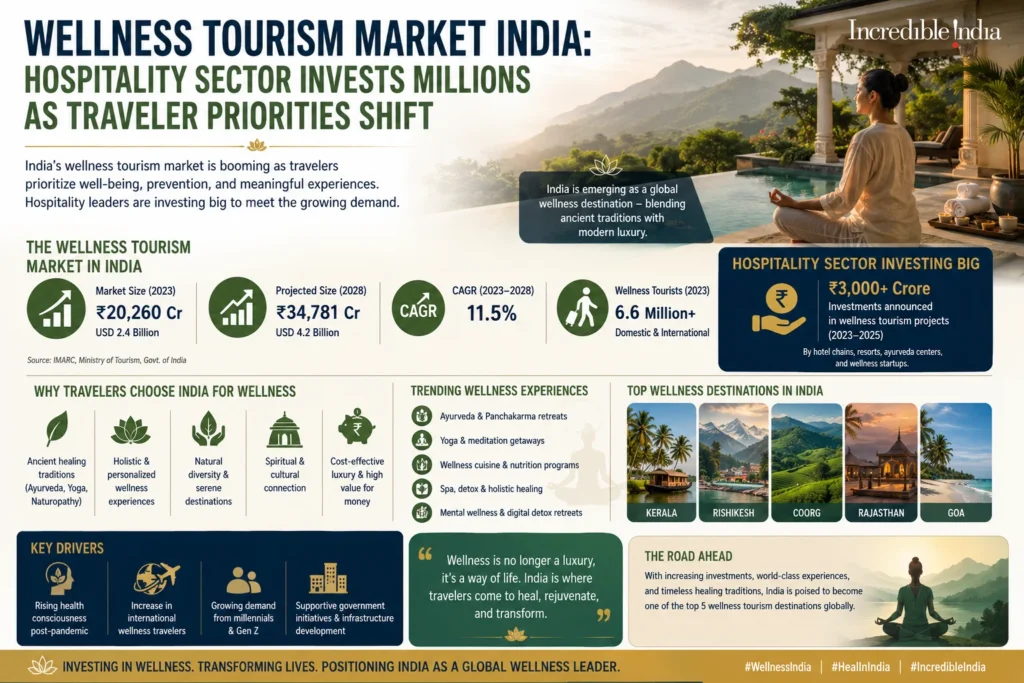
The global hospitality landscape is undergoing a structural change as guest expectations evolve past simple leisure travel toward holistic health and preventative care. According to the Ministry of Tourism, India’s domestic wellness and medical tourism segments have become major drivers of hospitality investment, transforming how properties are built, marketed, and operated.
Statistical data released by the Press Information Bureau (PIB) confirms that India has firmly established itself as the 12th largest wellness tourism market globally and the 5th largest within the Asia-Pacific region. This expanding footprint is prompting mainstream hotels and premium resorts alike to allocate millions of dollars to specialized infrastructure, medical integration, and personalized guest programming.
Data Telemetry: The Economics of Personal Well-Being
The financial incentive behind this investment surge is rooted in distinct spending and booking behaviors observed across the Indian travel sector. Industry tracking data compiled by global analytics groups highlights that 93 percent of Indian travelers are expressing a clear interest in booking dedicated, health-specific trips—often referred to directly as “glow-cations”—which emphasize skincare, high-tech hydration, and biological rhythm balancing.
Furthermore, official economic indicators from the India Tourism Market Framework demonstrate that wellness-focused guests generate significantly higher revenue streams compared to traditional vacationers. Properties integrating dedicated wellness packages have reported average occupancy boosts of up to 36 percent. Travelers looking for structured programs generally extend their stays to three or four nights rather than traditional weekend stays, and they show a greater willingness to allocate a larger portion of their travel budgets to targeted clinical and holistic consultations.
From Basic Spa Menus to Advanced Medical Integration
The definition of a hotel spa has moved far beyond aromatherapy treatments and steam rooms. Modern hospitality brands are aligning their services with clinical diagnostics and evidence-based longevity therapies to meet consumer demand for verifiable health outcomes.
Government policy has accelerated this integration through the Union Budget, which establishes designated funding to develop regional medical and wellness tourism hubs. This program facilitates a hybrid approach, allowing luxury retreats to pair traditional AYUSH practices (Ayurveda, Yoga, Unani, Siddha, and Homeopathy) with contemporary diagnostic technologies.
Properties are increasingly utilizing artificial intelligence tools, DNA testing, biomarker analysis, and sleep-tracking sensor systems to create highly personalized health plans. At premium wellness retreats, this approach extends to daily nutrition, where culinary teams routinely prepare dozens of individual, medically supervised menus tailored precisely to each guest’s biometric profile and metabolic needs.
Nature Immersion and Geographic Shifts in Hospitality Layouts
While advanced technology forms a major pillar of the urban wellness market, regional resorts are leveraging natural environments to provide restorative experiences. In destination clusters like Jim Corbett, Rishikesh, and the hill stations of Himachal Pradesh, operators are designing properties around biophilic principles—architecture that intentionally connects indoor spaces with the natural world.
Data from regional tourism boards indicates that outdoor activities such as forest bathing, guided foraging, meditation walks, and open-air yoga are no longer viewed as optional recreation, but as core components of a property’s wellness infrastructure. This nature-centric model is drawing substantial secondary wellness travelers—guests who do not book a dedicated clinical retreat but intentionally choose properties that offer quiet environments, clean air, and organic, farm-to-table dining frameworks.
Government Support and Quality Governance Frameworks
To maintain the country’s competitive advantage in the global market, the Ministry of Tourism has implemented a comprehensive National Strategy and Roadmap for Medical and Wellness Tourism. This governance framework focuses heavily on quality assurance, standardization, and international accessibility.
| Strategic Sector Indicator | Verified Administrative Data |
| Global Market Positioning | 12th globally for wellness tourism; 5th in Asia-Pacific |
| Key Regulatory Body | National Accreditation Board for Hospitals & Healthcare Providers (NABH) |
| Active Industry Certifications | Over 1,299 facilities accredited using 600 safety parameters |
| Core Legislative Initiative | “Heal in India” campaign supported by regional hub allocations |
| Special Visa Stream | Active e-Ayush Visa system for international wellness arrivals |
| High-Growth Activity Segment | Yoga & Meditation retreats leading with over 41% market share |
| Emerging Activity Segment | Digital-Detox Escapes expanding at a projected 17.3% growth rate |
The formalization of the e-Ayush Visa stream has simplified entry requirements for foreign nationals seeking long-stay traditional therapies, while the National Accreditation Board for Hospitals & Healthcare Providers (NABH) enforces over 600 safety and quality parameters across registered wellness centers. These centralized standards give travelers greater confidence regarding treatment legitimacy and facility operations.
Long-Term Integration Across Midscale and Premium Sectors
The massive influx of capital into health-focused amenities is no longer restricted to ultra-luxury boutique properties. Upscale and midscale corporate hotels are progressively updating their floor plans to include circadian lighting, advanced in-room air purification systems, noise-reduction materials, and menus focused on nutrition.
As corporate groups increasingly select wellness resorts for employee retention off-sites and executive retreats, the hospitality sector is adjusting to a market where health care and travel are permanently linked. By establishing certified infrastructure and point-to-point wellness options, hotel operators are ensuring that their properties can sustain steady, year-round demand, contributing directly to the long-term growth of the national leisure economy.
For more travel news like this, keep reading Global Travel Wire