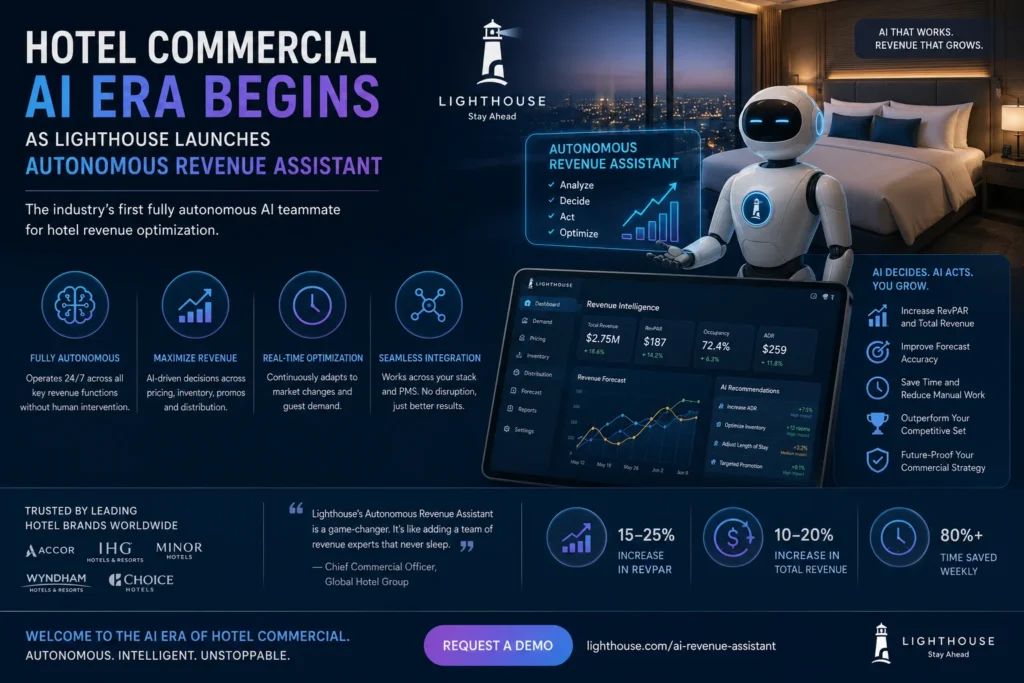
The technical frameworks guiding room pricing and distribution are undergoing a major shift as software platforms move from descriptive dashboards to active operational execution. In an official product announcement, hospitality intelligence provider Lighthouse revealed the launch of Ernest, a specialized hotel commercial AI designed to operate directly within corporate back offices. Rather than focusing on guest-facing chatbots, the system introduces a conversational workspace built to integrate directly with revenue management, marketing, sales, and distribution workflows.
The launch points to a broader change in how enterprise software handles data fragmentation. By connecting general large language models with industry-specific operational rules, the platform addresses the classic “last mile” problem of hotel automation—turning massive market datasets into immediate, controlled adjustments across connected booking channels.
Solving Back-Office Fragmentation Across Siled Systems
Modern hotel groups manage their daily pricing and inventory across a complex mix of disconnected software applications. Revenue managers frequently split their time between market rate shoppers, property management systems (PMS), central reservation systems (CRS), and individual direct booking portals. This fragmented environment creates data silos, which can cause significant delays when teams try to identify and respond to sudden changes in market demand.
The introduction of specialized hotel commercial AI seeks to create an analytical layer above these separate data streams. Operating as a unified conversational interface, the system aggregates internal property metrics alongside external market demand signals. This structure allows commercial teams to query their entire data ecosystem using natural language, removing the conventional requirement to log into multiple platforms to manually build daily performance summaries.
The Three Operational Layers: Intelligence, Guidance, and Action
According to technical specifications released by the development team, the software manages day-to-day commercial workflows through three distinct operational layers:
Unified Cross-Platform Intelligence: The platform automatically normalizes incoming data signals from multiple software environments. This allows users to request audit-ready competitive analyses, demand forecasts, and market benchmarks, with every answer linked back to the underlying source data to ensure verification.
Prescriptive Next-Move Recommendations: Moving past standard static reporting, the system analyzes historical property preferences, active pricing models, and room availability to suggest specific revenue adjustments. The recommendations adapt over time, learning the operational patterns preferred by management for a specific property or regional portfolio.
Controlled System-Wide Execution: Functioning as a system of action, the technology executes tasks directly inside a hotel’s existing software stack. Operating under user-defined rules and explicit approvals, it automates repetitive processes such as generating executive slide decks, updating rates, and sending real-time alerts.
Technical Infrastructure and System Integration Scope
Official deployment statistics from the software platform outline the scale and integration capabilities supporting the global launch.
| Operational Indicator | Verified Deployment Specifications |
| Developer Platform | Lighthouse Commercial Operating Platform |
| Active Global Footprint | Powers over 80,000 hotels across 185 countries |
| Core Software Module | Ernest Decision and Action Engine |
| Third-Party Integrations | Over 500 connected hospitality platforms and systems |
| Connected Infrastructure | PMS, CRS, Revenue Managers, and Direct Booking Channels |
| Delivery Framework | Natural language interface via web workspace, Email, Slack, and Teams |
| Launch Availability | Active beta rollout throughout the remainder of 2026 |
| Public Industry Preview | Scheduled for the HSMAI Commercial Strategy Conference |
Automating Daily Workflows and Reporting Routines
A major practical application of the platform involves the automation of routine data compiling tasks that typically consume the early morning hours of revenue and sales leaders. By establishing automated “Routines,” the AI prepares daily competitive overviews, performance summaries, and executive presentations before the corporate workday begins.
These automated outputs are delivered directly to existing team communication channels like Slack, Microsoft Teams, or corporate email. Because the system can scale its calculations across user, single-property, or multi-brand portfolio levels, corporate hospitality groups can maintain standard visibility across different locations while utilizing enterprise privacy controls to keep proprietary financial data secure.
The Long-Term Impact on Commercial Hospitality Roles
The deployment of automated decision layers addresses a core problem for modern hospitality executives: the imbalance between data management and strategic planning. When commercial teams spend the majority of their time pulling reports and manually cross-referencing dashboards, they have less time to focus on long-term corporate positioning and group sales relationships.
Industry updates indicate that the system is currently available in a controlled beta format for select pilot hotels, with a phased global rollout planned through the end of 2026. A live technical preview of the system’s pricing, distribution, and automation capabilities is scheduled to take place at the upcoming HSMAI Commercial Strategy Conference in San Antonio, highlighting how automated decision systems are becoming standard components of modern hospitality asset management.
For more travel news like this, keep reading Global Travel Wire