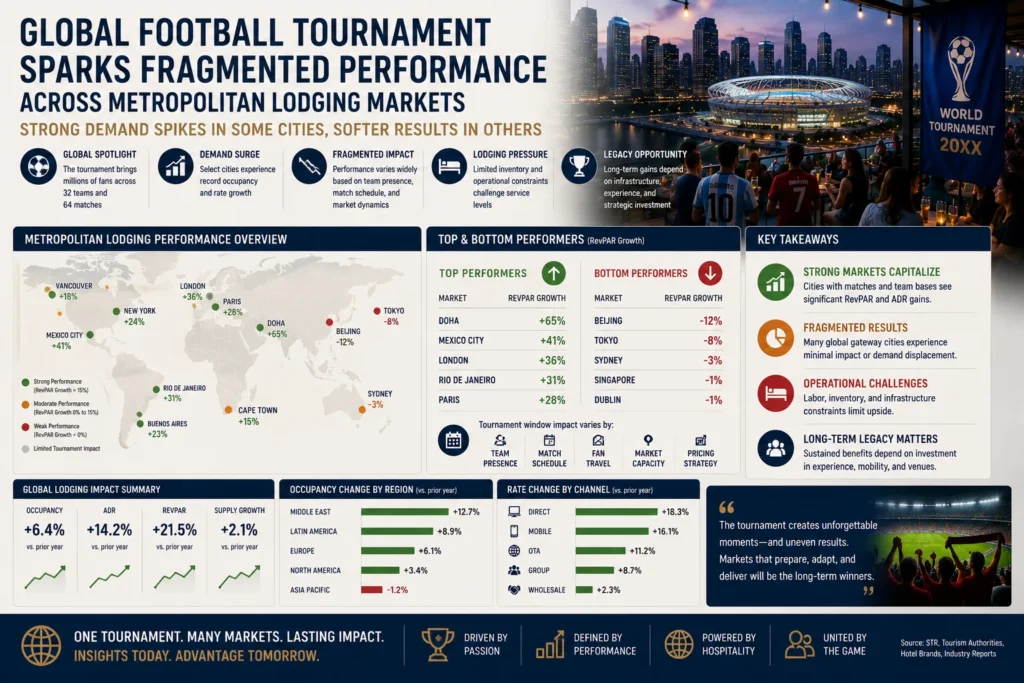
The massive international soccer tournament currently underway across North America is delivering a highly segmented economic reality for the hospitality and regional transport sectors. According to real estate analytics data compiled by CoStar and various domestic tourism boards, the highly anticipated influx of sports fans has generated a starkly mixed operational landscape. While certain inland hubs are registering major gains in overnight stays, several of the continent’s largest coastal gateways are experiencing baseline occupancy metrics that fall visibly short of initial projections.
Prior to the opening matches, international sports bodies had estimated that approximately forty percent of all tournament attendees would consist of long-haul international travelers. However, aggregate aviation data published by Cirium indicates that confirmed flight bookings finalized prior to June from major international origin markets, including the European Union, dropped when compared to the identical summer window from the previous year. This deceleration in long-distance arrivals has prompted travel security analysts and hospitality executives to recalibrate their immediate seasonal demand models.
Metropolitan Accommodation Pacing Experiences Divergent Trends
The operational statistics highlight a significant divide in how individual urban economies are absorbing the tournament footprint. In major metropolitan markets such as New York, Toronto, and Miami, real-time auditing reveals that the total number of host city hotel bookings recorded on active match days is currently pacing below the baseline levels established during the same period last year. Tourism research directors note that overall international visitation has trended softer than initially forecasted, leaving premier urban properties to rely heavily on late-stage domestic travelers and regional drive-in markets.
Conversely, inland destinations are logging substantial economic windfalls. Official indicators published by Visit Kansas City demonstrate that the Midwestern hub has captured the exact type of robust tourism acceleration that host cities universally anticipated. Across all six designated match periods, local hotels have achieved an impressive thirty-two percent growth rate in room bookings compared to the previous year. Furthermore, the municipal tourism authority confirmed that local short-term residential rentals have completely surged past expectations, effectively doubling their initial revenue projections for the summer quarter.
Despite the slow start in key coastal corridors, leadership bodies within the domestic lodging sector remain optimistic about a delayed wave of activity. In official statements, the American Hotel & Lodging Association expressed confidence that a significant volume of fans are waiting to finalize their itineraries and regional lodging reservations until the group stages conclude and the later-stage knockout matches are locked in.
Transit Networks Manage Shifting Commuter Dynamics and Tariff Structures
The fluctuating volume of international visitors has simultaneously placed intense scrutiny on regional public transit systems and their corresponding pricing frameworks. In the New York-New Jersey transit corridor, public infrastructure managers are navigating weaker-than-anticipated consumer response to specialized tournament logistics. Official agency ledger entries reveal that for the inaugural match hosted at the New York New Jersey Stadium, fewer than 22,000 specialized rail transit tickets were successfully validated.
The lower-than-projected volume follows a structured tariff implementation that drew notable public feedback. To help offset an estimated forty-eight million dollars in dedicated tournament infrastructure expenses, regional transit authorities established a specialized round-trip fare priced at ninety-eight dollars—representing a multiple nearly seven times higher than a standard commuter transit ticket.
Despite the slow initial ticket sales making it unlikely that the agency will fully recover its event-specific capital outlays through direct fare collection, the executive leadership of NJ Transit confirmed that there are no operational plans to alter the pricing matrix for the remaining games. State transport directors emphasized that even if total tournament fare revenues fail to cover the full operational delta, the agency will not request emergency financial subsidies from the State Legislature, choosing instead to manage internal balances without enacting service cuts or passing secondary costs onto daily regional commuters. Transport monitoring boards note that the lower volume of rail passengers could result in elevated vehicle congestion across major highway corridors as fans shift toward regional bus systems, private vehicles, and digital ride-sharing platforms.
Local Municipalities Transform into International Cultural Hubs
While the macro-economic accommodation numbers present a complex puzzle, the immediate social and cultural footprint within specific hosting municipalities is generating historic civic engagement. In Southern California, the city of Inglewood—home to L.A. Stadium—has effectively transformed into a major cross-cultural junction. Local administrative offices report that thousands of fans representing diverse global populations, including delegations from Japan, Switzerland, Iran, Paraguay, Bosnia, and Belgium, are converging on the municipality to attend its eight scheduled matches.
To maximize the economic opportunity for local independent businesses, municipal leadership has taken direct administrative action. The Office of the Mayor of Inglewood confirmed that the city has permanently accelerated its commercial permitting processes, enabling small businesses, neighborhood associations, and local dining establishments to quickly secure licenses for outdoor World Cup viewing areas, pop-up markets, and public community gatherings. This localized agility ensures that even in areas where traditional hotel occupancy remains in a phase of correction, the immediate cultural and commercial energy of the tournament is fully embraced by the host communities.
For more travel news like this, keep reading Global Travel Wire