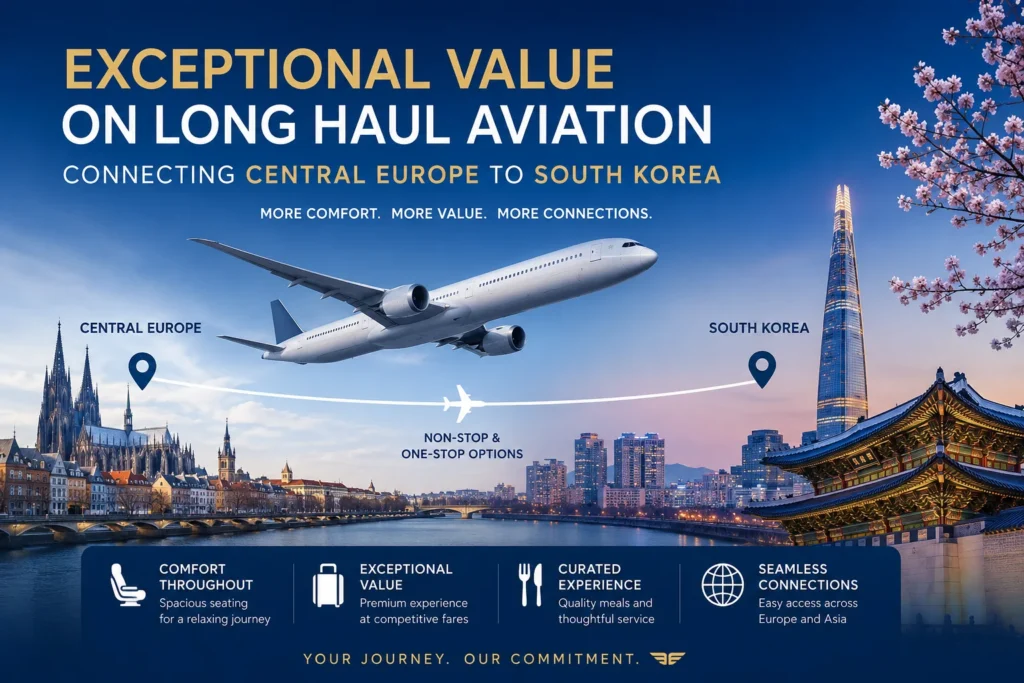
The long-haul aviation sector has registered significant pricing shifts, opening up fresh opportunities for international leisure travelers seeking cost-effective transit between Central Europe and East Asia. In a development tracking the sustained post-pandemic recovery of global commercial corridors, full-service airfare structures connecting Budapest Ferenc Liszt International Airport and Seoul Incheon International Airport have adjusted competitively, dropping to rates around €570. This pricing dynamic enables broader access for European holidaymakers looking to engage with East Asia’s cultural assets, historic heritage preservation zones, and dynamic urban tourism infrastructure.
Official operational records from Budapest Airport highlight a period of historic traffic expansion, with the gateway recording a record 19.6 million passengers annually. According to data provided by the airport authority, the facility has expanded its active portfolio to host 45 distinct airlines operating across 154 international routes. This structural expansion highlights Budapest’s evolving role as a highly connected passenger collection hub for Central and Eastern Europe. Leisure travelers departing from the Hungarian capital benefit directly from this heightened operational capacity, which leverages strategic bilateral air service agreements to maximize weekly frequencies and drive down long-haul booking costs on major Asian networks.
On the receiving end of this corridor, the Ministry of Culture, Sports and Tourism of the Republic of Korea alongside the Korea Tourism Organization have tracked a historic influx of international arrivals. Official statistical releases verify that the country’s inbound tourism market has entered a phase of structural expansion, welcoming approximately 18.93 million foreign visitors over a twelve-month period. Notably, while traditional short-haul regional markets remain robust, the most pronounced statistical growth has emerged from long-haul Western markets. Total inbound travel from European source countries registered a strong 15.3% expansion over historical baselines, a trend actively supported by more flexible aviation routing configurations and aggressive promotional fare strategies.
For passengers evaluating long-haul transit matrices, the full-service distinction on these multi-city itineraries remains an essential variable in overall cost calculations. Unlike the unbundled pricing models popularized by short-haul low-cost operations, standard full-service bookings on this route encompass comprehensive passenger amenities within the base ticket cost. Verified airline allowances routinely include dedicated checked baggage limits, complimentary hot meal rotations during extended flight segments, and advance seat allocation frameworks. These standard provisions effectively insulate budget-conscious travelers from hidden ancillary fees that can quickly escalate the real cost of cross-continental travel.
The travel duration for this Central Europe to East Asia transit vector typically stabilizes between 14 and 18 total hours. This schedule factors in seamless transfer windows at key strategic hub facilities, which are designed to minimize total ground delay while offering travelers clear multi-city connectivity. These intermediate transit windows also offer a structured pause during extended journeys, allowing long-haul passengers to make use of modern international terminal facilities before continuing their journey into Seoul’s expansive metropolitan matrix.
Upon arrival, international tourists encounter a highly diversified visitor economy that stretches far beyond the capital’s boundaries. According to data from the Korea Tourism Organization, the nation has prioritized the development of regional tourism assets, connecting primary urban hubs to coastal preservation zones, mountain retreats, and UNESCO World Heritage locations via the Korea Train Express high-speed rail network. This seamless domestic transport infrastructure enables incoming European visitors to maximize their local itineraries independently, transitioning from historic temple enclaves to high-tech urban centers without relying on complex private tour operators.
Furthermore, visitor access is facilitated by highly streamlined entry protocols maintained by the Ministry of Foreign Affairs. European Union citizens consistently profit from cooperative diplomatic arrangements, allowing visa-free entry for tourism stays extending up to 90 days. This baseline administrative simplicity, paired with the active deployment of electronic travel authorization platforms, reduces the bureaucratic overhead traditionally associated with intercontinental leisure travel.
As global aviation networks continuously recalibrate their operational capacities and route frequencies, the current affordability of the Budapest-to-Seoul corridor stands as a prime example of changing market dynamics. By taking advantage of these competitive long-haul tariffs, international travelers can systematically reduce their base transportation overhead and reallocate their primary financial resources directly into local hospitality experiences, regional culinary tours, and historical exploration throughout South Korea’s rapidly growing visitor landscape.
For more travel news like this, keep reading Global Travel Wire