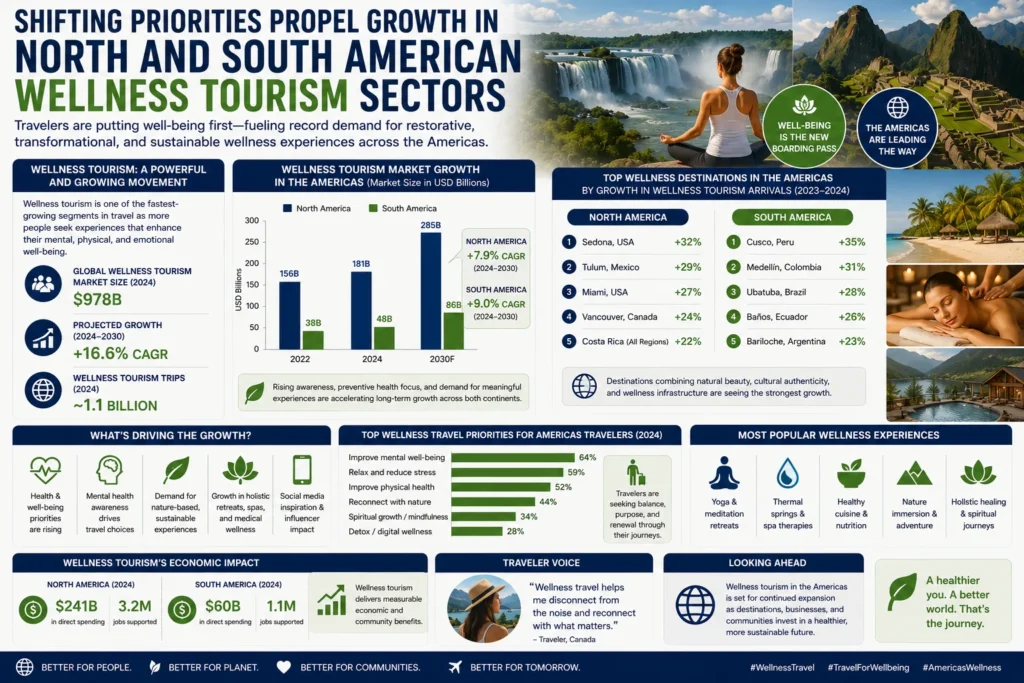
The global leisure sector is tracking a profound structural pivot as international travelers systematically replace rigid, hyper-scheduled sightseeing itineraries with fluid, rest-centric holiday blueprints. Industry intelligence released by the Global Wellness Institute and major regional tourism boards reveals that this adaptive behavior—frequently categorized as the unscripted or low-stress vacation movement—is fundamentally altering passenger flows across the Americas. Driven by an explicit consumer desire for psychological decompression, neural regulation, and natural isolation, nine distinct nations across the Western Hemisphere are logging unprecedented traffic surges within their dedicated eco-hospitality and wellness sectors.
Statistical updates provided by global research aggregates indicate that the international wellness economy has achieved historic scales, reaching a global valuation of $6.8 trillion. Propelled by heightened public awareness regarding physical and emotional health, the specific wellness tourism segment is estimated at $1.08 trillion. Sector analysts project this specialized market to expand at a compound annual growth rate of 9.3 percent, positioning the global valuation to approach $2.4 trillion. Crucially, North America continues to command the primary market footprint, retaining a dominant 35.9 percent share of total international revenue, while Central and South American sub-regions emerge as the fastest-evolving destinations for dedicated nature therapies.
Central America Leverages Environmental Protections to Capture High Value Leisure Portfolios
Costa Rica has firmly established its position as the operational vanguard of this movement, converting its traditional environmental philosophy into a highly lucrative premium travel model. Official entry statistics published by the Instituto Costarricense de Turismo confirm that the nation commenced its seasonal cycle with a historic record in international arrivals, welcoming 959,738 visitors by air during the opening quarter alone—a 12.9 percent expansion over historical baselines. This sustained traffic influx is highly concentrated at the Daniel Oduber Quirós International Airport in Guanacaste, which logged a 12 percent growth spike, driven by expanded premium routes catering to North American and European travelers seeking low-density, luxury eco-lodges along the Nicoya Peninsula.
This paradigm shift from high-volume, mass-market tourism to targeted, high-yield sustainability packages is similarly accelerating economic activity in neighboring Belize and Panama. The Belize Tourism Board has highlighted that low-impact coastal developments across its northern cayes are drawing extended-stay independent travelers who prioritize unhurried marine exploration and digital disconnection over commercial attractions. Concurrently, the Ministry of Tourism of Panama is actively directing public infrastructure resources toward the amplification of its pristine cloud forest corridors and off-grid Pacific island retreats, establishing clear fiscal incentives for boutique hospitality brands that incorporate native therapies and forest-bathing protocols into their primary guest offerings.
North American Vastness Serves as Infrastructure Backbone for Decompression Travel
Further north, the sheer geographic scale of Canada’s protected wilderness networks provides a natural solution to contemporary urban burnout. Data from Destination Canada outlines a sustained rise in the booking velocities of isolated alpine chalets, remote lake properties, and backcountry wellness expeditions across the Rocky Mountain corridors. By emphasizing complete acoustic isolation and dark-sky stargazing as premier luxury amenities, Canadian operators are successfully capturing a major share of the international secondary wellness market, where travelers combine standard leisure vacations with structured mindfulness routines.
Parallel trends are redefining the hospitality landscape within the United States and Mexico, where luxury developers are aggressively remodeling properties to eliminate travel-related friction. The Mexico Tourism Secretariat has tracked substantial capital investments dedicated to retrofitting premium coastal resorts in Riviera Maya, Los Cabos, and Puerto Vallarta with integrated wellness footprints, ranging from traditional indigenous thermal circuits to advanced sleep-support programs. In the United States, federal travel monitors report that national parks and specialized domestic wellness retreats are expanding their infrastructure to support a massive wave of weekend travelers looking for structured digital detox windows without navigating complex cross-border transit rules.
South American Regions Emerge as Prominent Bastions for Remote Luxury and Slow Living
The southern reaches of the hemisphere are witnessing an identical recalibration of visitor expectations, with Uruguay and Argentina leveraging their geographic isolation to cultivate highly distinct slow-travel ecosystems. Corporate data from regional hospitality registries shows an escalating demand for private estancias and boutique vineyard properties across Mendoza and the coastal hamlets of Uruguay. These locations offer international travelers an organic, low-stimulus environment where daily activities are entirely self-paced, effectively lowering stress metrics through immersive rural living and culinary simplicity.
In Ecuador, municipal tourism strategies are heavily capitalizing on the country’s compact, highly diverse geography to attract value-conscious health travelers. The Ministry of Tourism has highlighted that the ability to transition from the biodiverse corridors of the Amazon basin to high-altitude Andean thermal springs within a minimal transit window significantly reduces travel fatigue, which remains a primary deterrent for contemporary vacationers. By offering highly integrated, multi-ecosystem itineraries that require zero complex logistical planning from the end consumer, Ecuador successfully positions itself as an ultra-accessible healing environment.
As national tourism administrations throughout the Americas align their long-term growth strategies with changing global demographics, the commercial viability of rigid, high-density sightseeing models is expected to face continued pressure. The ongoing expansion of full-service wellness packages, simplified electronic entry frameworks, and integrated health amenities ensures that the American wellness tourism sector remains uniquely equipped to absorb this historic demand shift. By consistently prioritizing environmental preservation, structural safety, and seamless consumer interfaces, these nine leading nations are successfully transforming the act of travel from a source of holiday fatigue into a reliable mechanism for genuine long-term recovery.
For more travel news like this, keep reading Global Travel Wire