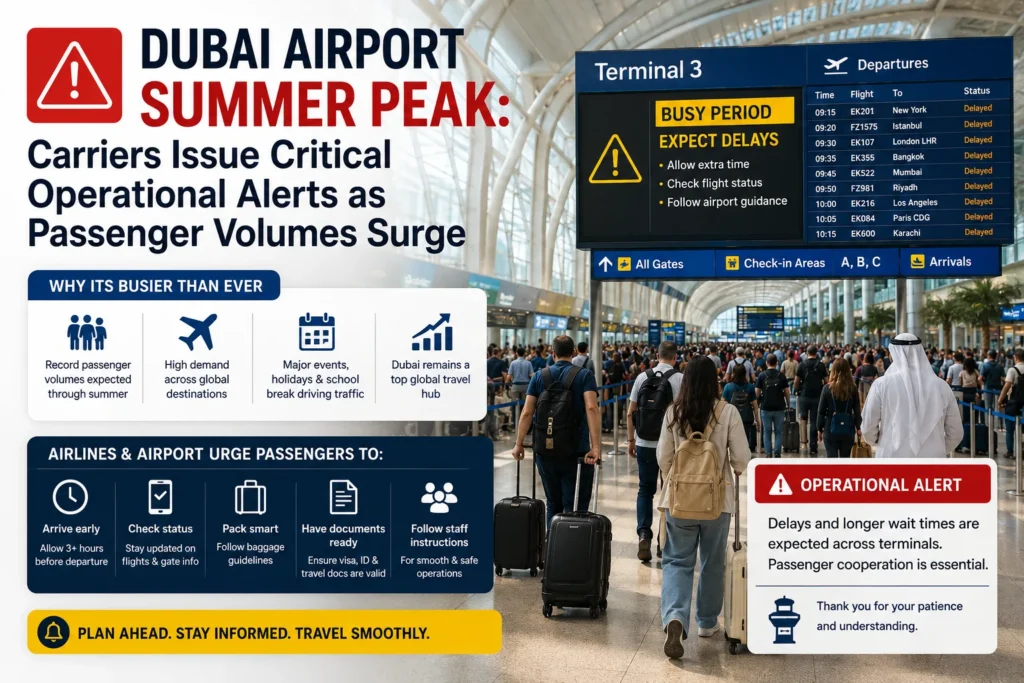
A major operational coordination effort is underway at Dubai International Airport as national carriers execute comprehensive strategy updates to manage an unprecedented wave of seasonal travelers. According to official travel advisories published by Emirates and supported by network data from regional partners, the standard timelines for processing international departures have been adjusted. Travelers utilizing the global aviation hub over the coming months are required to complete airport arrival protocols at least three hours prior to their scheduled departure times.
The specialized peak-season framework responds directly to record-breaking traffic projections across the terminals. Official statistical evaluations released by Dubai Airports highlight that the hub is functioning near its maximum physical parameters, with forecast models indicating that total passenger traffic is on track to approach 99.5 million travelers. This immense volume builds upon the historical benchmarks established during previous high-demand phases, including a single three-month quarter that accommodated 24.2 million passengers. The convergence of annual school holiday departures, regional expatriate migration, and an influx of international transit traffic linking major global corridors has prompted aviation authorities to initiate strict queue-mitigation measures.
Strict Gate Compliance and Layered Terminal Wait Times
Aviation management teams emphasize that the newly extended three-hour arrival window is an operational necessity designed to preserve global flight connectivity and terminal safety. Under the active high-density protocols, check-in desks, immigration screening matrices, and baggage handling networks are processing volumes at absolute capacity. Official statements confirm that security lanes and passport control zones are projected to experience longer-than-average transit intervals during daily peak departure windows.
To protect network punctuality and ensure systemic compliance, airlines are strictly enforcing boarding gate timelines. Final boarding processing will close systematically 60 minutes before scheduled aircraft departure, leaving zero margin for late-arriving travelers. Ground operations teams have confirmed that because flights are heavily booked across the entire summer schedule, passengers who miss their allocated boarding windows due to terminal delays face severe rebooking difficulties due to limited seat availability across consecutive routes.
Off-Airport Check-In and Digital-First Passenger Solutions
To systematically lower the physical density of crowds inside the main terminal departure halls, transport ministries and airline leadership are directing the public toward an array of digital-first and remote check-in platforms. Passengers are strongly encouraged to complete electronic check-in procedures via official mobile applications or web portals before commencing their physical journeys to the airport facility. Additionally, carriers are maximizing the use of self-service check-in kiosks and automated bag-drop ports situated directly within the terminal architectures.
Furthermore, verified public communications highlight a series of off-airport check-in infrastructure options designed to remove the baggage burden from the main facility. Travelers can utilize early bag-drop options available up to 24 hours prior to flight departure for standard international destinations, and up to 12 hours ahead for specific long-haul transoceanic routes. Off-airport hubs, such as the 24-hour Emirates City Check-in facility in Ajman and the City Check-in and Travel Store at ICD Brookfield Place within the Dubai International Financial Centre, are operating at expanded capacities. The urban financial center facility is officially extending its operational hours to handle baggage and issue boarding passes closer to residential and corporate zones.
Metro Infrastructure Promoted to Evade Urban Road Bottlenecks
In tandem with terminal processing challenges, landside transportation access points leading directly into the airport geographic perimeter are experiencing significant vehicle congestion. Municipal transport authorities have noted that vehicular approach lanes frequently sustain severe traffic slowdowns during morning and evening peak departure windows, potentially adding up to 45 minutes of unexpected transit delay for passengers arriving by car or taxi.
To completely bypass landside traffic variables, aviation boards are strongly urging the public to utilize the direct rail connectivity provided by the Dubai Metro system. The metro line features direct terminal integration, depositing passengers directly into Emirates Terminal 3 without requiring exposure to roadside bottlenecks. Transport ministry schedules confirm the rail network operates extensive weekly timetables running from early morning until midnight from Monday through Thursday and on Saturdays, with extended weekend service stretching past midnight on Fridays to accommodate nighttime flight surges.
System-Wide Readiness and Long-Term Capacity Projections
The active summer response plan reflects a highly coordinated effort across the entire aviation ecosystem, which comprises thousands of specialized ground handlers, customs officials, security personnel, and logistical support teams. Operational divisions have deployed enhanced biometric pathway tracking systems across smart gates, allowing pre-registered frequent flyers and loyalty members to complete passport control verifications via facial recognition tech, bypassing manual processing lines entirely.
This prolonged period of high asset utilization underscores why long-term infrastructure investments are expanding rapidly across the emirate. As the main international hub continues to push the boundary of its physical limitations, government frameworks are accelerating the development of the multi-billion-dollar expansion at Al Maktoum International Airport to handle long-term regional population and tourism growth. Until those macro-scale expansions come online in the next decade, maintaining terminal fluidity requires strict passenger adherence to the current three-hour early arrival directive. Travelers are urged to verify that all personal contact data is meticulously updated within digital booking profiles to ensure the seamless receipt of real-time operational alerts throughout the summer travel cycle.
For more travel news like this, keep reading Global Travel Wire