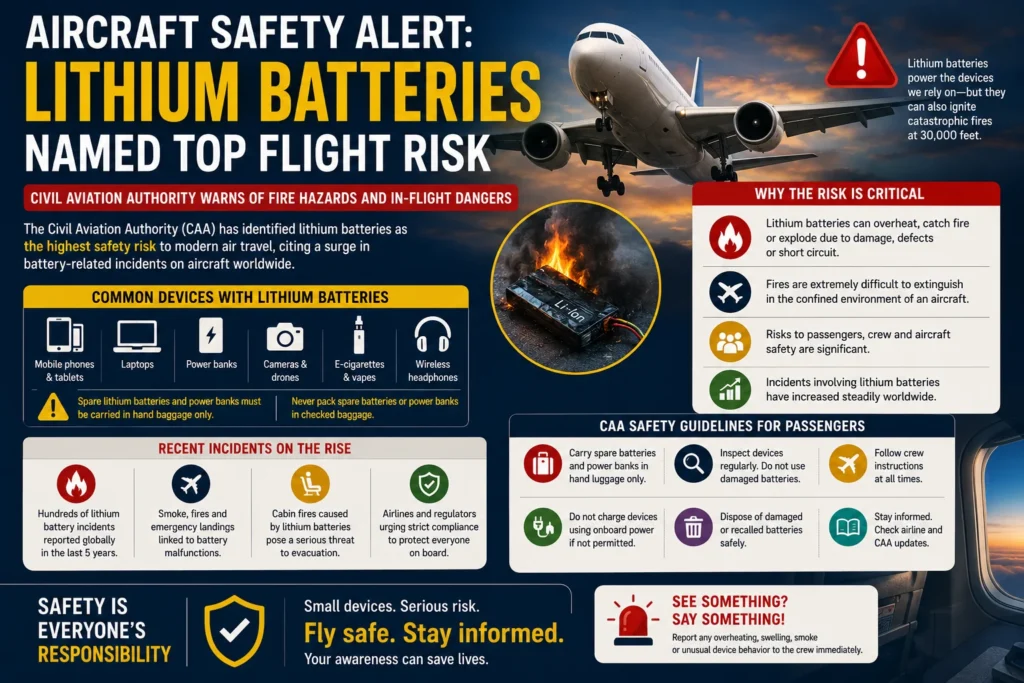
Global aviation regulators and airport authorities have enacted an emergency consumer awareness campaign ahead of the peak summer travel season. According to official safety circulars published by the UK Civil Aviation Authority (CAA), the improper packing of portable electronic devices has emerged as the leading threat to commercial flight safety. Regulators are issuing a firm airline safety warning to international tourists regarding the transportation of lithium-ion batteries, which power everyday travel accessories such as vapes, smartphones, laptops, smartwatches, and portable power banks.
Aviation data compiled by federal transport registries reveals that lithium-ion battery incidents have escalated significantly over the past fiscal year. The CAA verified that reports of malfunctioning or overheating passenger electronics nearly doubled between 2024 and 2025, tracking a 98 percent year-on-year surge. Furthermore, instances of passengers inadvertently placing these reactive power cells inside checked hold luggage spiked by 91 percent during the same statistical period, establishing this logistical issue as the primary active hazard to contemporary commercial air transport.
The Mechanics of Thermal Runaway in Aircraft Holds
The core hazard prompting the revised airline baggage restrictions involves a dangerous chemical process known as thermal runaway. Civil aviation engineers explain that lithium-ion batteries compress an extraordinary amount of electrical energy into a compact structural footprint. If a battery is physically compromised, contains a manufacturing defect, or experiences an internal short circuit, it can overheat rapidly. This thermal spike can trigger an uncontrollable self-sustaining fire that discharges toxic gasses and extreme heat within seconds.
While aircraft cabins are actively monitored by flight crews equipped with specialized containment gear, a battery fire originating inside an isolated cargo hold presents a much more complex operational challenge. If an unmonitored electronic device undergoes thermal runaway inside a checked suitcase, the resulting fire can compromise adjacent luggage before automated suppression systems can fully smother the chemical reaction. To illustrate the immediate severity of these events, aviation registries pointed to recent international incidents, including an onboard fire that erupted within an overhead storage compartment during a commercial flight last October, which required immediate emergency intervention.
Statistical Flight Risks and Passenger Disclosures
Comprehensive data updates from state aviation boards reveal that thermal anomalies involving passenger electronics are no longer rare exceptions. Regulatory logs confirm that approximately two lithium battery incidents are currently reported each week on domestic and international flights.
| Operational Metric | 2024 Logged Incidents | 2025 Logged Incidents | Year-on-Year Statistical Increase |
| Checked Bags Containing Prohibited Batteries | 316 reports | 643 reports | 103.4% volume expansion |
| Overheating / Malfunctioning Cabin Devices | 123 incidents | 206 incidents | 67.4% frequency growth |
| Overall Passenger Awareness Deficit | — | — | 36% of travelers uneducated on risk |
| Average Device Load Per Passenger | — | — | 4 lithium-powered items per traveler |
Despite the documented uptick in risk frequencies, public awareness regarding luggage compliance remains surprisingly low. Official consumer behavioral studies conducted by aviation boards reveal that 36 percent of surveyed flyers remain entirely unaware of the safety regulations governing checked baggage. This gap in public knowledge is highly problematic given modern travel habits: statistical records show that 92 percent of flyers travel with a smartphone, 55 percent carry a personal laptop, and 49 percent utilize a portable power bank. With the average consumer carrying four lithium-powered items, a single high-capacity widebody aircraft like an Airbus A380 can easily transport over 2,000 lithium batteries simultaneously.
Official Directives for the Summer Travel Rush
To lower the risk of luggage-related delays and potential structural emergencies, the CAA—in direct alignment with major international airlines and premier transit hubs like London Heathrow Airport—has formalized clear, mandatory packing protocols under the global campaign slogan, “Pack Right for a Safe Flight.”
Keep Personal Vaporizers in the Cabin: All e-cigarettes, vapes, and associated personal vaporizers must be packed exclusively within hand luggage or carried directly on your person. These devices are entirely banned from checked hold luggage.
Strict Power Bank Limitations: Portable power banks must remain in the passenger cabin at all times. Passengers are strictly restricted to a maximum of two power banks per person, and these units must never be connected to a charging source while onboard the aircraft.
Deactivate Laptops Completely: If a passenger must place a laptop or large electronic tablet within checked baggage, the device must be powered down entirely. Placing a device in “sleep” or “standby” mode is prohibited, as the item could inadvertently activate and generate trapped heat inside a suitcase.
Inspect Third-Party Electronics: Product safety organizations advise travelers to inspect their electronic accessories before flying. Substandard or uncertified batteries purchased through unverified third-party sellers are statistically far more prone to mechanical failure and spontaneous combustion.
Coordinated Enforcement by Hubs and Operators
Aviation executives and safety directors emphasize that keeping commercial aviation safe requires active cooperation from passengers before they arrive at the departure gate. Transport oversight bodies note that failing to adhere to packing rules can result in security personnel removing bags from the loading line, which frequently leads to missed flights, luggage delivery delays, and costly gate adjustments.
As airports prepare for record-breaking passenger traffic through the summer months, major international carriers are updating their check-in apps and digital ticketing portals to display these battery rules clearly. By standardizing safety messages and encouraging passengers to review cargo regulations early, international transport ministries aim to reduce transit friction, safeguard airline personnel, and protect global passengers throughout the busy summer travel season.
For more travel news like this, keep reading Global Travel Wire