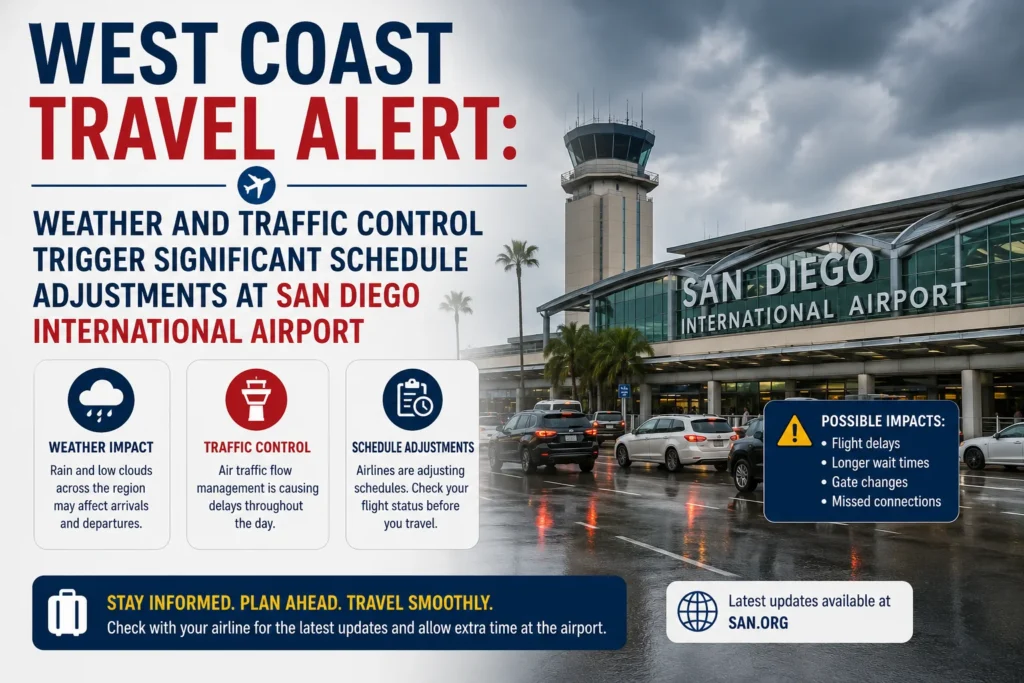
Coastal weather patterns paired with strict regional air traffic control restrictions have led to unexpected scheduling modifications at San Diego International Airport. According to official flight data logs from the major Southern California transport hub, the facility processed 68 flight delays and 3 cancellations. The operational bottlenecks impacted thousands of travelers across critical domestic corridors along the Pacific Coast and high-profile international transatlantic routes.
Aviation tracking metrics from the airport authority indicate that a dense marine layer and localized coastal fog heavily reduced visibility during peak morning arrival windows. To maintain strict safety parameters, the Federal Aviation Administration implemented increased spacing requirements between aircraft, reducing the airport’s standard hourly landing capacity and creating consecutive delays that rippled across multiple airline networks throughout the day.
Regional and Major Carriers Manage Varying Operational Impacts
The operational burden fell unevenly across the airlines utilizing the terminal facilities. Regional operator Horizon Air, running flights under the Alaska Horizon banner, recorded all three of the afternoon’s flight cancellations, which effectively removed five percent of its active daily schedule out of San Diego. Regional airlines frequently navigate tighter airport turnaround windows, making their tightly linked regional schedules highly susceptible to sudden air traffic flow adjustments.
Due to its extensive operational footprint at the airport, Southwest Airlines experienced the highest volume of total delays. The carrier logged 29 delayed departures from Terminal 1, representing roughly 15 percent of its scheduled daily operations in San Diego. The accumulation of late-arriving aircraft placed temporary strain on local gate availability and disrupted the flow of connecting passengers attempting to transition between domestic flights.
Legacy and international carriers also reported localized disruptions. British Airways navigated challenges on its limited long-haul schedule, with two delayed flights resulting in an altered schedule for half of its transatlantic passengers bound for London Heathrow. Mainline carriers United Airlines and American Airlines each adjusted five flight times, affecting eight percent of their respective schedules. Delta Air Lines experienced six delays, impacting 12 percent of its planned daily flights, while regional provider SkyWest Airlines registered six delays, representing seven percent of its regional operations.
Major Inbound and Outbound Corridors Face Logistical Constraints
Official arrival logs confirm that the three cancellations at San Diego International Airport originated entirely from West Coast regional airports: Oakland International, Roberts Field Redmond Municipal in Oregon, and Santa Barbara Municipal. Inbound flights from several cities experienced complete delay patterns due to incoming air traffic congestion. Beyond the long-haul service from London Heathrow, single daily incoming flights from John Glenn Columbus International, Missoula Montana, and Eppley Airfield in Omaha all touched down behind schedule.
Notable inbound delay clusters included four flights arriving from Harry Reid International in Las Vegas and three arriving from Salt Lake City International, alongside dual-delay patterns stemming from major national transit hubs like Denver International, Dallas-Fort Worth, and San Francisco International.
For outbound tourists and business travelers, routes heading up the Pacific Coast encountered the most severe logistical bottlenecks. San Francisco International Airport served as the primary point of distress, absorbing seven delayed flights from San Diego, which compromised 41 percent of that specific regional route. Portland International Airport experienced a higher percentage-based disruption, with three delayed departures representing 60 percent of its planned scheduled service out of San Diego. Outbound routes to San Jose logged three delays, while Sacramento and Seattle-Tacoma International each recorded two delayed departures.
Recommended Consumer Protection Steps for Disrupted Passengers
Under established federal aviation consumer protection guidelines, passengers caught in unexpected schedule adjustments are encouraged to take proactive measures to manage their travel plans. Aviation officials suggest utilizing mobile airline applications rather than joining physical queues at airport customer service desks, as digital platforms typically process automated rebookings and real-time gate changes with greater efficiency.
According to Department of Transportation regulations, passengers affected by the Horizon Air cancellations are legally entitled to a full refund of their ticket price if they choose to cancel their travel plans entirely rather than accept a rebooking on the next available flight. For travelers facing extended delays that require an unexpected overnight stay, transport authorities recommend consulting directly with gate agents to verify if the delay falls within the airline’s operational control, which can trigger eligibility for corporate meal vouchers and hotel accommodations.
As regional airport operators work closely with federal controllers to clear the remaining backlog, standard operations are projected to stabilize as coastal weather clearing patterns emerge. The recent San Diego flight disruptions highlight the intricate relationship between regional microclimates and the broader national airspace network, emphasizing the continuous need for coordination between weather forecasters, air traffic managers, and commercial airlines.
For more travel news like this, keep reading Global Travel Wire