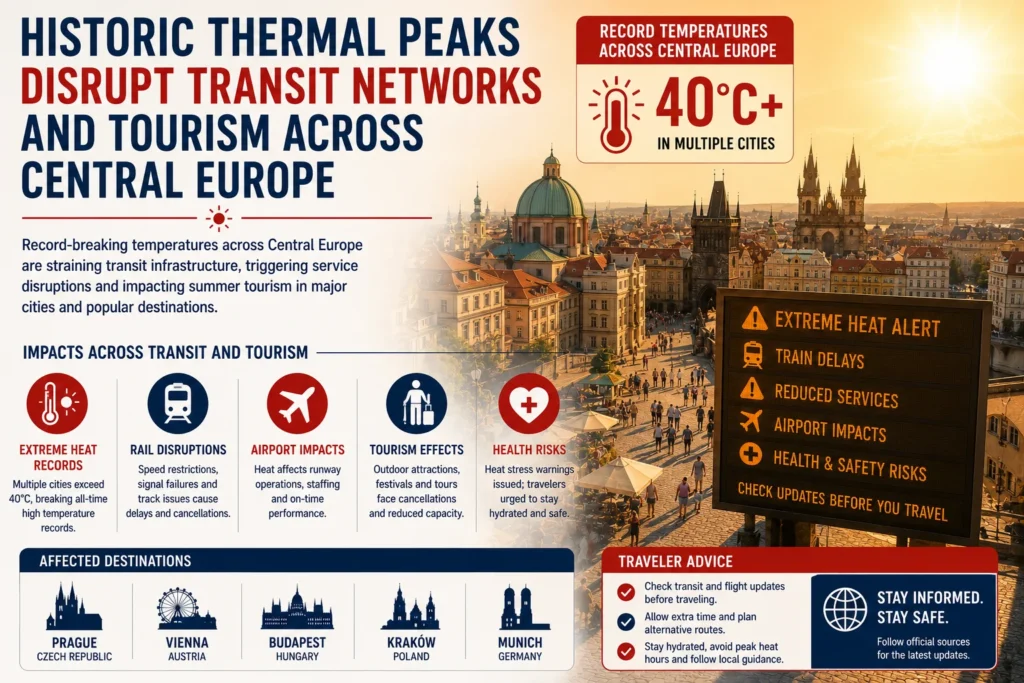
A severe and unprecedented climate system is actively reshaping summer tourism as a historic Central Europe heatwave moves across the continent. National meteorological agencies in Switzerland, Denmark, and the Czech Republic have confirmed consecutive, record-breaking temperature peaks. The extreme atmospheric pressure has introduced significant operational hurdles for regional transportation networks, triggered widespread rail delays, and prompted ministries to issue urgent holiday safety warnings for international visitors.
As municipal temperatures rise well above traditional seasonal baselines, cross-border travel patterns are facing immediate logistical challenges. National tourism boards are collaborating with emergency management departments to broadcast real-time safety advisories, urging holidaymakers to restructure their urban sightseeing plans and minimize outdoor transit during intense peak afternoon hours.
Infrastructure and Alpine Crossings Manage Intense Thermal Expansion
The impact on infrastructure has been particularly pronounced within Switzerland, a primary gateway for international alpine excursions and trans-continental rail journeys. The Swiss Federal Office of Meteorology and Climatology confirmed that the northern city of Basel reached a record June temperature of 39.0 degrees Celsius at its Basel-Binningen monitoring station, marking an all-time high since data collection began at the facility.
The extreme heat has created localized structural stress on the nation’s highly integrated transit lines. Extreme temperatures cause steel rail tracks to expand and vulnerable overhead electrical wires to sag. To safeguard passenger safety and preserve track integrity, state rail operators have implemented mandatory speed restrictions, resulting in cascading rail delays across major domestic and cross-border corridors.
For the summer tourism sector, these adjustments require widespread adaptation. Travelers moving through urban centers and high-altitude transit hubs are adjusting their schedules to avoid walking tours and open-air heritage districts when the heat peaks. Local tourism offices report a notable shift in demand toward indoor cultural institutions, air-conditioned alpine cable cars, and water-based transit options as visitors seek relief from the intense sun.
Northern Territories Track Extreme Historical Milestones
In Northern Europe, Denmark is managing an unprecedented climate anomaly that has introduced significant logistical adjustments to a destination famous for its mild summer conditions. The Danish Meteorological Institute officially confirmed that temperatures rose to 36.6 degrees Celsius at Hans Christian Andersen Airport, located north of Odense. This landmark measurement establishes the warmest day ever recorded in the Scandinavian nation since formal observations began in 1874, breaking a long-standing absolute temperature record from 1975.
The exceptional weather pattern has altered traditional holiday activities in major hubs like Copenhagen and surrounding coastal regions. The extreme daytime heat has triggered an increase in tropical nights, where overnight temperatures fail to drop below 20 degrees Celsius.
To protect transport links, national road authorities implemented temporary weight and movement restrictions for heavy commercial vehicles to prevent damage to softened asphalt surfaces. The severe heatwave also coincided with major regional cultural gatherings, such as the opening of the Roskilde music festival. To safeguard thousands of international attendees, festival organizers and local authorities responded by rapidly deploying emergency water distribution networks and shaded cooling stations to prevent heat exhaustion.
Urban Tourism Adapts as Czech Republic Exceeds 41 Degrees
The Czech Republic has recorded some of the most intense temperature spikes in the region. The Czech Hydrometeorological Institute reported that the northern town of Doksany registered an unprecedented national June peak of 41.1 degrees Celsius. This historic milestone marks the first time an official weather station in the country has ever broken the 41-degree barrier, following a consecutive series of tropical nights and dense regional smog alerts.
In Prague, the unusual heat has transformed standard tourist behavior around iconic landmarks like the Charles Bridge and Old Town Square. Midday foot traffic in the historic core has dropped substantially, with visitors choosing to stay in air-conditioned spaces, shaded public parks, or regional swimming facilities.
To manage the extreme conditions, Prague’s public transit operators reduced tram speeds across the urban network to minimize the risk of overhead lines warping in the intense heat. Municipal utility teams have deployed water trucks to continuously spray city streets, a tactical measure designed to cool down urban concrete surfaces and manage rising ground-level ozone concentrations. Cultural operators managing historical castles and open-air monuments have adapted by encouraging early-morning visits and extending evening admission hours, shifting the destination’s tourism model toward cooler parts of the day.
A Structural Transition Toward Climate-Resilient Leisure Travel
The severe conditions generated by the Central Europe heatwave demonstrate a clear shift from temporary weather anomalies to a dynamic climate reality that international operators must incorporate into long-term planning. For the global travel industry, the traditional summer peak season is becoming a window that requires flexible, climate-aware scheduling to ensure passenger protection.
As transport ministries and infrastructure operators invest in heat-resilient track materials, shaded public zones, and upgraded cooling networks, travelers are urged to maintain flexible itineraries. Staying updated via verified meteorological channels, carrying independent water supplies, and selecting climate-controlled transit routes remain the most effective strategies for ensuring safety while navigating the changing European vacation landscape.
For more travel news like this, keep reading Global Travel Wire