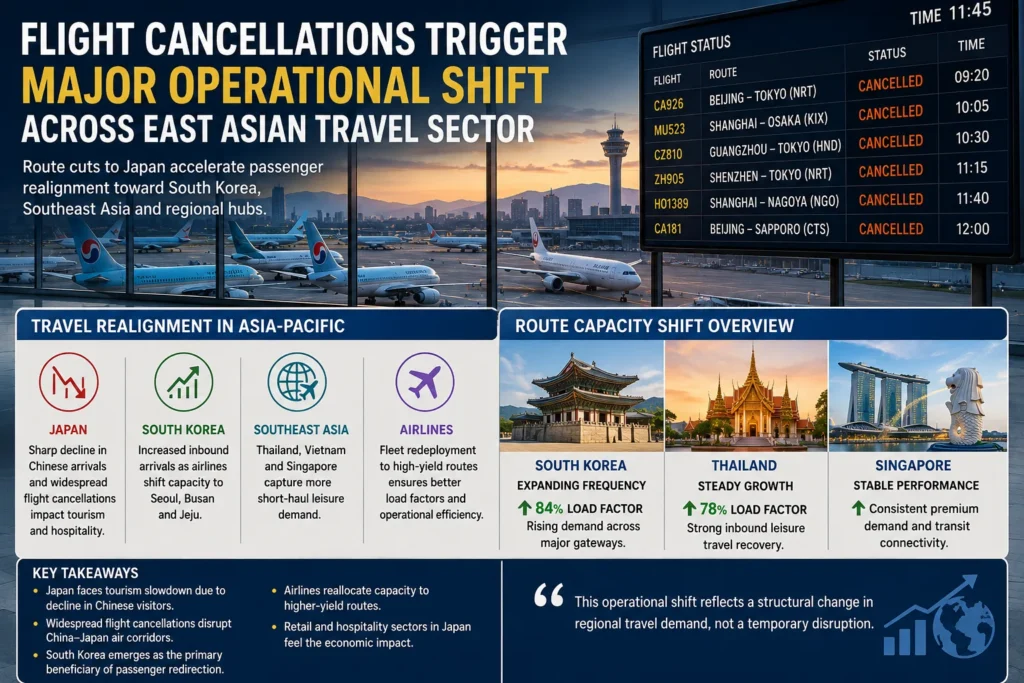
A pronounced structural realignment is unfolding across the East Asian travel sector this year, driven by a sharp contraction in outbound travel from mainland China to Japan. Official monthly immigration trackers and aviation data reveal that hundreds of scheduled flights connecting major Chinese hubs with Japanese destinations have faced prolonged suspensions or cancellations. This sudden reduction in cross-border capacity has directly reshaped passenger traffic routing, creating a ripple effect that extends well beyond the air corridors themselves.
According to official inbound metrics released by the Japan National Tourism Organization (JNTO), the drop in Chinese traveler volume has interrupted several quarters of steady, high-velocity growth. While other international source markets remain robust, the targeted reduction in passenger capacity along specific transpacific and regional corridors has forced major aviation groups to actively realign their fleet deployments.
Analyzing Shifts in the Regional Travel Realignment Matrix
As carriers minimize exposure to underperforming corridors, the broader marketplace is adjusting. Public aviation data and port authority announcements indicate that airlines are optimizing route patterns by redeploying twin-aisle, long-haul aircraft away from underperforming sectors and toward higher-yielding destinations in Southeast Asia and parts of Europe. This optimization process has transformed the functional roles of several major destinations within the regional travel realignment matrix:
China: Operating as a major outbound source market, experiencing high flight suspensions across Japan corridors while maintaining outbound volume toward alternative short-haul zones.
Japan: Serving as a primary inbound destination, the region is managing lower load factors on specific mainland routes, which in turn influences urban center infrastructure occupancy.
South Korea: Emerging as a major alternative hub, capturing redirected short-haul passenger traffic via fleet reallocations toward key international gateways.
Thailand: Holding steady as a major leisure destination, absorbing short-haul vacation packages with resilient capacity.
Singapore: Functioning as a premium transit hub, maintaining consistent passenger load factors through well-connected regional transit links.
South Korea Captures Redirected Passenger Traffic and Expands Capacity
South Korea has emerged as the primary beneficiary of these shifting regional corridors. Flight tracking statistics and arrival logs handled at Incheon International Airport confirm a steady increase in international visitor numbers. Major national flag carriers, including Korean Air and Asiana Airlines, have successfully adjusted their operational schedules to absorb the displaced passenger flows, ensuring that terminal utilization rates remain high.
Airlines have progressively upgraded aircraft sizes and launched fresh route frequencies targeting South Korean hubs like Seoul, Busan, and the resort island of Jeju. This capacity reallocation is strongly supported by flexible local entry policies and refreshed marketing campaigns aimed at capturing regional holiday demand. Government statistics indicate that by diversifying its inbound focus, South Korea is developing a highly resilient tourism framework designed to weather unilateral shifts in single-source market stability.
Evolving Flight Corridor Performance and Yield Outlooks
A closer examination of current flight corridor operational frequency reveals highly contrasting trends in profitability and aircraft load factors across the region. Regional aviation infrastructure remains stable, yet carriers are moving swiftly to adjust frequencies based on changing yields:
China to Japan Corridors: Currently undergoing scheduling cuts and frequency reductions. The average passenger load factor has hovered around 62%, placing considerable downward pressure on yield metrics for both full-service flag carriers and regional low-cost operations.
China to South Korea Corridors: Experiencing expanding operational frequency and fleet upgrades. The average passenger load factor has climbed to 84%, supported by a highly favorable yield outlook.
China to Thailand Corridors: Maintaining steady frequency levels with consistent schedule allocations, resulting in an average passenger load factor of approximately 78% and a moderate yield recovery.
Economic Adjustments and Shifting Hospitality Dynamics
The operational impact of these cancellations extends directly to ground infrastructure. Historically, Chinese independent and group travelers have represented one of the highest-spending retail demographics in metropolitan Japanese hubs. The sudden reduction in available airline seats has placed notable pressure on luxury hospitality operators and duty-free retail zones located in premium shopping districts like Ginza in Tokyo and Shinsaibashi in Osaka.
Urban hotel networks that previously relied on high-occupancy tour blocks are now adjusting their seasonal marketing strategies. Local tourism bureaus are expanding promotional campaigns to attract a wider variety of international markets, leaning heavily on the competitive value provided by current currency exchange rates.
Future Regional Outlook and Capacity Optimization
Long-term aviation projections from regional transport ministries suggest that air networks will continue to optimize their fleet capacity around Southeast Asian and South Korean corridors for the foreseeable future. Industry analysts note that point-to-point capacity between mainland China and Japan is unlikely to return to its previous baseline before next year, forcing remaining travelers on those routes to adapt to higher baseline connection costs.
In response, regional airlines are coordinating closely with slot allocation committees at major transit hubs like Incheon and Bangkok. By anchoring operations around flexible, high-demand routes, the regional aviation network is ensuring long-term operational stability while completely redefining the flow of international tourism across East Asia.
For more travel news like this, keep reading Global Travel Wire