The long-awaited revival of Coco Palms Resort on Kauai has secured $431 million in financing, marking a decisive step toward restoring one of Hawaii’s most recognisable hospitality landmarks.
The financing supports the redevelopment of the approximately 32-acre property in Wailua, where the former resort has remained closed since Hurricane Iniki caused extensive damage in 1992. The project is being advanced by Reef Capital Partners and is planned to reopen as Coco Palms, A Kimpton Resort, under IHG Hotels & Resorts’ luxury and lifestyle portfolio.
Current plans call for a reopening in 2028, bringing the historic destination back into Kauai’s tourism economy after more than three decades of uncertainty.
The capital package provides approximately 80 percent loan-to-cost financing and combines $185.6 million in conventional senior-secured debt with $245.35 million in Commercial Property Assessed Clean Energy funding.
Financing Unlocks Large-Scale Resort Construction
The funding is expected to support restoration, rebuilding and infrastructure work across the former Coco Palms site.
Plans include the reconstruction of accommodation buildings, restoration of historic elements and redevelopment of dining, retail and event spaces. The financing also supports energy-efficiency improvements intended to reduce long-term operating costs.
The project is expected to create more than 1,000 construction jobs during development and approximately 350 full-time positions once the resort begins operating.
For Kauai, the scale of the transaction strengthens the island’s hospitality investment pipeline at a time when destinations across Hawaii are placing greater emphasis on sustainable tourism, cultural responsibility and higher-value visitor experiences.
The redevelopment will also return a major underused property to active economic use, potentially increasing demand for local suppliers, transportation companies, restaurants and tourism businesses across eastern Kauai.
Historic Resort Returns Under Kimpton Brand
Coco Palms first became prominent during the expansion of Hawaii’s post-war tourism industry and developed an international reputation during Hollywood’s golden era.
The resort became especially famous after appearing in the 1961 Elvis Presley film Blue Hawaii. Its tropical setting, coconut grove, lagoon and ceremonial traditions helped establish an image of Hawaiian resort travel recognised around the world.
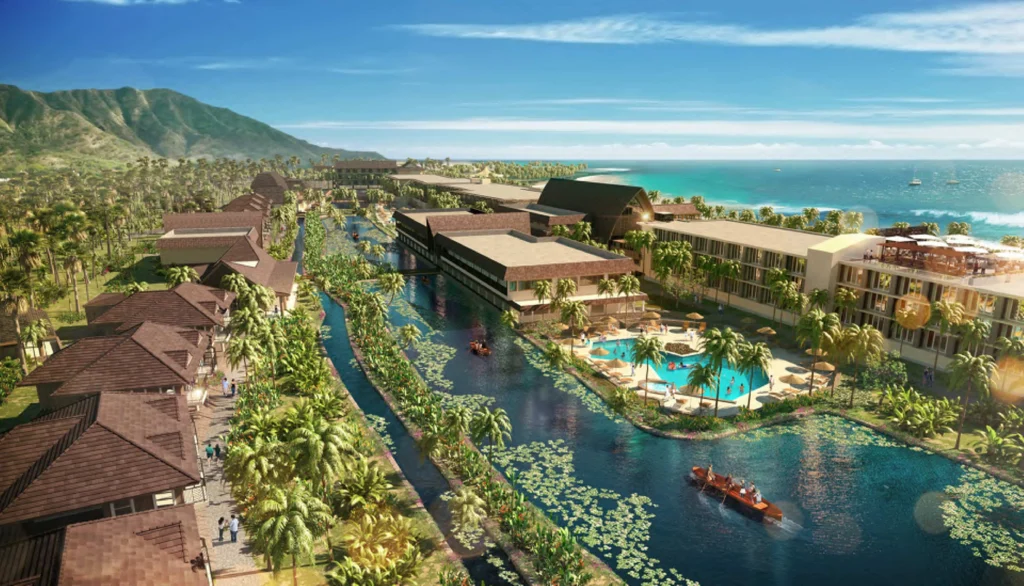
The new Kimpton property is expected to include approximately 350 accommodations across three low-rise hotel buildings and cottages.
IHG has also outlined plans for a spa, three outdoor swimming pools and multiple restaurant and bar concepts, including a rooftop venue, pool bar and restored shoreline restaurant.
A revived torch-lighting ceremony is expected to continue one of the property’s best-known traditions, while a cultural centre and museum will focus on Kauai’s history, artistic community and Native Hawaiian heritage.
Heritage Protection Shapes the Restoration
Coco Palms is listed on both the National Register of Historic Places and the Hawaii Register of Historic Places.
Its designation reflects the resort’s importance to tourism architecture, entertainment history and the development of mid-century Hawaiian hospitality. The site retains its historic location, landscape setting and cultural associations despite decades of deterioration.
The redevelopment must therefore balance modern hotel requirements with the protection of significant structures, landscape elements and archaeological resources.
Reef Capital Partners has stated that Native Hawaiian advisors are helping guide the restoration process. This consultation is intended to create a culturally respectful visitor experience while recognising Wailua’s importance in Kauai’s pre-contact and early post-contact history.
The wider district contains sacred and historically important places, making cultural stewardship central to the project rather than an optional design element.
Wailua Location Adds Strong Tourism Value
The property occupies a prominent position in Wailua on Kauai’s eastern shoreline, an area commonly known as the Coconut Coast.
The destination is accessible through Lihue Airport, Kauai’s principal aviation gateway, which connects the island with Honolulu and major mainland United States markets.
Nearby attractions include the Wailua River, Fern Grotto, Opaekaʻa Falls and state-managed cultural landscapes. The region’s combination of beaches, tropical scenery, outdoor recreation and Hawaiian heritage makes it one of Kauai’s most important visitor areas.
The resort’s reopening could increase luxury accommodation capacity on the island while encouraging visitors to explore cultural and natural attractions beyond the hotel itself.
However, the project will continue to draw attention because of concerns surrounding traffic, flooding, environmental conditions and development near culturally sensitive lands.
Sustainability Becomes Part of the Investment Strategy
The financing structure places energy performance and environmental improvements at the centre of the redevelopment.
C-PACE funding is designed to support efficient building systems and long-term sustainability measures. The development team estimates that the resort’s energy-efficiency design could generate more than $11 million in savings over the life of the improvements.
This approach reflects a broader shift in hospitality investment, where major hotel projects increasingly combine luxury positioning with lower energy use, resilient infrastructure and stronger environmental performance.
For Hawaii, such measures are particularly important because island hotels face high energy costs and must operate within sensitive coastal ecosystems.
Coco Palms Enters a New Tourism Era
The $431 million financing milestone gives the Coco Palms redevelopment the financial structure needed to move deeper into construction.
Its return under the Kimpton brand could restore an internationally recognised name while adding a new cultural and luxury tourism product to Kauai.
The project’s success will depend on whether development, cultural preservation and community impact can remain balanced throughout the rebuilding process.
After decades of stalled plans, Coco Palms is now positioned to begin a new chapter as a restored heritage resort, major employer and flagship investment in Hawaii’s evolving luxury hospitality market.
For more travel news like this, keep reading Global Travel Wire