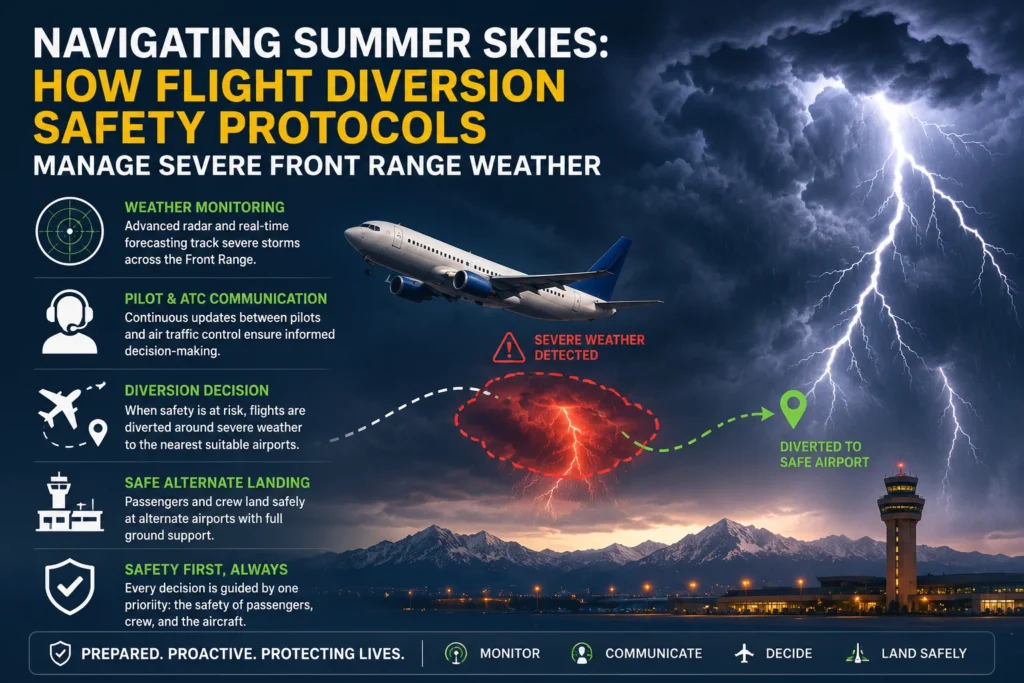
A United Airlines flight operating between Montana and Colorado successfully executed an unscheduled rerouting, highlighting the critical nature of flight diversion safety protocols within modern commercial aviation. The flight, operating as United Airlines flight UAL2027, was utilizing an Airbus A319-131 airframe to transport travelers from Great Falls International Airport to Denver International Airport. While descending toward the Colorado Front Range, the aircraft encountered a rapidly developing line of severe summer convective weather systems, prompting a swift tactical change by the flight crew and regional air traffic control networks.
The high-altitude plains near Denver are historically susceptible to sudden, volatile atmospheric shifts during the peak summer tourism season. In this instance, an active storm front brought intense lightning, turbulence, and dangerous wind shear directly over the active arrival runways at Denver International Airport. As atmospheric conditions deteriorated, regional air traffic controllers instructed multiple commercial airframes to enter standard holding patterns in an effort to wait out the storm cells. However, prolonged holding patterns can quickly alter the operational margins of an aircraft, leading the flight crew to enact a pre-planned alternate routing strategy rather than risking an extended delay in unstable skies.
Selecting the Ideal Alternate Aviation Hub
When unpredictable meteorological events temporarily close an airport airspace, flight decks work directly with corporate dispatch networks to evaluate surrounding airfields. For flight UAL2027, Salt Lake City International Airport was selected as the optimal diversion hub. The choice was driven by favorable localized weather trends across Utah and the substantial runway capacity available at the facility, which easily accommodates mainline commercial twin-engine aircraft.
The Airbus A319-131 transitioned smoothly out of the turbulent Front Range airspace and initiated a stable descent into Utah, landing without further operational incident. Upon arrival on the main runway, ground handling teams and airport operations staff immediately met the aircraft to execute routine safety inspections and facilitate refueling. Passengers onboard experienced an unexpected pause in their travel itineraries while the ground dispatch teams monitored the movement of the thunderstorm cells over Colorado. The aircraft remained safely parked at the gate until clear, compliant routing pathways opened up, allowing the flight to safely resume its journey toward the original Rocky Mountain destination.
Advanced Technological Warning Systems and Risk Mitigation
The decision to completely bypass the landing approach at Denver International Airport was heavily informed by automated ground-based and airborne safety systems. Specifically, the low-level windshear alert system at Denver triggered a critical macroburst warning. In meteorological and aviation terms, a macroburst represents a large, violent column of sinking air that spreads outward destructively upon hitting the ground, creating extreme wind shifts that can rapidly destabilize an aircraft during low-speed landing phases.
Attempting to push through an active macroburst field presents severe challenges to aircraft controllability. To navigate away from the hazard, the flight crew utilized onboard multi-scan radar systems to pinpoint the precise boundaries of the convective cells. By leveraging real-time cockpit avionics, the crew mapped a safe flight path out of the turbulent zone, effectively eliminating the risk of a low-fuel emergency that can occur when aircraft are trapped in extended holding patterns near severe weather.
Precautionary Fuel Window Protocols in Commercial Travel
Aviation safety mandates require all commercial operations to carry rigid fuel reserves. These reserves must be sufficient to allow an aircraft to approach its primary destination, execute an aborted landing, fly to a designated alternate airfield, and hold for a specified period. Throughout any domestic or international flight, pilots continuously monitor these fuel margins against live flight data.
Remaining inside a holding pattern adjacent to active thunderstorm cells depletes these reserve windows. Executing an early, decisive diversion ensures that an aircraft enters the alternate airfield’s traffic pattern with optimal fuel buffers intact. For major carriers, prioritizing traveler protection over schedule recovery remains the standard operational mandate during volatile summer weather cycles. Rerouting an aircraft under these conditions represents a well-executed, standard safety buffer rather than an airborne emergency.
Widespread Impacts of Convective Weather Patterns
The shifting atmospheric dynamics on this date influenced multiple routes across the domestic aviation network, demonstrating how localized storms cause cascading delays. For example, another United Airlines flight, operating a Boeing 737-800 from Denver to Philadelphia, faced similar airspace constraints. That flight was forced to reroute to Richmond International Airport due to high traffic volumes and arrival challenges aggravated by the severe weather moving across the Eastern United States.
Managing the logistics of unexpected passenger traffic during regional weather delays requires immense coordination between municipal airports, regional air traffic control centers, and airline hub operations. Alternate airports must dynamically allocate gates, baggage handlers, and fueling resources to prevent terminal gridlock when multiple flights divert simultaneously. As seasonal climate patterns continue to show increased volatility, the aviation and tourism industries remain focused on expanding runway capacity at key diversion hubs and upgrading predictive meteorological tools to maintain seamless, secure skies for global travelers.
For more travel news like this, keep reading Global Travel Wire