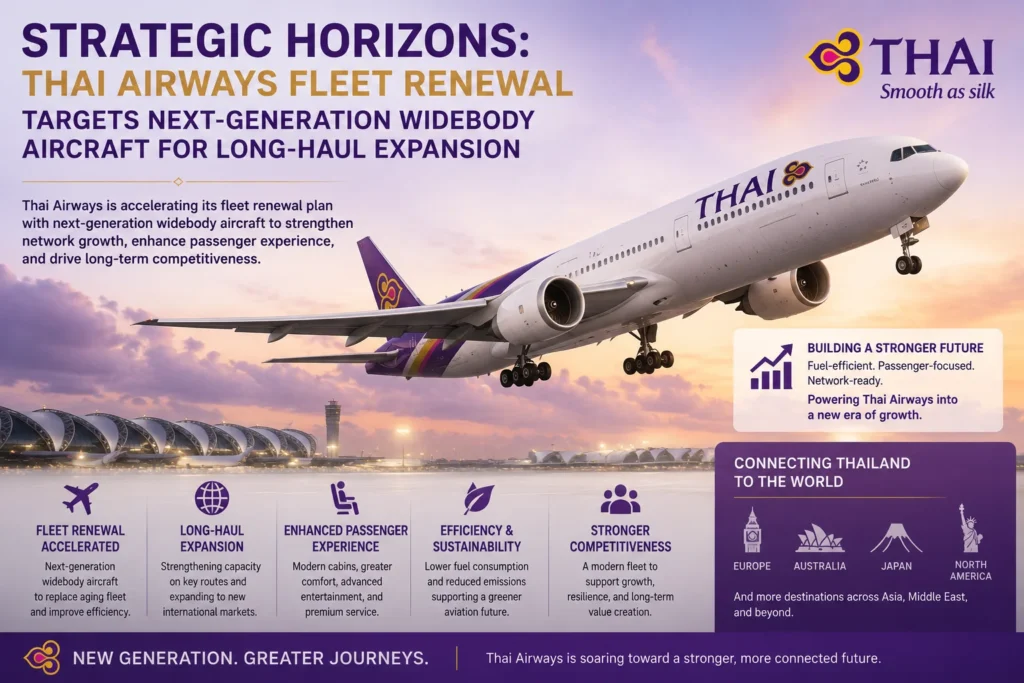
The structural modernization of Southeast Asia’s aviation infrastructure is advancing rapidly as Thailand’s national carrier initiates a major long-term strategy to overhaul its intercontinental network. Thai Airways is actively executing an expansive review of its long-haul widebody capabilities, evaluating advanced options including the Boeing 777X and the Airbus A350-1000. This multi-billion dollar procurement initiative is designed to phase out aging aircraft variants, dramatically lower carbon emissions, and expand international passenger capacity directly from the country’s primary gateway at Suvarnabhumi Airport in Bangkok.
According to official corporate updates and state-backed development blueprints, the flag carrier expects to finalize its choice of next-generation aircraft types within the next twelve to twenty-four months. The strategic plan positions initial aircraft deliveries to commence in 2036, establishing a continuous twenty-year operational roadmap. This extended planning horizon is closely coordinated with Thailand’s national tourism objectives, ensuring that the country’s primary air transport provider possesses the long-range capacity needed to support growing passenger volumes over the coming decades.
Bolstering the Bangkok Aviation Hub through Modernization
The central objective behind this rigorous fleet assessment is the systemic replacement of older, less efficient widebody jets currently handling high-demand long-distance paths. As older airframes incur mounting maintenance overheads and elevated fuel burn metrics, transitioning to contemporary aerospace architecture has become a operational necessity. By focusing on next-generation dual-engine widebody technology, the carrier aims to optimize its operating cost per seat while significantly lowering its overall environmental footprint.
The selection process concentrates heavily on balancing route profitability with maximum range capabilities. Integrating state-of-the-art long-haul aircraft allows the airline to realign its international route map, creating opportunities to reinstate direct, non-stop connections between Bangkok and major economic and leisure markets across North America and Europe that were previously deemed financially unviable. This expansion aligns seamlessly with the Ministry of Transport’s broader vision to reclaim and expand Bangkok’s market share as a premier transit gateway linking Europe, Oceania, and Asia.
Evaluating the Engineering Merits of Next-Generation Competitors
The selection process presents two distinct technological pathways for long-term network growth, with each aerospace manufacturer offering specific advantages tailored to high-density passenger operations.
The Boeing 777X program leverages advanced aerodynamics, including high-efficiency composite wings and the latest generation of turbofan propulsion technology. This model is engineered to deliver exceptional payload capacity and favorable operating economics over ultra-long distances. For an airline that has historically anchored its long-haul network on the twin-engine Boeing 777 family, this option ensures a high degree of operational continuity, simplifying future flight crew transitions and utilizing existing ground support equipment at Suvarnabhumi Airport.
Conversely, the standard Airbus A350-1000 variant stands out due to its advanced structural composition, utilizing lightweight carbon-fiber reinforced polymers to reduce empty weight and maximize fuel efficiency. This model features highly advanced cabin pressurization and humidity control systems designed to minimize passenger jetlag and fatigue during extended intercontinental travel. Official statements from airline leadership have explicitly excluded the specialized ultra-long-range variant of the A350-1000 from the evaluation matrix, citing that the excessive per-seat weight and operating costs of that specific modification do not align with the carrier’s primary high-capacity commercial requirements.
The ultimate determination will rest on an extensive, multi-variable cost-benefit analysis, focusing on elements such as:
Total lifecycle cost of ownership across a twenty-year operational window.
Full compatibility with existing hangar and maintenance infrastructure in Bangkok.
Specific payload-range efficiencies across key commercial corridors.
Adaptability to seasonal fluctuations in international leisure travel demand.
Synergy with Financial Transformation and Fleet Stability
This long-term widebody evaluation is deeply integrated into the airline’s ongoing post-restructuring growth strategy. Following a period of successful financial stabilization and asset rationalization, the carrier is transitioning away from capital preservation toward aggressive network development. Modernizing the fleet acts as a defensive shield against volatile global fuel prices, which represent one of the highest variable costs in commercial aviation.
The long-term widebody program is running parallel to intermediate fleet upgrades already taking place on the ground. The carrier recently celebrated a major milestone by taking delivery of its first factory-new, lessor-financed Boeing 787-9 aircraft equipped with advanced propulsion systems. This separate, near-term delivery stream serves as an operational bridge, providing immediate capacity adjustments and fuel savings while the broader, decade-long decision regarding the larger 777X and A350-1000 airframes is thoroughly finalized.
Transforming the International Passenger Experience
By targeting advanced airframes for deployment by 2036, the airline is proactively addressing the changing expectations of global leisure and business travelers. Modern international tourists increasingly base their booking decisions on environmental sustainability, cabin noise reduction, and advanced in-flight connectivity options. Both the 777X and the A350-1000 incorporate these elements natively, offering spacious cabin architectures, larger windows, and lower cabin altitude pressures that collectively elevate the long-haul transit experience.
This commitment to premium fleet standards directly enhances Thailand’s competitiveness against other regional aviation giants. As global airline networks expand their ultra-long-haul footprints, having a modern, highly efficient flag carrier ensures that the kingdom remains a top-tier destination for high-value international tourism, supporting thousands of hospitality and travel sector jobs nationwide.
For more travel news like this, keep reading Global Travel Wire