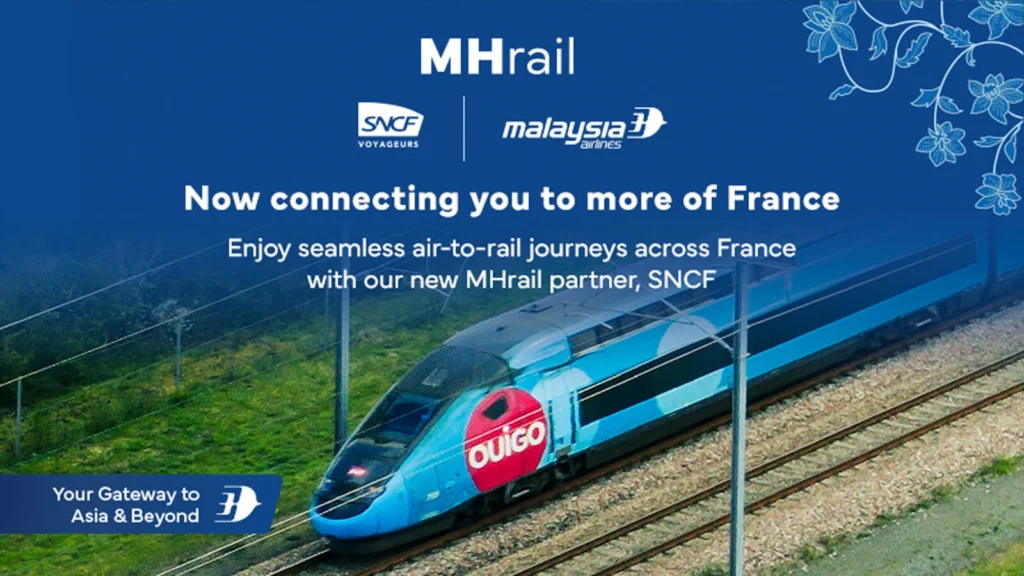
Malaysia Airlines has expanded its European tourism network through a new partnership with SNCF Voyageurs, enabling international passengers to combine flights and high-speed rail journeys across France within a single itinerary.
Introduced under SNCF Voyageurs’ TRAIN + AIR programme, the collaboration connects Paris Charles de Gaulle Airport with 28 railway destinations across France. Tickets became available through Malaysia Airlines’ booking platform from 10 July 2026, giving travellers a simpler way to reach regional cities after arriving in Paris.
The development places Malaysia Airlines alongside international carriers including Air France, Lufthansa and KLM that have integrated rail services into their wider transport networks. It also reflects an important aviation shift in which airlines are extending connectivity beyond airports instead of relying entirely on additional short-haul flights.
For European tourism, this model can make regional destinations more accessible, distribute visitors beyond major gateway cities and support local hotels, attractions, restaurants and transport businesses.
Twenty-Eight French Destinations Join One Itinerary
Malaysia Airlines passengers travelling through Paris Charles de Gaulle can now continue to destinations including Lyon, Strasbourg, Lille, Rennes and Marseille using SNCF’s high-speed railway network.
Previously, travellers reaching Paris often needed to arrange separate railway bookings, manage different tickets and take responsibility for coordinating connection times. The new arrangement brings the air and rail sectors together under one reservation.
Malaysia Airlines places its marketing code on participating SNCF services through AccesRail’s “9B” airline-designator code. Consequently, eligible train journeys can appear alongside flights during the booking process.
The system expands Malaysia Airlines’ practical French network without requiring the carrier to operate domestic flights or deploy additional aircraft. It also gives travellers from Malaysia and connecting Asian markets easier access to commercial, cultural and leisure destinations throughout France.
Regional France Gains Stronger Tourism Access
The partnership could help international visitor spending move beyond Paris, which remains France’s primary aviation gateway and one of the world’s leading urban tourism destinations.
Lyon offers gastronomy, heritage and business travel experiences, while Strasbourg provides access to the Alsace region and cross-border European itineraries. Marseille connects visitors with Mediterranean tourism, and Rennes acts as a gateway to Brittany.
Lille also benefits from its location close to Belgium and major northern European transport corridors.
By making these cities available through an integrated itinerary, Malaysia Airlines and SNCF Voyageurs can encourage longer stays and multi-destination holidays. Regional hotels, tour operators, cultural sites and hospitality businesses may benefit as international passengers find it easier to travel beyond the French capital.
Malaysia Airlines Builds on MHrail Strategy
The SNCF agreement supports Malaysia Airlines’ broader MHrail initiative, which integrates airline journeys with railway services at selected international gateways.
Malaysia Aviation Group’s airline leadership described the French partnership as another step towards seamless end-to-end connectivity. Extending the network beyond Paris allows the carrier to offer broader destination coverage while retaining a coordinated customer journey.
The airline has already developed intermodal connectivity through other gateways, including London and Seoul. France now becomes an important addition because of its extensive high-speed railway infrastructure and its position as a leading global tourism market.
Instead of viewing the airport as the final destination, Malaysia Airlines is increasingly positioning it as one part of a wider journey connecting travellers directly with cities and tourism regions.
Air France and KLM Advance Integrated Travel
Air France and SNCF Voyageurs have operated combined air-and-rail services for more than three decades. Their Train + Air programme allows passengers to reserve eligible flights and domestic railway connections together.
The partnership has expanded across numerous French routes and now includes selected TGV INOUI and OUIGO services. Passengers can receive coordinated assistance and rebooking support when eligible disruptions affect their connections.
KLM has adopted a similar approach through Air&Rail services linking Amsterdam Schiphol with Brussels and Antwerp using Eurostar trains.
These connections provide an alternative to short regional flights while integrating Belgium with KLM’s international network through Amsterdam.
Lufthansa Strengthens Germany’s Air-Rail Network
Lufthansa has also established a major intermodal system with Deutsche Bahn.
Through Lufthansa Express Rail, passengers can travel between Frankfurt Airport and numerous German railway stations using coordinated train and flight bookings. Rail schedules are designed to connect with international departures, while transfer protection supports passengers when disruptions occur.
The separate Rail&Fly programme gives eligible airline customers access to thousands of Deutsche Bahn stations throughout Germany.
Other carriers have adopted comparable arrangements in Germany, demonstrating how rail networks can extend an airline’s reach without requiring additional domestic aviation capacity.
SWISS and Austrian Airlines also integrate international flights with railway services in Switzerland and Austria, where strong public transport infrastructure supports convenient airport connections.
Travellers Gain Simpler European Journeys
The central benefit for passengers is convenience. One itinerary can reduce the complexity of purchasing separate tickets, comparing schedules and coordinating independent reservations.
Air-rail integration can also offer more travel options when major airports are far from a passenger’s final destination. High-speed trains frequently arrive in central urban locations, reducing the need for lengthy road transfers from regional airports.
However, travellers must still review baggage and check-in conditions carefully. On many combined journeys, passengers remain responsible for carrying their luggage between the train and airport facilities.
Air-Rail Partnerships Reshape Tourism Growth
Airlines are increasingly recognising rail operators as strategic partners rather than competitors.
Integrated transport allows carriers to extend their destination maps while conserving aircraft capacity for routes where aviation remains essential. Meanwhile, railway companies gain access to international passengers arriving through global airline networks.
Malaysia Airlines’ agreement with SNCF Voyageurs therefore represents more than a booking enhancement. It strengthens access between Asia and regional France while reinforcing a wider transformation in European mobility.
As Air France, KLM, Lufthansa and other carriers continue developing similar services, air-rail travel is moving closer to becoming a standard part of international tourism. For travellers, the result is a more connected journey in which the destination network continues far beyond the airport terminal.
For more travel news like this, keep reading Global Travel Wire