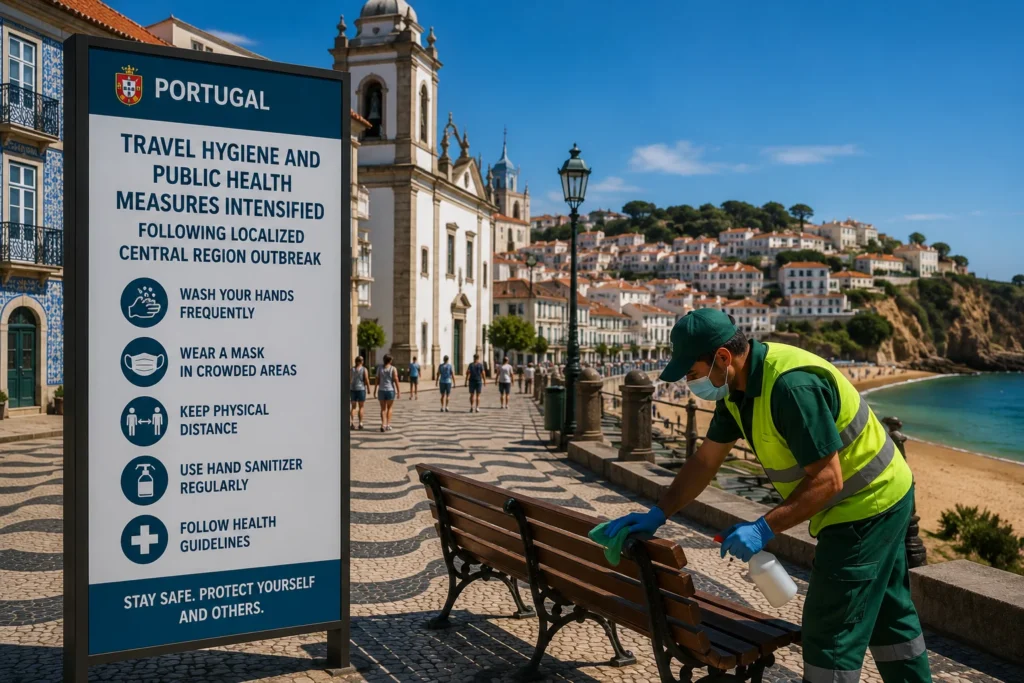
Public health officials and municipal authorities in Portugal have significantly scaled up regional sanitation and wellness protocols to safeguard visitors during the active summer travel period. This defensive optimization follows a localized Genogroup II norovirus cluster centered in the central municipalities of Caldas da Rainha and Óbidos. While major entry points and international transport infrastructures continue to operate at standard capacity, the systematic response underscores the nation’s rigid commitment to structural travel hygiene.
Official medical declarations confirm that the temporary gastrointestinal spike has stabilized, totaling 122 documented cases within the affected central zone. Comprehensive diagnostic reviews executed by the Doutor Ricardo Jorge National Institute of Health verified the specific presence of Genogroup II norovirus from localized biological samplings. The cluster primarily impacted a specific population segment, with approximately 80 infections identified among young athletes, coaching personnel, and accompanying family members participating in an international youth football tournament organized between late June and early July.
Strategic Inspections and Transmission Investigations
Following initial emergency clinical presentations at the Caldas da Rainha Hospital, where individuals sought standard care for acute gastrointestinal discomfort, the national Authority for Food and Economic Safety (ASAE) initiated proactive corporate audits. Food safety inspectors and regional health directorates conducted immediate structural evaluations of the regional businesses, catering infrastructure, and specialized food delivery providers contracted for the local sporting events.
Formal reports published by ASAE confirmed that strict environmental and food sample testing revealed zero systemic irregularities or physical contamination within the designated culinary facilities. Furthermore, municipal technical teams completely ruled out the regional public water supply and the nearby Óbidos Lagoon as potential environmental sources of the contamination. Public health teams have concluded that the localized spread occurred through close physical proximity and person-to-person transmission within communal athletic housing, a common phenomenon in high-density youth gatherings during summer weather cycles.
Maintaining Tourism Infrastructure Continuity and Economic Safety
Rather than imposing broad restrictions or causing disruption to the tourist economy, the incident has driven a rapid deployment of preventive medical protocols. The Local Health Unit of Oeste (ULS Oeste) confirmed that all affected individuals experienced standard, highly favorable clinical progressions, requiring no prolonged hospitalizations or emergency interventions. The rapid containment framework has allowed major national transit centers and resort networks to function flawlessly.
Primary tourist regions, including Lisbon, Porto, the Algarve coast, Madeira, and the Azores islands, report regular operating schedules with zero travel limitations. The national tourism board has emphasized that ensuring robust public safety is a key component of modern sustainable tourism. By implementing rigid inspection parameters, the state preserves the international appeal of its historic municipalities while insulating the broader hospitality sector from localized community health strains.
Municipal Health Frameworks and Event Planning Upgrades
In direct response to the central region case study, Portuguese regional administrations are integrating advanced health monitoring structures into all planned summer cultural, sporting, and musical festivals. Municipalities are working in tandem with local health clusters to mandate dedicated environmental sanitation teams for large gatherings, ensuring that high-contact surfaces in shared venues are systematically treated with medical-grade disinfectants.
These regulatory steps are designed to reinforce consumer confidence as the country manages exceptionally high international travel volumes. Official statistics from the national tourism authority indicate that Portugal continues to perform as a premier European destination, welcoming more than 30 million international arrivals annually from core source markets, including the United Kingdom, Spain, Germany, France, and the United States. Integrating high-visibility hygiene enforcement ensures that the substantial economic contributions of summer tourism continue to directly support heritage conservation and local community development safely.
Essential Practical Advice for International Summer Visitors
For international travelers navigating historic destinations or participating in group excursions across the country this summer, observing simple, verified personal hygiene measures remains the most reliable method to eliminate the risk of transient illness:
Rigorous Hand Hygiene: Prioritize thorough handwashing with soap and running water for at least 20 seconds before consuming meals and after utilizing public transport hubs. Travelers are reminded that standard alcohol-based hand gels alone are not fully effective at neutralizing norovirus particles compared to traditional mechanical friction with soap.
Hydration Management: Maintain adequate fluid intake using verified, safe drinking water sources, which is particularly essential for children and older adults exploring historic outdoor locations during high-temperature summer afternoons.
Vigilant Symptom Tracking: Recognize standard gastrointestinal symptoms, which typically clear naturally within 24 to 72 hours, and immediately utilize localized public health hotlines or municipal clinics if standard recovery timelines are delayed.
Strategic Crowding Avoidance: Consider visiting iconic locations, such as the historic medieval fortifications of Óbidos, during early morning hours or off-peak windows to experience the cultural assets comfortably while minimizing close-quarters contact.
Through transparent public health reporting and structured municipal safety management, Portugal successfully maintains its reputation as a highly secure, reliable, and deeply welcoming destination for millions of global holidaymakers.
For more travel news like this, keep reading Global Travel Wire