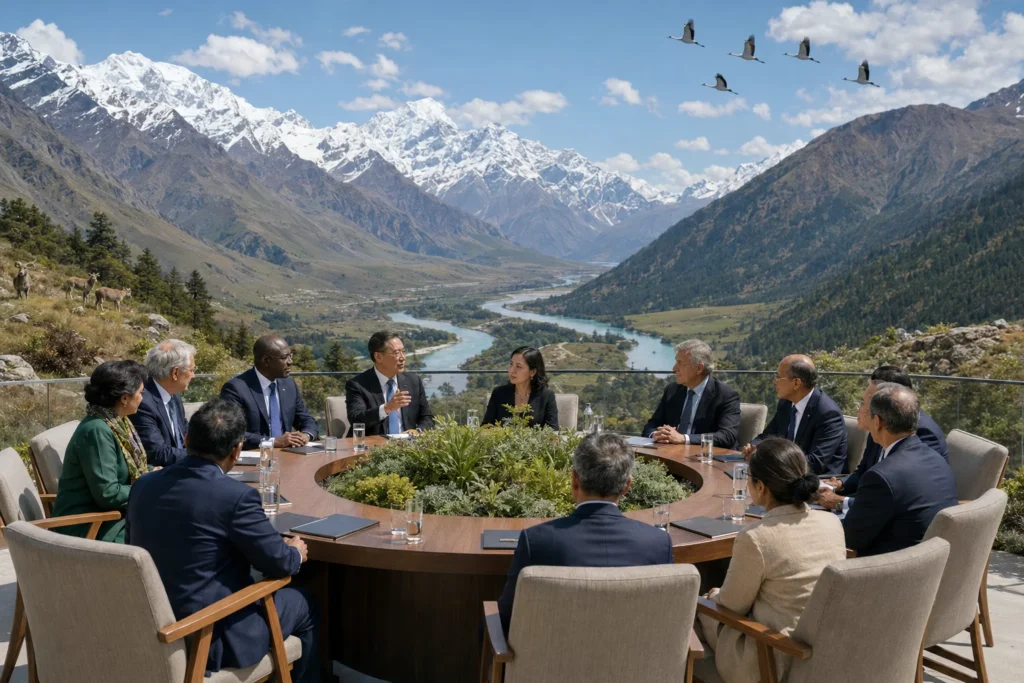
The push for ecological preservation and cross-border environmental governance across the world’s highest mountain ranges has taken center stage in Xizang. Government delegations, environmental scientists, and international policymakers gathered in the city of Nyingchi for the official opening ceremony of the Fifth China Xizang Trans-Himalaya Forum for International Cooperation. Held at the Nyingchi Rui Crown Hotel, this high-level diplomatic and environmental assembly serves as a primary international platform for deepening socioeconomic partnerships, advancing sustainable tourism frameworks, and establishing resilient green economies across trans-Himalayan nations.
Amid expanding regional efforts to protect fragile mountain ecosystems, the forum has drawn ministerial delegations and university researchers from more than 50 nations. The central focus remains clear: accelerating the implementation of global environmental frameworks while establishing a cooperative blueprint that balances human economic activity with the natural environment.
Elevating the Global Biodiversity Framework
During the inaugural plenary, high-level diplomatic representatives stressed that the Trans-Himalaya region is uniquely positioned to drive the next phase of the Kunming-Montreal Global Biodiversity Framework. The consensus among participating nations emphasizes that mountain ecosystems require a unified, multi-sectoral approach that transcends geographic borders to reverse the systemic drivers of habitat alteration and climate vulnerability.
Official ministerial addresses underscored that regional sustainability can only be achieved by investing heavily in nature-based solutions. Strategic priorities highlighted during the forum include broad-scale ecosystem restoration, targeted investments in renewable energy infrastructure, and the implementation of policies that facilitate the sustainable use of local natural resources. By framing conservation as a driver of long-term economic stability, regional authorities are seeking to transform ecological protection into a functional foundation for regional development.
Scientific Alliances and Regional Discovery
A primary highlight of the ministerial briefings centered on the success of ongoing bilateral and multilateral scientific partnerships. Official reports from environmental departments detailed highly productive, collaborative field research initiatives conducted between national scientific institutions, such as the strategic alliance between the Myanmar Forest Department and the Chinese Academy of Sciences. These joint expeditions into remote high-altitude corridors have yielded substantial contributions to global science, resulting in the documentation of numerous previously unknown species of flora, fish, arachnids, and crustaceans.
Furthermore, the forum highlighted the evolving role of the International Centre for Integrated Mountain Development. As founding entities and member nations look to optimize evidence-based policymaking, the institution continues to provide the critical baseline data necessary to balance local socioeconomic demands with rigorous environmental conservation. This scientific foundation is increasingly utilized by regional governments to draft master plans for eco-tourism and low-impact rural development.
Harmonizing Infrastructure and Ecological Protection
As structural expansion continues under regional frameworks like the Belt and Road Initiative, the forum dedicated significant attention to the concept of green infrastructure. Delegations expressed a shared commitment to ensuring that new transport, logistics, and tourism networks across trans-Himalayan corridors conform to the highest environmental impact standards.
The consensus reached in Nyingchi indicates that the future of trans-Himalayan tourism and commerce relies entirely on preserving the pristine landscapes that define the region. By integrating strict ecological safeguards into regional infrastructure planning, member states aim to foster a sustainable model where high-value, low-impact cultural tourism can thrive alongside robust environmental protection. The forum concluded its initial sessions with renewed pledges from participating nations to expand joint research funding, share technical expertise in forestry and watershed management, and maintain an open channel for multilateral environmental governance.
For more travel news like this, keep reading Global Travel Wire