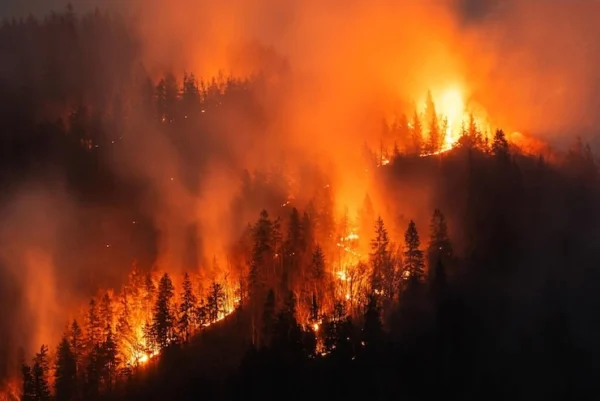
France’s peak summer tourism season is facing renewed wildfire pressure as Var, Provence and other Mediterranean destinations confront dangerous fire conditions, active emergency operations and restrictions designed to protect residents and millions of visitors.
Southern France remains under heightened surveillance as hot, dry weather and strong winds increase the possibility of fires spreading rapidly through forests and scrubland.
Météo-France reported elevated forest-fire danger across parts of southern and western France on July 22, while its outlook for July 23 warned of persistent summer heat and winds reaching around 60 to 70 kilometres per hour along parts of the Var coastline. Such conditions can complicate firefighting and increase the speed at which flames spread.
The situation is particularly important for travellers from the United States, Australia, the United Kingdom, India and other international markets visiting Provence, the French Riviera and Mediterranean holiday destinations during the busy July season.
The wider tourism and safety concerns outlined for visitors across southern France are also reflected in the travel brief provided for this report.
Var faces major wildfire restrictions
The Var department has emerged as one of the areas requiring particular attention.
Authorities confirmed that a major fire affecting Taradeau and Les Arcs-sur-Argens burned around 200 hectares of forest, prompting significant firefighting operations and additional preventive measures.
The Var prefecture has announced restrictions for Thursday, July 23, as authorities respond to major fires and continuing danger across vulnerable areas.
For tourists, restrictions can affect forest access, hiking, cycling, camping and other activities in natural areas.
Travellers should never assume that an attraction, trail or forest road remains accessible simply because nearby hotels and towns are operating normally.
Conditions can change within hours.
Provence tourism enters high-risk period
The wildfire threat comes during one of southern France’s busiest tourism periods.
Provence-Alpes-Côte d’Azur attracts visitors for Mediterranean beaches, vineyards, historic villages, coastal resorts and outdoor experiences.
Areas such as Saint-Tropez, Marseille, the inland Provençal countryside and communities throughout the Var depend heavily on summer visitor activity.
Wildfires do not need to directly reach a major tourism centre to disrupt holidays.
Smoke can reduce visibility. Roads may close to allow emergency vehicles through. Forests can be temporarily shut, while campsites and outdoor attractions may introduce evacuation or access procedures.
Visitors travelling by rental car should therefore build flexibility into regional itineraries.
Firefighters and aircraft remain mobilised
France has extensive wildfire-response resources that combine local firefighters, national civil-security support, aircraft and law-enforcement personnel.
Earlier in July, France’s national gendarmerie confirmed that major fires across southern departments required substantial emergency deployments, with security forces supporting firefighters by protecting communities, securing affected zones and managing investigations.
Water-bombing aircraft and helicopters can be deployed where conditions permit, while firefighters on the ground focus on containment, property protection and preventing renewed outbreaks.
However, strong winds remain a serious complication.
Météo-France notes that the mistral can become powerful and extremely dry across the Rhône Valley and Provence, conditions capable of accelerating fire development.
Flights remain broadly operational
There is currently no indication of a general shutdown of aviation across southern France because of the wildfire situation.
Major gateways including Nice Côte d’Azur Airport, Marseille Provence Airport and Toulon-Hyères Airport continue to play their normal role in Mediterranean tourism.
Nevertheless, travellers should monitor flights carefully.
Wildfire disruption can affect airport access roads, ground transport and local visibility even when an airport remains operational.
Passengers should check directly with airlines and airports before departure rather than relying on earlier schedules.
Outdoor visitors need extra caution
The greatest immediate impact may fall on travellers planning nature-based activities.
Hiking routes, forests, nature reserves and rural recreation areas can be restricted or completely closed when authorities determine that fire danger is too high.
Visitors should respect every closure.
Entering restricted forests can expose travellers to rapidly changing fires while also interfering with emergency operations.
Campers should pay particular attention to instructions from campsite operators and local authorities.
Open flames, discarded cigarettes and activities capable of producing sparks can create serious risks during exceptionally dry conditions.
Heat and wind keep risk elevated
Météo-France expects very warm conditions to continue across southern France.
Forecasts for July 23 indicate maximum temperatures reaching roughly 32°C to 36°C across parts of southern France, with temperatures potentially climbing higher in Aude and inland Provence. Strong mistral and coastal winds are also expected in some areas.
These conditions mean travellers should monitor wildfire information daily rather than checking only before leaving home.
Southern France remains open but vigilance is essential
The wildfire emergency does not mean that all of Provence or the French Mediterranean coast is closed to tourism.
Many destinations remain accessible and continue welcoming visitors.
However, conditions vary significantly from one department and municipality to another.
Travellers should confirm accommodation access, check official local restrictions, avoid closed forests and follow evacuation instructions immediately when issued.
France’s latest wildfire pressure reinforces an increasingly important reality for Mediterranean summer tourism: weather and fire conditions must now form part of daily itinerary planning.
For visitors heading toward Var, Provence and surrounding regions, flexibility and official safety information remain essential while firefighters continue working to protect communities and some of France’s most popular holiday landscapes.
For more travel news like this, keep reading Global Travel Wire