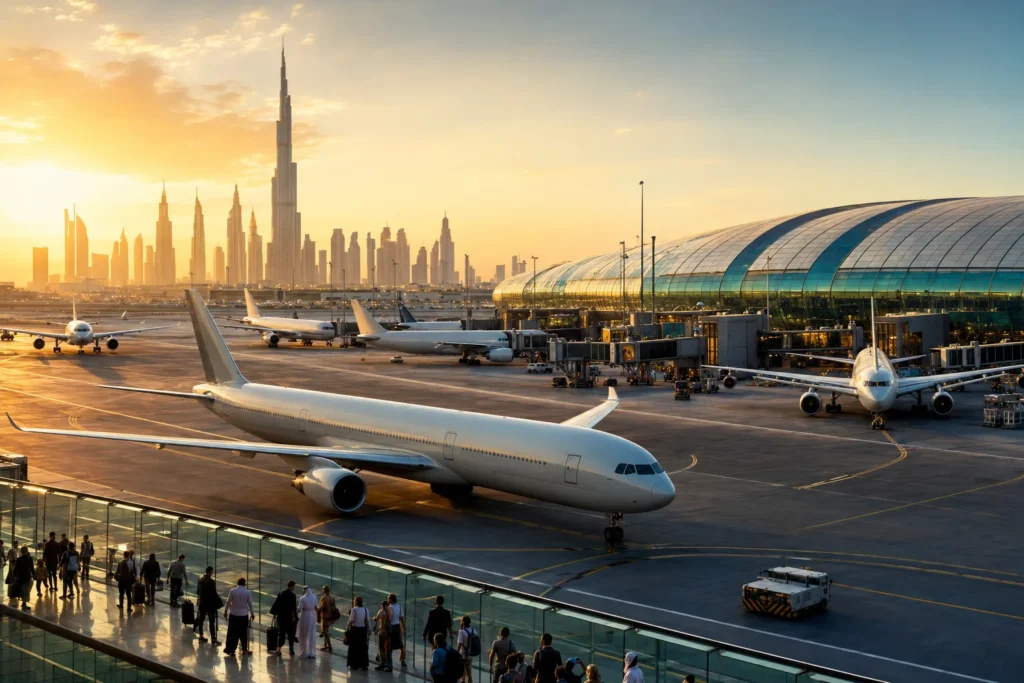
Dubai International Airport has reinforced its standing as the world’s premier international travel hub after ranking first globally for scheduled international airline seat capacity. According to official capacity performance metrics released for the period, the emirate’s central aviation gateway recorded 4.35 million scheduled international seats, leading major international transit hubs worldwide as long-haul air travel demand continues its global momentum.
The performance highlights sustained operational expansion by international airlines operating through the emirate. Dubai surpassed other prominent global gateways, including London Heathrow Airport, which recorded 4.23 million international seats, Amsterdam Schiphol Airport at 3.82 million, Incheon International Airport at 3.75 million, and Paris Charles de Gaulle Airport at 3.70 million.
Official figures indicate that Dubai’s international scheduled capacity expanded by 18 percent compared to the same period last year. This growth highlights the rapid development of the city’s aviation infrastructure and the continued strengthening of its air connectivity network across established and emerging international travel markets.
Sustained Leadership Across Global Transit Hubs
The latest achievement follows a series of strong operational milestones established throughout the year. Dubai International Airport maintained its top position in global international capacity rankings earlier in the first quarter, surpassing major long-haul transit hubs worldwide.
On an annual basis, official statistics published by Dubai Airports confirm that the facility retained its status as the world’s busiest airport for international passenger traffic by seat capacity, recording 62.4 million seats—a 4 percent increase over previous figures.
Furthermore, Dubai Airports reported a historical milestone by handling a record 95.2 million passengers over the full annual period. This marked the highest annual passenger volume recorded in the airport’s history, cementing its role as an indispensable pillar of global civil aviation and international tourism.
Operational momentum has carried seamlessly into the current year. Official passenger traffic data reveals that the airport served 18.6 million passengers during the first quarter alone, driven by expanded carrier flight schedules, increased flight frequencies, and enhanced airspace stability across key transit corridors.
Strategic Alignment with Dubai’s Tourism and Economic Goals
The expansion of aviation capacity directly supports the strategic objectives established by the Dubai Department of Economy and Tourism. According to official performance reports from the tourism entity, Dubai welcomed 19.59 million international overnight visitors over the annual period, marking a 5 percent increase year-on-year and establishing a third consecutive year of record-breaking visitation.
The growth in international flight capacity has enabled the emirate to attract high visitor volumes from key international source markets. Official destination statistics show strong demand across primary regions, led by Western Europe, the Gulf Cooperation Council, South Asia, and Eastern Europe.
Tourism leadership attributes this sustained growth to a diversified market approach executed in partnership with airlines, hotel operators, and international trade partners. The record passenger throughput supports the broader Dubai Economic Agenda D33, which aims to double the size of the emirate’s economy and consolidate its position among the top three global cities for tourism and business.
Advanced Infrastructure and Smart Border Processing
To accommodate rising passenger volumes without compromising traveler experience, airport authorities have accelerated investments in next-generation airport technology and digital infrastructure. Dubai Airports, in coordination with the General Directorate of Residency and Foreigners Affairs, has deployed several advanced passenger processing solutions designed to reduce wait times and streamline transit.
Key technological innovations include:
Pre-travel eligibility verification systems that allow passengers to confirm smart gate access before arriving at immigration control.
Advanced biometric identification gates utilizing combined facial and iris recognition technology for fast contactless processing.
The Red Carpet seamless travel corridor, enabling multiple arriving and departing passengers to complete passport verification simultaneously without stopping.
These digital infrastructure investments have significantly enhanced operational throughput, allowing the airport to manage record-setting seat capacity while delivering high levels of passenger satisfaction.
Future Capacity Planning and Aviation Infrastructure
To support long-term traffic forecasts, Dubai’s aviation sector is executing comprehensive strategic development plans. Official projections indicate that passenger traffic at Dubai International Airport will reach 99.5 million passengers, operating near the facility’s maximum physical capacity.
To accommodate anticipated long-term demand—projected by international civil aviation bodies to reach 12.4 billion global passengers by mid-century—the Government of Dubai has initiated a master expansion plan for Al Maktoum International Airport at Dubai World Central. The expansion initiative represents a major long-term infrastructure investment designed to ultimately handle up to 260 million passengers annually.
Through synchronized investments in airline network capacity, smart airport technologies, and long-term infrastructure, Dubai continues to strengthen its position as the leading global gateway for international business and tourism.
For more travel news like this, keep reading Global Travel Wire