Global mobility, international border regulations, and tourism infrastructure undergo continuous evolution as government authorities and official tourism boards refine travel protocols. Official reports published by international economic organizations, public health agencies, and national tourism ministries highlight shifting mobility trends, updated safety advisories, and digital entry systems designed to enhance visitor processing and expand sustainable tourism across primary global destinations.
Shifts in Global Mobility and Government Travel Advisories
Passport mobility rankings and international travel access frameworks have experienced notable adjustments based on evolving bilateral entry agreements and border security metrics. Standard mobility assessments indicate shifting access levels for long-haul international travelers, prompting governments to streamline entry procedures while maintaining robust border oversight.
Concurrently, public health and diplomatic agencies have released updated destination advisories to inform international travelers of localized regulations and health protocols:
Turks and Caicos Islands: The U.S. Department of State issued updated travel guidance for the British Overseas Territory, emphasizing strict local laws prohibiting firearms and ammunition. Official advisories urge visitors to review baggage thoroughly, as regional judicial authorities strictly enforce local weapons regulations at all ports of entry.
Saint Lucia: Official travel advisories for Saint Lucia were adjusted to Level 2 status, encouraging visitors to exercise increased caution in public areas and remain aware of local security conditions in high-density tourist zones.
Costa Rica: The Centers for Disease Control and Prevention issued a public health travel notice regarding chikungunya transmission in Costa Rica’s Guanacaste Province. Health authorities recommend practicing insect bite prevention measures and consulting healthcare providers regarding vaccination options prior to international departure.
Streamlined Entry Visas and Automated Airport Border Technologies
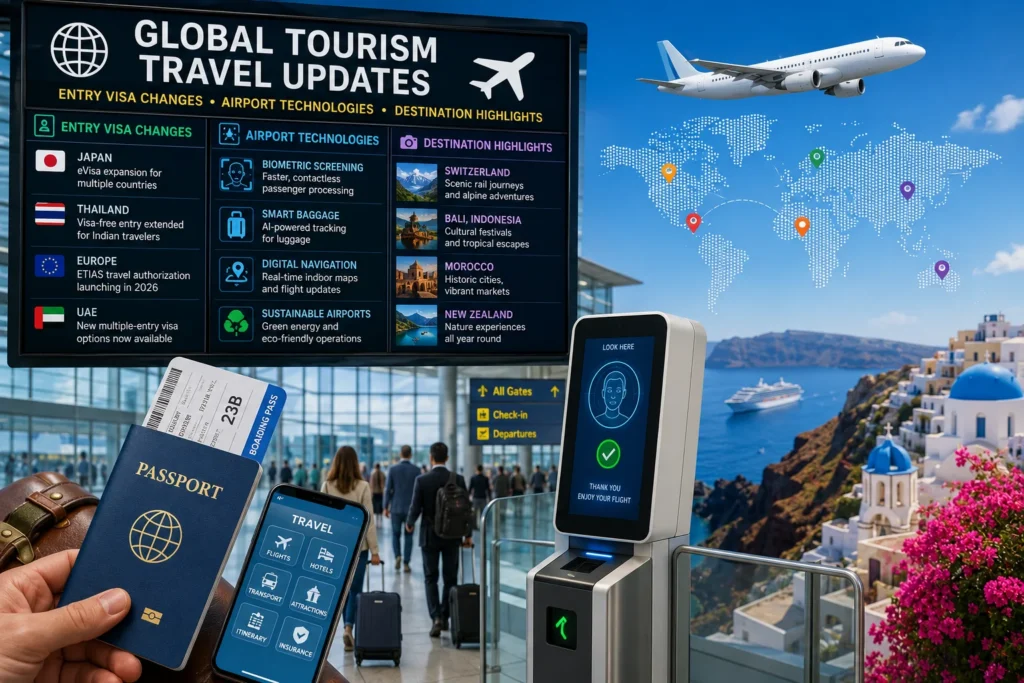
National tourism authorities and immigration departments are increasingly deploying digital visa solutions and biometric border systems to modernize airport operations and reduce entry processing times for incoming passengers.
In Saudi Arabia, the Ministry of Tourism launched the Saudi Package Visa program. This initiative allows licensed travel providers and tour operators to bundle electronic tourist visa issuance directly into verified hotel, flight, and ground transportation packages, simplifying travel planning for international visitors.
In Costa Rica, Directorate General of Migration and Foreigners authorities introduced automated eGates at Juan Santamaria International Airport in San Jose. Utilizing facial recognition software and high-speed passport scanning, the automated biometric gates significantly slash processing times for arriving and departing passengers.
In South Africa, the South African Revenue Service implemented the mandatory Customs Online Traveller Declaration system. The digital platform requires all incoming and outgoing travelers, including citizens and accompanying minors, to complete an online declaration prior to travel, issuing a digital QR code for scanning upon airport arrival. Transit passengers remain exempt from the requirement.
In Egypt, the Ministry of Tourism and Antiquities expanded its digital entry visa platform at Cairo International Airport. The upgraded system provides arriving international tourists with digital QR codes while standardizing entry visa processing fees at official airport border checkpoints.
Record International Arrivals and Coastal Environmental Mitigation
Data published by the Organization for Economic Co-operation and Development demonstrates a historic recovery in international travel, with member and partner nations recording over 847 million international arrivals. The figures reflect sustained demand for cross-border cultural, leisure, and business travel worldwide.
The Turks and Caicos Islands Tourist Board reported a 6 percent year-over-year increase in overnight stayover arrivals during the first half of the year. The growth is supported by expanding direct air connectivity from primary international markets and new luxury hospitality developments across the territory.
Across the Caribbean basin and the Mexican Caribbean coast, environmental and tourism authorities are managing record arrivals of pelagic sargassum seaweed. Hospitality associations along the Riviera Maya have coordinated with municipal governments and naval environmental units to secure emergency mitigation funding, deploying offshore barriers and specialized clearing equipment to protect coastal ecosystems and maintain pristine beach corridors for visitors.
Heritage Developments, Cruise Infrastructure, and Event Tourism
Destinations are continuing to invest in cultural, astronomical, and maritime infrastructure to broaden their visitor offerings and accommodate growing passenger volumes.
In Saudi Arabia, the Royal Commission for AlUla unveiled architectural and scientific designs for the AlUla Manara astronomy center. Located within a certified International Dark Sky Park, the facility combines cutting-edge astronomical observatories, interactive galleries, and planetarium experiences to position the ancient heritage region as a premier hub for global astrotourism.
In St. Kitts, the Ministry of Tourism and the St. Kitts Tourism Authority officially broke ground on the expansion of the Port Zante cruise terminal in Basseterre. The infrastructure project enhances berth capacity and passenger handling facilities to accommodate next-generation cruise vessels and support long-term cruise tourism growth.
In the United States, official tourism sentiment studies conducted by the U.S. Travel Association indicate strong public enthusiasm for hosting major international sports gatherings. Over 80 percent of surveyed residents expressed positive engagement regarding international visitors attending major global tournaments, such as the FIFA World Cup, emphasizing the economic and cultural value of welcoming global travelers to domestic communities.
For more travel news like this, keep reading Global Travel Wire