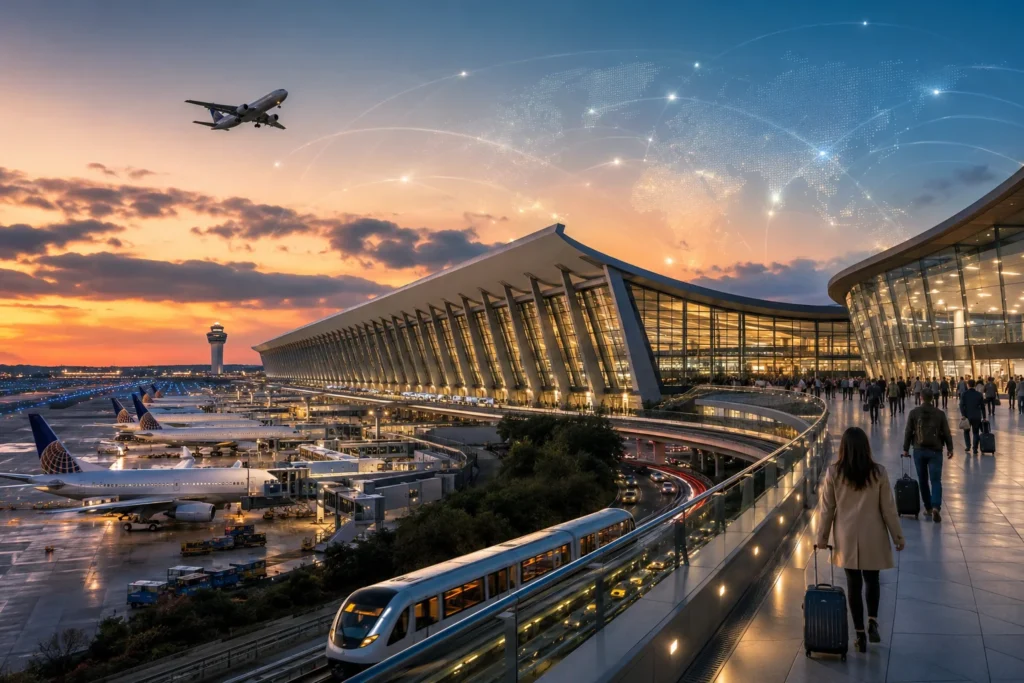
Official announcements from the Metropolitan Washington Airports Authority, United Airlines, and the United States Department of Transportation confirm a landmark capital development program exceeding $20 billion to redevelop Washington Dulles International Airport. As one of the largest infrastructure investments in United States aviation history, the multi-year program will modernize every stage of the passenger journey—from curbside arrival to international baggage retrieval—while preserving the iconic Main Terminal designed by architect Eero Saarinen.
The ambitious initiative aims to transform the gateway into a world-class international hub, expanding long-haul flight connectivity, improving passenger mobility, and catering to record volumes of international business and leisure travelers entering the National Capital Region.
Anchoring United Airlines Global Network Expansion
United Airlines, the primary hub carrier operating at Washington Dulles, plays a central operational role in executing the multi-stage master plan. The transformation strengthens the airline’s long-term investment in its primary Mid-Atlantic gateway, expanding its capacity to serve non-stop domestic routes and transoceanic international destinations.
Official statements from United Airlines and airport authorities emphasize that the redevelopment will deliver expanded gate capacity, modern customer service facilities, and elevated premium passenger lounges. Key enhancements include expanded United Club facilities and the construction of one of the largest United Polaris lounges in the global network, specifically tailored to long-haul international flyers.
For connecting passengers, the upgraded infrastructure offers significantly reduced transfer times, more spacious boarding zones, and a seamless link between domestic arrival gates and international departure concourses.
Expanding 5 Million Square Feet of Modern Terminal Space
The overall footprint of the airport will expand substantially, introducing more than 5 million square feet of new and renovated terminal space. Designed to accommodate future passenger growth over the next decade, the project reshapes the airport’s physical architecture to eliminate operational bottlenecks and elevate traveler comfort.
Key passenger-facing upgrades across the expanded terminal complex include:
Redesigned Airport Entry: Streamlined vehicle access roads, expanded drop-off zones, and close-in parking facilities.
Next-Generation Security Checkpoints: State-of-the-art screening technology designed to accelerate processing and ease peak-period congestion.
Spacious Gate Environments: Bright, expansive waiting areas featuring ergonomic seating, integrated digital charging stations, and dedicated workspace pods.
Expanded Concessions and Retail: A broader curation of regional dining options, global retail brands, and accessible passenger services.
Replacing Concourses C and D with Next-Generation Facilities
A major milestone of the Washington Dulles airport transformation is the eventual replacement of the existing Concourse C and D complex. Long serving as the primary operational hub for United Airlines, these temporary structures will be retired in favor of permanent, state-of-the-art concourses engineered for modern wide-body aircraft operations.
The replacement facilities will feature wide passenger corridors, elevated ceilings, direct gate access, and flexible layout configurations capable of supporting larger international aircraft. The new design shifts the focus toward passenger wellness and operational efficiency, ensuring the airport remains competitive with major international aviation hubs along the US Eastern Seaboard.
As an early phase of the broader concourse strategy, the construction of Concourse E provides immediate gate expansion. Connected directly to the airport’s automated train system, Concourse E offers added capacity for long-distance international flights while the primary concourse replacements advance in structured phases.
Retiring Mobile Lounges for Expanded AeroTrain Systems
In a significant operational shift, the airport will gradually phase out its historic mobile lounge vehicles—the ground transportation carriers that have moved passengers between terminals for decades. While historically distinct, the mobile lounges have created movement bottlenecks during peak flight banks.
The redevelopment replaces these vehicles with an expanded AeroTrain network and a central walking tunnel. Completing the full train track loop to all concourses will allow passengers to move rapidly between the Main Terminal, concourses, and gate areas.
Enhanced walkability and level pedestrian paths also improve accessibility for families traveling with children, international visitors, and passengers with reduced mobility, creating a predictable and intuitive navigation experience throughout the complex.
Upgrading International Customs and Luggage Infrastructure
International arrivals processing will receive comprehensive upgrades to handle growing overseas visitor arrivals. A new, expanded United States Customs and Border Protection facility will feature walkable access from international gates, modernized digital processing technology, and optimized passenger flow channels to reduce immigration wait times.
Complementing the border clearance upgrades is a complete overhaul of the airport’s baggage handling systems. Advanced automated luggage routing technology will accelerate bag delivery times to claim carousels, addressing a critical priority for arriving international passengers.
Financed through airport revenue frameworks and municipal bonds, the multi-billion-dollar redevelopment operates without reliance on direct federal tax appropriations. By modernizing infrastructure while preserving architectural heritage, the Washington Dulles airport transformation positions the capital region as a premier global destination and international transit hub for decades to come.
For more travel news like this, keep reading Global Travel Wire