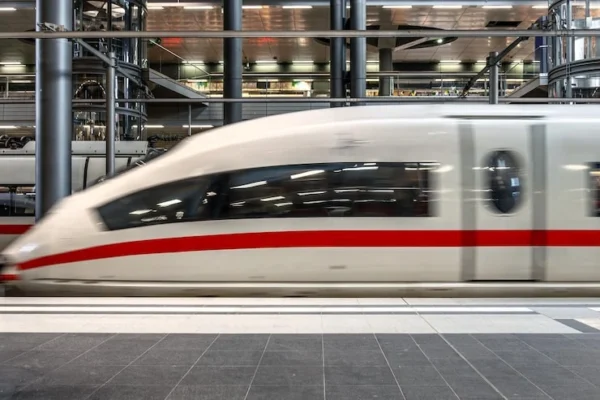
India is advancing plans for an indigenous high-speed rail signalling framework as Indian Railways prepares to expand bullet train connectivity beyond the country’s first Mumbai–Ahmedabad corridor.
The proposed Bharat Train Control System, or BTCS, is intended to provide India with greater control over the critical technology used to supervise high-speed train movements. It could support future corridors while reducing long-term dependence on imported signalling protocols.
The development comes as the government moves ahead with seven additional high-speed rail corridors spanning nearly 4,000 kilometres. These routes were announced as strategic growth connectors under the Union Budget 2026–27.
Together, the planned corridors are expected to attract investment of approximately ₹16 lakh crore and create a faster intercity passenger network connecting major economic, technology and tourism centres.
For travellers, the programme could eventually deliver shorter journey times, stronger regional connectivity and a competitive alternative to domestic air travel on selected routes.
Indigenous technology strengthens railway independence
Advanced signalling and train control systems form the digital backbone of a high-speed railway.
They continuously supervise train movements, maintain safe distances, communicate operating instructions and help control services across an entire corridor.
BTCS is being developed as a flexible framework that can be adapted to Indian operating conditions and future network requirements. A domestic platform could also simplify upgrades, maintenance and system integration as India’s bullet train network expands.
An indigenous system would allow Indian engineers and railway organisations to retain greater control over technical standards and future development.
It could also create commercial opportunities for domestic signalling manufacturers, telecommunications companies, software developers and railway system integrators.
The initiative supports the government’s Make in India and Aatmanirbhar Bharat strategies, which seek to expand domestic capability across advanced transport infrastructure.
Mumbai–Ahmedabad project creates technical foundation
India’s first bullet train corridor is providing valuable engineering and operational experience for future high-speed rail projects.
The Mumbai–Ahmedabad High-Speed Rail Corridor covers approximately 508 kilometres and will connect 12 stations across Maharashtra, Gujarat and Dadra and Nagar Haveli.
The corridor is being developed using Japanese Shinkansen technology and operating practices. Trains are planned to operate at speeds of up to 320 kilometres per hour, with infrastructure designed for speeds reaching 350 kilometres per hour.
The project includes J-Slab ballastless tracks, advanced electrification, specialised bridges, tunnels and high-speed train control infrastructure.
Indian engineers and technicians are receiving training in construction, track installation, maintenance and railway operations. Much of the machinery and several infrastructure components are also being produced domestically.
This transfer of knowledge is expected to help India establish standard designs and construction practices for its wider high-speed rail network.
Seven corridors could transform intercity travel
The government has announced seven new high-speed rail corridors designed to connect major cities and economic regions.
They include Delhi–Varanasi, Varanasi–Siliguri, Mumbai–Pune, Pune–Hyderabad, Hyderabad–Bengaluru, Hyderabad–Chennai and Chennai–Bengaluru.
The southern corridors could create a connected high-speed travel triangle between Chennai, Bengaluru and Hyderabad.
Official projections indicate that a Chennai–Bengaluru journey could take approximately one hour and 13 minutes. Bengaluru–Hyderabad travel could fall to around two hours, while Chennai–Hyderabad could take about two hours and 55 minutes.
The proposed Mumbai–Pune corridor could reduce travel time between the two western Indian economic centres to approximately 48 minutes.
Detailed surveys, route planning and technical assessment will determine the final alignments, station locations, costs and construction schedules.
Faster rail could support tourism growth
High-speed rail can reshape tourism by making short leisure trips and multi-city itineraries more practical.
The Delhi–Varanasi corridor could strengthen access to one of India’s most important spiritual and cultural destinations. An extension towards Siliguri would improve connectivity to the gateway serving Darjeeling, Kalimpong and the northeastern states.
Southern routes could support tourism between Chennai, Bengaluru and Hyderabad while improving access to heritage attractions, technology hubs, medical facilities and business events.
Mumbai–Pune connectivity could benefit weekend tourism, corporate travel and visitor flows towards nearby hill stations and cultural destinations.
Rail-based journeys may also appeal to travellers seeking city-centre connections without lengthy airport transfers.
However, the tourism benefits will depend on station accessibility, affordable fares and integration with metro, bus and regional railway services.
Domestic train manufacturing gathers momentum
India is also building the industrial capability required to manufacture high-speed rolling stock.
Railway manufacturers are developing indigenous trainsets designed for speeds of around 280 kilometres per hour. These efforts could eventually complement domestic signalling, track, electrification and maintenance systems.
Standardised designs across future corridors would improve procurement, staff training and spare-parts management. They could also reduce construction time and control long-term operating costs.
Research institutions, Indian Institutes of Technology and specialist railway organisations are supporting the development of high-speed rail expertise.
India prepares for a connected railway future
The Bharat Train Control System represents an important part of India’s attempt to build a complete domestic high-speed rail ecosystem.
Significant development, testing and safety certification will be required before an indigenous platform can manage commercial bullet train operations.
Nevertheless, combining local train manufacturing with Indian signalling and engineering capabilities could strengthen railway self-reliance.
As planning progresses across the seven proposed corridors, high-speed rail could become a major driver of regional development, tourism mobility and sustainable intercity transport.
India’s bullet train ambition is therefore moving beyond a single corridor. It is becoming a wider national programme built around faster journeys, domestic innovation and long-term connectivity.
For more travel news like this, keep reading Global Travel Wire