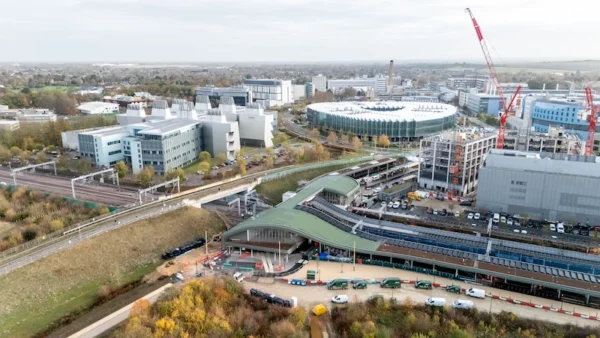
Cambridge South station recorded more than 110,000 passenger journeys during its first month, demonstrating immediate demand for direct rail access to the Cambridge Biomedical Campus and wider UK transport network.
The £250 million station entered public service on June 28, 2026. It now serves thousands of employees, patients, researchers, students and visitors travelling to one of Europe’s largest biomedical and medical research centres.
Services operated by Greater Anglia, Great Northern, Thameslink and CrossCountry provide direct connections to major cities and transport hubs. These include London, Birmingham, Norwich, Brighton, Stansted Airport, Gatwick Airport and London St Pancras International.
The strong opening-month performance highlights how strategically located railway infrastructure can rapidly change passenger behaviour. It also supports efforts to reduce road congestion by giving campus users a practical alternative to private vehicles.
Cambridge South is expected to handle approximately 1.8 million journeys annually as passenger demand develops.
New station delivers faster campus access
The station’s main role is to provide direct rail access to the Cambridge Biomedical Campus.
The site employs more than 20,000 people and receives around 40,000 daily visitors. It includes Addenbrooke’s Hospital, Royal Papworth Hospital, The Rosie Hospital, university research facilities and major life-sciences organisations.
Before Cambridge South opened, many passengers arriving from other parts of Britain needed to continue from Cambridge station by bus, bicycle, taxi or on foot.
The new station places rail passengers much closer to hospitals, research centres and employment facilities. This simplifies journeys for patients attending appointments and employees commuting from surrounding towns.
Direct services from London King’s Cross can complete the journey in approximately 45 minutes. Great Northern operates two trains per hour on this connection, improving access between the Biomedical Campus and central London.
The link can also support collaboration between universities, healthcare organisations, pharmaceutical companies and international investors.
Frequent services strengthen UK connections
Cambridge South has been designed as a major regional gateway rather than a station serving only local commuters.
Up to nine trains an hour operate between Cambridge South and central Cambridge during the busiest periods. As many as 20 services can call at the station during peak hours.
Passengers can travel directly to London King’s Cross and London Liverpool Street, while services through St Pancras provide access to international rail connections.
Direct trains to Stansted and Gatwick airports strengthen links between Cambridge’s research economy and international aviation gateways.
CrossCountry services connect the station with Birmingham, Peterborough and other destinations across its wider network. Thameslink trains also run through central London to Brighton without requiring passengers to transfer to the Underground.
These options can benefit business travellers, medical visitors and tourists combining Cambridge with other British destinations.
The station may also reduce pressure on Cambridge’s existing central station by distributing passengers more effectively across the city.
Tourism and business travel gain new gateway
Cambridge is internationally recognised for its university, historic architecture, museums and scientific institutions.
The new station primarily serves the southern part of the city and the Biomedical Campus. However, its frequent connection to central Cambridge makes it useful for visitors arriving from London, regional cities and international airports.
Improved rail access could support conferences, medical tourism, academic events and corporate travel linked to the life-sciences sector.
It may also encourage visitors to combine professional trips with leisure stays in Cambridge. Hotels, restaurants, cultural attractions and local transport providers could benefit from greater passenger movement.
The station strengthens access to jobs and education while supporting Cambridge’s position as a destination for research, healthcare and innovation.
The Biomedical Campus already contributes approximately £4.7 billion annually to the UK economy. Better connectivity is expected to support its continued expansion and wider regional employment.
Sustainable facilities encourage greener journeys
Cambridge South has been planned around sustainable transport rather than extensive private-car access.
The four-platform station connects directly with local walking and cycling routes. It provides capacity for 1,000 bicycles, helping commuters combine train travel with cycling.
Its location beside the guided busway also allows passengers to continue towards Cambridge city centre, park-and-ride facilities and surrounding communities.
Blue Badge bays improve access for passengers with mobility requirements, while six lifts provide step-free movement between entrances and platforms.
Other passenger facilities include accessible toilets, waiting areas, ticket machines, baby-changing facilities and a Changing Places toilet.
The station’s design incorporates a green roof and solar panels. These features help integrate the building with the neighbouring Hobson’s Park nature reserve while supporting biodiversity and energy-efficiency objectives.
First Great British Railways-branded station
Cambridge South is the first newly built station to carry Great British Railways branding.
The project brings infrastructure management and passenger operations together through GBR Anglia, involving Network Rail, Greater Anglia and other railway partners.
This integrated approach aims to improve planning, coordination and passenger information across the railway.
The station also includes capacity to support future East West Rail services. That programme is intended to improve connectivity across the Oxford–Cambridge growth corridor.
Its first-month passenger figures show that demand for direct campus access existed before the station opened.
As usage continues to grow, Cambridge South is positioned to become a vital gateway for healthcare, research, business travel and regional tourism.
The station demonstrates how targeted rail investment can shorten journeys, connect communities and support more sustainable economic development across Britain.
For more travel news like this, keep reading Global Travel Wire