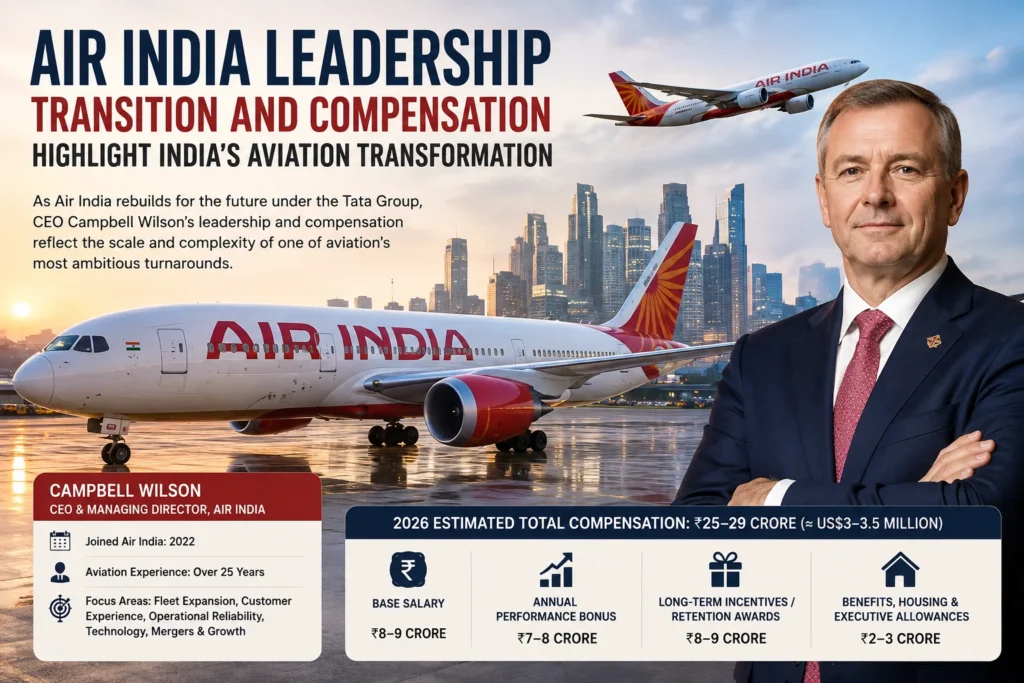
India’s commercial aviation sector is experiencing one of the most remarkable operational overhauling projects in modern travel history. Since returning to private ownership under the Tata Group, Air India has pursued an aggressive strategy to modernize its fleet, integrate operational units, and elevate service standards. Central to this monumental effort has been Chief Executive Officer and Managing Director Campbell Wilson, who joined the carrier in 2022. As the airline navigates a crucial leadership transition following Wilson’s decision to step down after establishing foundational stability, the executive compensation and strategic milestones reflect the immense scale of rebuilding a global flag carrier.
The Multi-Billion Dollar Modernization of India’s Flag Carrier
The ongoing overhaul of Air India represents a strategic effort to establish the nation as a premier global hub for international passenger traffic and tourism. Historically, a significant portion of long-haul travel to and from South Asia was routed through third-party international transit hubs. The modern strategy focuses on capturing direct international routes, improving passenger comfort, and offering world-class inflight experiences.
To support this ambitious vision, the airline initiated a historic fleet expansion program, placing firm orders for hundreds of advanced narrow-body and wide-body aircraft. This fleet renewal includes cutting-edge models such as the Airbus A350, Boeing 787 Dreamliner, and Boeing 777, designed to serve nonstop long-haul routes connecting major global financial centers and cultural tourist destinations directly to India. Coupled with a comprehensive retrofit project for existing aircraft, the modernized cabins feature upgraded seating, advanced inflight entertainment systems, and expanded onboard Wi-Fi connectivity.
Leadership Legacy and Executive Strategy Under Campbell Wilson
Bringing over two decades of international aviation expertise from Singapore Airlines and Scoot, Campbell Wilson assumed leadership of Air India with a mandate to execute an extensive turnaround program. His tenure focused on transitioning the organization from legacy public-sector practices to an agile corporate governance structure.
Under his direction, the airline successfully executed the consolidation of four distinct aviation entities under the Tata umbrella, creating a streamlined dual-carrier model comprising a full-service international airline and a low-cost domestic subsidiary. Beyond fleet acquisitions, Wilson prioritized critical enabling infrastructure to support long-term growth. Key initiatives include establishing South Asia’s largest aviation training academy, constructing state-of-the-art flight simulator centers, launching a basic flight training school, and building a greenfield Maintenance, Repair, and Overhaul facility. These foundational investments ensure that the airline can train thousands of pilots, cabin crew, and engineers internally to keep pace with rapid fleet expansion.
Having established these foundational building blocks, Wilson announced his intention to step down, remaining in his position through a planned transition period until a successor assumes office. This deliberate transition ensures that ongoing operational initiatives, cabin retrofits, and aircraft deliveries proceed without interruption.
Breakdown of Air India CEO Compensation and Executive Pay Structures
Rebuilding a complex international airline operating in a highly competitive market requires competitive executive leadership packages aligned with long-term strategic benchmarks. Executive compensation at Air India combines a stable fixed base with substantial performance-linked incentives tied directly to turnaround milestones, operational efficiency, and fleet integration targets.
Reflecting the vast complexity of managing an enterprise of this scale, official disclosures and corporate approvals indicate an annual compensation package for the CEO role structured around key operational targets:
Base Fixed Salary: Estimated at approximately ₹8 crore to ₹9 crore annually, providing core executive compensation.
Annual Performance Bonus: Valued at roughly ₹7 crore to ₹8 crore, awarded upon meeting rigorous operational, customer satisfaction, and financial performance criteria.
Long-Term Incentives and Retention Awards: Approximately ₹8 crore to ₹9 crore, structured to reward multi-year strategic execution and airline integration success.
Executive Allowances and Benefits: Estimated at ₹2 crore to ₹3 crore, encompassing housing, health coverage, relocation, and associated executive perks.
In total, this structure aligns the chief executive’s total annual remuneration package to an estimated range between ₹25 crore and ₹29 crore (equivalent to approximately US$3 million to US$3.5 million). This competitive valuation reflects global aviation standards required to attract and retain senior leadership capable of managing complex, multi-year airline turnarounds.
Expanding Infrastructure, Fleet Overhauls, and the Future of Indian Tourism
The ongoing transformation of the flag carrier plays a direct role in driving domestic economic growth and stimulating inbound international tourism. As India expands its domestic airport infrastructure—opening new greenfield facilities and modernizing terminal infrastructure across metropolitan hubs—the availability of direct, high-quality air connectivity becomes a primary driver for overseas visitor arrival numbers.
Enhanced non-stop flights to North America, Europe, Australia, and Southeast Asia significantly reduce travel friction for business travelers, leisure tourists, and the global Indian diaspora. By replacing older cabin interiors with modern lie-flat business suites and ergonomically designed economy seating, the airline aims to deliver a competitive passenger experience that mirrors the world’s leading international carriers.
Although global supply chain constraints and aircraft delivery schedules present short-term industry challenges, the long-term outlook for Indian aviation tourism remains strong. With major infrastructure projects settling into place and hundreds of new aircraft scheduled for delivery over the coming years, the transformation initiated under Campbell Wilson sets the stage for India to solidify its position as a major center for global air travel and international tourism.
For more travel news like this, keep reading Global Travel Wire