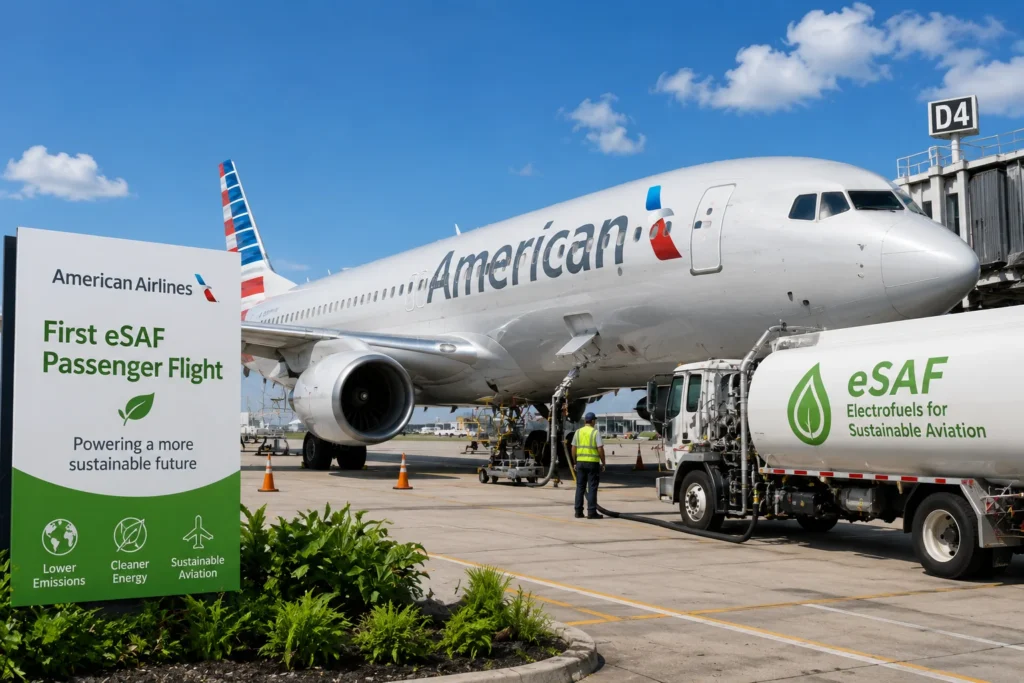
American Airlines has achieved a historic milestone in sustainable aviation tourism by successfully operating a commercial passenger flight powered by electro sustainable aviation fuel (eSAF). The domestic flight departed from Corpus Christi International Airport in Texas and arrived at Dallas Fort Worth International Airport, demonstrating the practical application of next-generation power-to-liquid fuels in commercial passenger operations.
This landmark flight marks the first delivery of synthetic sustainable aviation fuel produced without biobased feedstocks to a commercial airport in the United States. Manufactured from captured waste carbon dioxide and renewable energy, the synthetic fuel represents a major technological leap for eco-conscious travelers and the global travel industry seeking to minimize the environmental footprint of long-distance air travel.
Next-Generation Power-to-Liquid Technology Takes Flight in Texas
The innovative eSAF batch utilized for the commercial flight was manufactured and blended at Infinium’s Project Pathfinder facility located in Corpus Christi. Operating since 2023, Project Pathfinder stands as the world’s first commercial-scale power-to-liquids production site. The facility captures industrial waste carbon dioxide emissions and combines them with hydrogen derived from water using renewable electricity, creating ultra-low-carbon drop-in synthetic fuels.
Prior to fueling the passenger aircraft, the synthetic fuel was blended with conventional Jet A fuel and tested against international ASTM International specifications. The certification confirms that the drop-in synthetic fuel complies fully with global aviation safety standards, allowing it to be used in standard commercial aircraft engines and airport fueling equipment without requiring mechanical adjustments or specialized airport infrastructure.
By delivering the fuel directly into the common airport fuel storage tanks at Corpus Christi International Airport, the project demonstrated the seamless integration of non-biological eSAF into existing commercial airport supply chains. This achievement highlights a crucial pathway toward decarbonizing long-distance air transport while maintaining the operational reliability that global travel and tourism rely upon daily.
How Waste Carbon Dioxide Transforms into Drop-In Jet Fuel
Conventional sustainable aviation fuels primarily rely on biological feedstocks, such as used cooking oils, agricultural residues, or municipal solid waste. While effective, biobased fuel production often faces constraints regarding feedstock availability and land usage. In contrast, electro sustainable aviation fuel utilizes waste carbon dioxide captured from industrial processes and pairs it with green hydrogen generated via clean power.
According to technical specifications from Infinium, eSAF can achieve a lifecycle greenhouse gas emissions reduction of more than 90 percent compared to traditional petroleum-derived jet fuel. Because aviation accounts for significant global carbon emissions, transitioning to synthetic power-to-liquid fuels offers an essential mechanism for preserving international travel connectivity while supporting net-zero aviation targets.
By utilizing captured carbon emissions and clean power rather than food crops or organic waste, eSAF provides a scalable solution for airlines seeking to reduce direct operating emissions and supply chain impacts. This technological transition directly supports sustainable aviation tourism initiatives by offering travelers a lower-carbon option for long-distance leisure and corporate travel.
Strengthening Eco-Friendly Air Travel and Regional Tourism Infrastructure
The commercial demonstration between Corpus Christi and Dallas Fort Worth reinforces how technological innovation at regional industrial facilities can directly enhance sustainable travel infrastructure across major transport hubs. Dallas Fort Worth International Airport, one of the busiest passenger gateways in the world, serves as a primary hub for global leisure and commercial transit.
Commercial aviation currently consumes nearly 100 billion gallons of conventional jet fuel annually, with sustainable aviation fuels comprising less than 1 percent of total global jet fuel supply. Demonstrating that ultra-low-carbon synthetic fuels can enter standard fuel distribution networks provides a viable roadmap for expanding the availability of eco-friendly air travel across domestic and international route networks.
Furthermore, corporate travel partnerships are playing an increasingly active role in driving sustainable fuel adoption. American Airlines has collaborated with financial services firm Citi through a targeted arrangement designed to reduce Scope 3 indirect emissions associated with corporate employee travel, demonstrating how corporate partnerships can accelerate commercial demand for clean energy solutions in tourism and travel.
Scaling Low-Carbon Production for the Future of Global Tourism
While the Corpus Christi flight represents a significant commercial demonstration, efforts are already underway to expand eSAF production capacity significantly. American Airlines has entered into a commercial purchase agreement to acquire large-scale volumes of eSAF from Infinium’s Project Roadrunner facility, which is currently under construction in Texas.
Supported by clean energy investment initiatives from Breakthrough Energy Catalyst, Brookfield Asset Management, and project debt financing from HSBC, Project Roadrunner is scheduled to begin commercial fuel deliveries in 2027. Once fully operational, the facility is projected to produce more than 5 million gallons of eSAF annually, providing a consistent supply of synthetic fuel to help decarbonize commercial passenger routes.
As global passenger volumes exceed four billion travelers annually, expanding the supply of affordable, high-performance sustainable aviation fuels remains vital for safeguarding the future of global tourism. Through strategic partnerships between commercial airlines, technology developers, and energy investors, the adoption of electro sustainable aviation fuel is shifting from early-stage demonstration into practical, real-world deployment, paving the way for a more sustainable future for global air travel.
For more travel news like this, keep reading Global Travel Wire