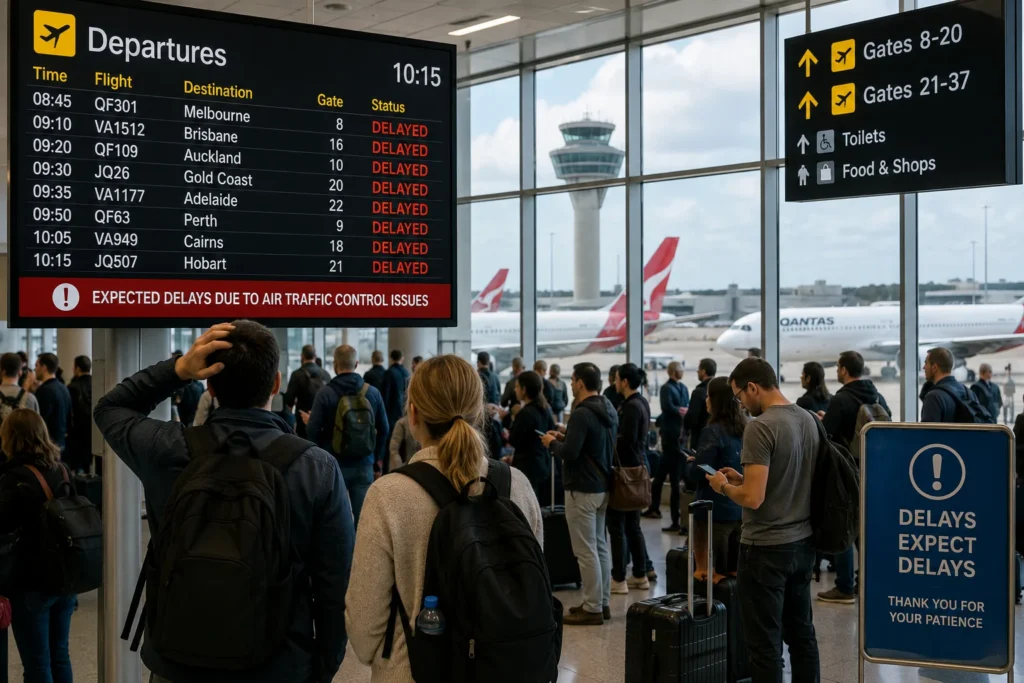
A sudden operational slowdown at Kingsford Smith Airport in Sydney created widespread travel friction as air traffic control staffing constraints forced ground stops, gate holds, and extended tarmac delays. As Australia’s busiest international gateway and a central transit pillar for domestic and global travel, the disruption sent ripple effects across tourism corridors, leaving thousands of passengers navigating schedule shifts, missed connection windows, and prolonged waits inside aircraft cabins.
Official statements confirmed that the operational bottlenecks began early in the day when roster management and unexpected staffing limitations inside the air traffic control facility required immediate intervention. To preserve aviation safety standards, safety authorities instituted temporary flow control protocols, restricting the movement rate of both departing and arriving aircraft. While normal capacity was restored as staffing levels stabilized, the event highlighted the delicate balance between aviation infrastructure resilience and passenger flow management across major tourist destinations.
Air Traffic Management Measures Enforced to Ensure Airspace Safety
The decision to limit aircraft departures at Sydney Airport stemmed directly from protocol requirements established by national air navigation provider Airservices Australia. When operational coverage within control sectors falls below required thresholds, air traffic controllers implement air traffic flow management procedures. These regulatory safety mechanisms regulate the precise timing of takeoffs to avoid overcrowding active airspace and destination runways.
While air traffic flow management prevents safety risks aloft, its real-world outcome on the ground is immediate congestion. More than 100 flights across multiple domestic and international carriers experienced departure delays ranging from 45 minutes to over two hours. Dozens of aircraft remained parked at terminal gates or held in long queues along tarmac taxiways as control towers managed flight clearances on a restricted release schedule.
Official briefings from air navigation authorities emphasized that reducing operational throughput was an essential precautionary measure. By maintaining strict separation standards and controlling the density of active flights, aviation regulators prioritized airspace integrity over schedule adherence while additional operational personnel were brought in to relieve tower shifts.
Widespread Impact on Australian Domestic and International Tourism
The operational slowdown at Sydney Airport delivered an immediate blow to domestic and inbound international tourism flows. Sydney serves as the primary arrival hub for international visitors exploring Australia, as well as the central connector for popular domestic travel corridors, including the Sydney-to-Melbourne route, Queensland beach destinations, and regional transport routes.
When a primary aviation hub experiences delays of this scale, the operational consequences compound quickly across the tourism value chain:
Missed International Connections: Overseas visitors arriving in Sydney faced missed domestic flight connections to regional tourism highlights such as the Great Barrier Reef, Uluru, and Tasmania, forcing hotel re-bookings and itinerary adjustments.
Cruise and Tour Disruption: Cruise passengers arriving by air faced tight turnaround schedules at Sydney’s overseas passenger terminal, while regional tour operators reported delayed group arrivals across New South Wales.
Economic Strain on Hospitality: Unexpected travel delays disrupt regional accommodation providers, dining venues, and local transport operators who rely on predictable flight arrival timetables.
Reduced Passenger Confidence: Repeated scheduling disruptions risk undermining long-term travel sentiment among domestic weekend travellers and high-yield international tourists planning complex multi-destination itineraries.
Industry representatives noted that flight delays during peak travel windows place an administrative burden on airlines and tourism businesses alike, as ground teams work to reframe logistics, re-accommodate stranded guests, and manage baggage routing under constrained conditions.
Strategic Oversight and Call for Network Resilience
The widespread flight delays sparked significant discussion across the aviation and travel sectors regarding operational readiness at major Australian airports. Peak airline industry groups and tourism representatives expressed strong concern over the vulnerability of primary transport hubs to localized staffing shortfalls, emphasizing that air traffic control services represent essential national infrastructure.
Aviation advocacy bodies emphasized that reliable air navigation operations are foundational to Australia’s broader economic and tourism health. Unlike regions with dense high-speed rail networks, Australia relies heavily on commercial air transport to move leisure travellers, business visitors, and essential services across vast geographical distances. Disruptions at Sydney Airport rapidly affect regional airports in Brisbane, Melbourne, Adelaide, and Perth, where aircraft scheduled for onward journeys are held up waiting for inbound arrivals.
In response to ongoing workforce challenges, official resource resilience plans have been introduced by air navigation authorities to expand controller training pipelines, modernize traffic tracking technology, and enhance shift coverage protocols. These efforts aim to prevent future roster imbalances from triggering network-wide travel restrictions.
Operational Recovery and Guidance for Transiting Passengers
Following the adjustment of control tower staffing levels, air traffic restrictions were formally lifted, allowing Sydney Airport to resume full operational capacity. However, because flight crews, aircraft positioning, and gate allocations were displaced throughout the morning, operational recovery required several hours as airlines worked down the backlog of delayed departures.
Official travel advisories urge passengers departing from or transiting through major Australian airports to monitor flight status updates through official airline platforms prior to heading to the terminal. Travel insurance providers also recommend maintaining detailed documentation of flight delays caused by air traffic management directives, as accommodation and re-booking coverage often depends on formal operational notices from airport authorities or air navigation providers.
As Australia continues to welcome growing numbers of international tourists and domestic holidaymakers, ensuring seamless, predictable air service remains a vital priority for tourism authorities and aviation stakeholders nationwide.
For more travel news like this, keep reading Global Travel Wire