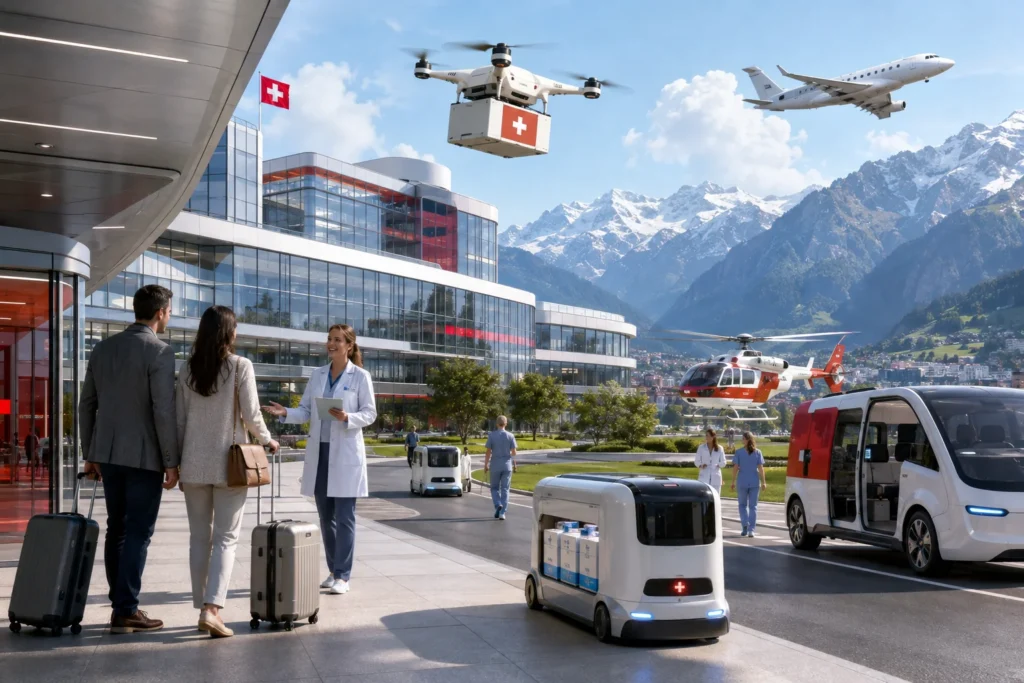
Switzerland has long stood at the pinnacle of global health travel, drawing international visitors seeking world-class clinical expertise, discreet wellness care, and pristine alpine environments. In a significant move that elevates the standard of patient-centric infrastructure, Swiss mobility leader Schindler has successfully completed a pioneering digital transit retrofit at HOCH Health Ostschweiz in St. Gallen. By integrating autonomous mobile units into the hospital’s vertical transportation network, the eastern Swiss medical center is establishing a new benchmark for smart healthcare hospitality across the European wellness and medical tourism landscape.
The modernization comes at a crucial time as international health travelers increasingly prioritize high-tech facilities, rapid service delivery, and stringent hygiene standards when selecting overseas treatment destinations. By automating back-of-house logistics, medical staff can dedicate more direct, personalized attention to international and local patients, enhancing the overall care experience in one of Switzerland’s major regional health hubs.
Seamless Integration of Autonomous Mobility in Healthcare Infrastructure
The newly completed Haus 07A complex at HOCH Health Ostschweiz represents a centerpiece of eastern Switzerland’s regional healthcare modernization program. Featuring a state-of-the-art operating and interventional floor alongside 96 modern patient suites, the facility was designed to accommodate complex surgical procedures and premium recovery stays.
During the construction phase, project managers identified the need to streamline internal logistics across the expansive medical campus. To address this, thirty Automated Guided Vehicles (AGVs) were introduced into daily operations to handle the transport of critical supplies, including sterile medical equipment, patient meals, fresh linens, and operational waste.
To enable these autonomous units to move seamlessly across multi-story clinical buildings, Schindler integrated its proprietary transit management system with third-party software via the Schindler CoLab digital platform. This interface allows the central elevator control system to communicate directly with autonomous transport units, summoning lifts, holding doors, and clearing transit corridors automatically without human intervention.
Project managers at HOCH Health Ostschweiz confirmed that enabling autonomous vehicles to move both horizontally across floor corridors and vertically via intelligent elevator systems was essential for achieving operational efficiency. As renovation phases progress through 2027, the hospital plans to expand its fleet to 50 autonomous guided vehicles across the entire facility.
Elevating the Guest and Patient Experience in Swiss Health Travel
The integration of robotic logistics directly supports Switzerland’s reputation as a premier destination for international medical travel. High-value health tourists visiting Swiss clinics expect an environment that combines the precision of advanced medicine with the comfort and discretion of luxury hospitality.
Automating routine supply chain movements within healthcare facilities delivers clear advantages for international visitors and care teams alike:
Enhanced Noise Control and Serenity: Autonomous transport units operate quietly along designated service corridors, minimizing ambient noise and foot traffic near private patient rooms and recovery suites.
Strict Hygiene and Infection Control: Contactless transport of medical supplies and waste reduces manual handling, upholding the stringent sanitation protocols demanded by global health travelers.
Direct Staff Allocation to Patient Care: By offloading logistical transport tasks to automated systems, nursing and hospitality teams can spend significantly more time assisting patients, answering family inquiries, and personalizing recovery care.
Optimized Vertical Transit: Intelligent elevator dispatching separates heavy logistical transport from human transit, ensuring swift, uninterrupted elevator availability for medical specialists, visitors, and patients.
Official representatives from Schindler’s digital solutions division noted that building management technologies operating within a unified digital framework provide healthcare institutions with the operational flexibility needed to adapt to evolving automation requirements over time.
St. Gallen as a Growing Hub for Innovation and Medical Excellence
Situated near the picturesque shores of Lake Constance and the Swiss Alps, St. Gallen is steadily expanding its profile within the national tourism and health sector. Known historically for its UNESCO World Heritage abbey, cultural heritage, and academic institutions, the city is rapidly earning recognition as an innovation leader in digital health and modern hospital design.
The successful deployment of smart building technologies at HOCH Health Ostschweiz aligns with regional tourism board initiatives aimed at promoting eastern Switzerland as a integrated destination for health, culture, and high-tech innovation. By offering cutting-edge medical infrastructure set against a backdrop of historic charm and alpine nature, St. Gallen provides an appealing setting for international patients undergoing medical treatments, specialized rehabilitation, or preventative health retreats.
As global medical travel markets become increasingly competitive, destinations that invest in digital transformation and smart building infrastructure stand out to discerning international visitors. The continuous modernization of Swiss clinical facilities ensures that the country maintains its competitive edge as a top-tier destination for specialized medical care.
The Future Outlook for Smart Healthcare and Hospitality Architecture
The successful integration of autonomous robotic transit at HOCH Health Ostschweiz offers a compelling model for future healthcare and hospitality construction across Europe. Building mobility experts emphasize that as automated systems become standard in large-scale public facilities, building architecture must evolve to support multi-modal traffic consisting of both humans and intelligent machines.
Schindler’s previous experience adapting transit management software for high-end hospitality and retail environments provided the foundation for applying smart mobility algorithms to complex clinical settings. By coordinating passenger movements alongside autonomous service fleets, smart transit systems ensure that multi-story buildings operate with maximum spatial efficiency.
For Switzerland’s medical tourism sector, the adoption of smart hospital logistics highlights a broader commitment to continuous innovation, operational excellence, and elevated guest care. As hospitals across the region adopt similar digital building frameworks, Switzerland reinforces its status as a global pioneer in combining advanced technology with world-class medical hospitality.
For more travel news like this, keep reading Global Travel Wire