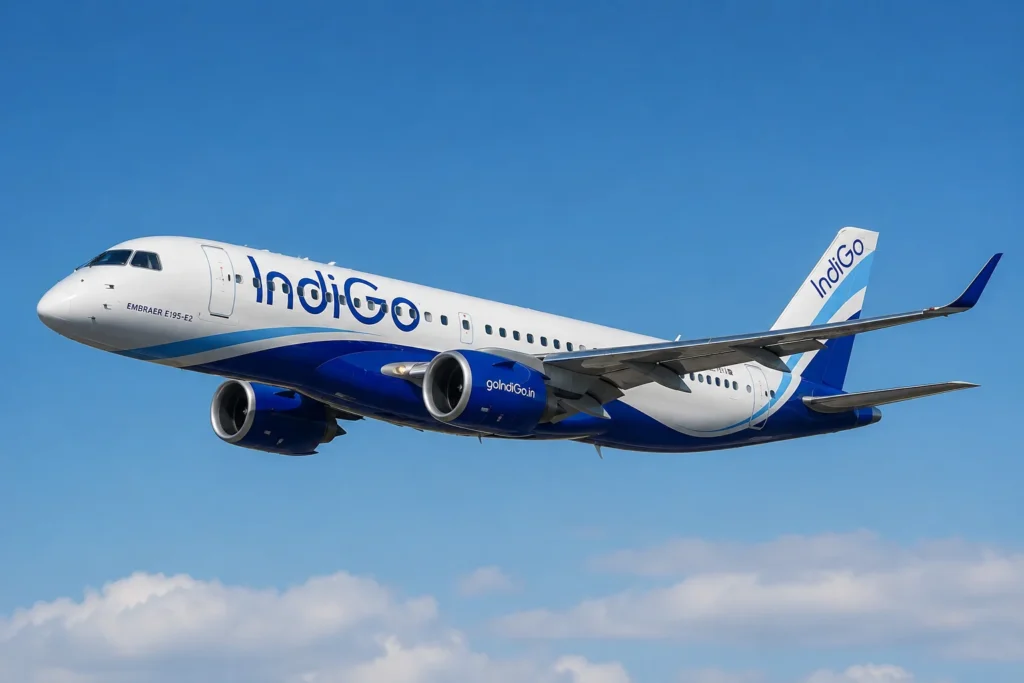
Fleet planning across India’s rapidly accelerating aviation sector is entering a pivotal stage as InterGlobe Aviation, the parent entity of IndiGo, evaluates Embraer’s E2 regional jet family as part of its long-term network vision. India stands as the world’s third-largest domestic aviation market, driven by rising passenger traffic and expanded regional infrastructure. The ongoing discussions regarding a potential acquisition of jet aircraft focus on creating a specialized regional fleet strategy, establishing an intermediate seating layer between the carrier’s turboprop fleet and its primary mainline Airbus narrowbody aircraft.
As of March 31, 2026, the airline operated an extensive commercial fleet. Incorporating regional jets into this network framework is designed to optimize flight frequencies and passenger capacity across secondary and tertiary urban centers throughout India.
IndiGo Fleet Architecture and Capacity Ladder
Unlocking regional travel potential relies on matching passenger volume requirements with optimal aircraft seat configurations. Data verified in coordination with the Directorate General of Civil Aviation (DGCA) of India and official airline financial statements outlines the current operational layers and strategic roles across the carrier’s fleet.
| Aircraft Fleet Layer | Strategic Network Role | Deployed Aircraft Model | Operational Fleet Count | Capacity Classification |
| Mainline High-Capacity | High-density domestic corridors & international routes | Airbus A321neo / A321XLR | 173 aircraft | Dense narrowbody (180+ seats) |
| Mainline Medium-Capacity | High-volume primary domestic trunks | Airbus A320neo / A320ceo | 208 aircraft | Standard narrowbody (150–180 seats) |
| Regional Intermediate (Proposed) | Secondary city routes & regional jet operations | Embraer E2 Family | Under evaluation | Regional jet (100–140 seats) |
| Regional Short-Haul | Shorter, thinner regional feeds & feeder airports | ATR-72 Turboprops | 46 aircraft | Regional turboprop (70–78 seats) |
The prospective introduction of 100-to-140-seat regional jets offers a versatile intermediate solution for routes where passenger demand exceeds 78-seat turboprop capacity but cannot consistently fill 180-seat mainline jets. This tier allows the carrier to launch higher-frequency services to emerging regional airports without over-supplying seat capacity.
Ground Logistics and India Domestic Airport Transit
Navigating domestic airports across India efficiently requires adherence to updated passenger processing procedures and terminal logistics. Ministry of Civil Aviation guidelines and airport authority bulletins highlight several key transit recommendations for travelers moving through major aviation hubs:
Digi Yatra Biometric Processing
Travelers are encouraged to register their government-issued identity documents on the official Digi Yatra mobile application prior to airport departure. Available at major national gateways—including Indira Gandhi International Airport in Delhi, Chhatrapati Shivaji Maharaj International Airport in Mumbai, and Kempegowda International Airport in Bengaluru—biometric entry gates allow pre-registered passengers to navigate security checkpoints rapidly without physical paper credentials.
Terminal Transfer Allowances
Multi-terminal airport hubs frequently require ground transfers between distinct terminal buildings. When connecting between separate facilities—such as transferring between Terminal 1 and Terminal 3 at Delhi Airport—passengers should maintain a minimum layover buffer of three hours to clear security and transfer via official airport shuttle buses.
Cabin Luggage Compliance
India’s domestic aviation regulations enforce a standard hand baggage limit of 7 kilograms per passenger. Travelers should verify bag dimensions and weight prior to check-in to avoid additional baggage processing fees at airport departure counters.
Through-Check Luggage Arrangements
For itineraries that combine a short-haul regional turboprop flight with a mainline narrowbody connection on a single ticket, passengers should confirm at initial check-in that luggage is tagged directly through to the final destination, removing the need for re-claiming and re-checking bags during transit.
Regional Infrastructure Expansion and Domestic Demand Growth
The evaluation of a new regional fleet strategy aligns with the government’s nationwide efforts to upgrade regional aviation infrastructure. Official releases from the Ministry of Civil Aviation detail substantial progress under the regional connectivity scheme, known as UDAN (Ude Desh ka Aam Nagrik). By mid-2026, the initiative activated 95 regional airports, heliports, and water aerodromes, supporting 677 routes, 3.58 lakh flights, and over 168 lakh passengers, backed by ₹4,881.10 crore in Viability Gap Funding. Revised government targets aim to expand this footprint by adding 100 new airports, 200 helipads, and 441 operational airstrips.
This infrastructure push is mirrored by sustained commercial passenger demand. Official traffic metrics from the International Air Transport Association (IATA) record steady year-over-year domestic growth, with passenger demand (RPKs) rising by 5.2% and seat capacity (ASKs) increasing by 6.7%, maintaining a healthy passenger load factor of 85.2% across Indian domestic routes.
Complementing these fleet evaluations are long-term industrial partnerships. Embraer’s strategic collaboration with Adani Defence & Aerospace aims to establish a final assembly facility for E175 jets in India, reflecting a shared commitment to building domestic manufacturing capability and serving the long-term growth of Indian regional tourism and air travel.
For more travel news like this, keep reading Global Travel Wire