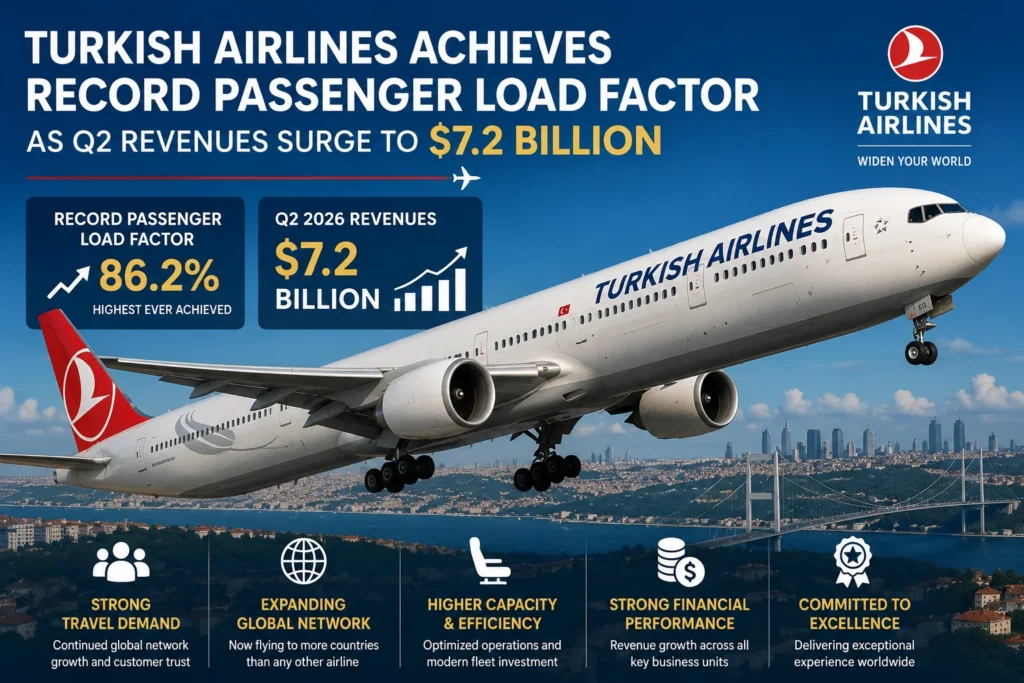
Turkish Airlines has reported strong operational performance and financial results for the second quarter of 2026, anchored by expanding international route connections and sustained global passenger demand. According to official investor relations filings verified in coordination with the Ministry of Transport and Infrastructure of Turkey, the national flag carrier recorded total quarterly revenues of $7.2 billion, representing a 20.5 percent year-on-year increase compared to the second quarter of 2025.
A central highlight of the quarter was achieving a record Q2 passenger load factor of 84.0 percent, an improvement of 1.8 percentage points over the prior year. This passenger volume performance was supported by the operational scale of the carrier’s primary hub at Istanbul Airport, which continues to strengthen its position as a central intercontinental transit node connecting flight corridors across Europe, Asia, Africa, and the Americas.
Q2 2026 Financial Metrics and Operational Indicators
The airline recorded an operational profit of $197 million for the three-month period ending June 30, 2026. Financial performance was further highlighted by generating over $900 million in EBITDAR, translating to an EBITDAR margin of 12.6 percent and surpassing initial target guidance of 8.0 percent.
The financial filings confirm that strong summer booking trends across key long-haul and short-haul markets are expected to sustain momentum into the third quarter of 2026, with projected Q3 EBITDAR margins anticipated between 20.0 percent and 25.0 percent.
Traveler Logistics and Istanbul Airport Layover Support
For international tourists and transit passengers traveling through Istanbul Airport, understanding terminal navigation and carrier-sponsored stopover programs enhances the overall travel experience. Istanbul Airport operates as one of the world’s largest single-terminal facilities, and airport authorities recommend maintaining a minimum transfer buffer of two hours between connecting flights to navigate terminal concourses comfortably.
To support long-layover passengers and promote local cultural tourism, Turkish Airlines offers specialized transit programs:
Touristanbul Complimentary City Tours: Passengers holding international transfer tickets with layover times between 6 and 24 hours can access complimentary city tours of Istanbul. Eligible travelers can register at the dedicated Hotel Desk in the arrivals hall following passport control. The service includes guided transport, entry to historic landmarks, and traditional meals at no additional charge.
Transit Accommodation Support: For international passengers facing extended layovers exceeding 12 hours in Economy Class or 9 hours in Business Class—where no earlier connecting flight is available—the airline provides complimentary hotel accommodations in designated partner facilities.
Automated Border Control e-Gates: Eligible international travelers possessing biometric passports can utilize automated e-Gates at Istanbul Airport border control checkpoints to complete arrival and departure processing in under five minutes.
Cargo Revenue Expansion and Fleet Growth Trajectory
Beyond passenger transport, air freight operated as a primary revenue generator during the second quarter. Turkish Cargo generated $1.3 billion in revenue, marking a 58.0 percent surge compared to the same period in 2025. Total cargo volume grew by 11.3 percent year-on-year, propelled by growing demand for international e-commerce distribution, perishable goods transport, and time-sensitive industrial logistics.
To support its long-term strategic objectives under the Centennial Strategy—which aims to scale global operations significantly ahead of the airline’s 100th anniversary in 2033—the group expanded its active fleet to 552 aircraft by the end of June 2026. This fleet expansion represents a 14.0 percent increase in overall seat capacity compared to the prior year, backed by a $3.1 billion capital investment in modern aircraft acquisitions during the first half of 2026, elevating total consolidated group assets to $51 billion.
Supporting Global Tourism and Cultural Exchange
The record passenger load factor achieved in the second quarter reinforces Turkey’s role as a major hub for global tourism and international commerce. By offering direct flight connections to more countries than any other airline, the flag carrier continues to drive international visitor traffic to coastal resort regions, historic cultural destinations, and business hubs across Turkey.
As summer passenger traffic peaks across European, Asian, and Transatlantic corridors, the airline’s continued investment in fleet expansion, digital passenger services, and transit hospitality programs position Istanbul as a premier global travel crossroads for millions of international visitors.
For more travel news like this, keep reading Global Travel Wire