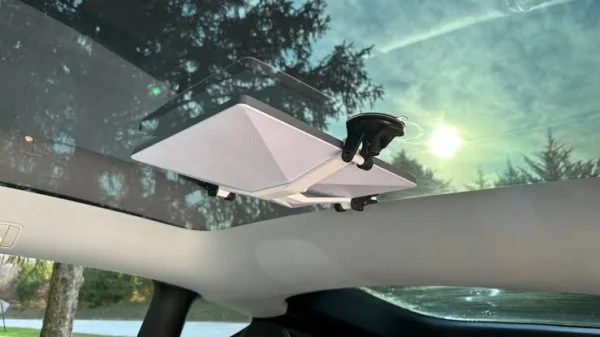
Starlink in cars could become a major force in the future of global road travel as satellite connectivity moves closer to becoming an integrated feature of connected vehicles.
Elon Musk indicated on August 10, 2026, that Starlink could eventually become available across vehicles as demand grows for high-bandwidth connectivity on the move. The long-term vision could significantly affect road trips, autonomous transport, tourism fleets and journeys through destinations where conventional mobile coverage remains limited.
The concept has gained attention alongside testing of Tesla’s Cybercab, where satellite connectivity could potentially complement existing communications infrastructure.
However, universal Starlink-equipped cars are not an immediate reality. Current Starlink mobility services require appropriate hardware, service availability and regulatory authorisation in individual markets.
Satellite connectivity enters future mobility
Vehicles are increasingly becoming connected digital platforms.
Navigation, entertainment, passenger communication and fleet management already depend heavily on internet connectivity. Yet terrestrial mobile networks can weaken significantly across mountains, deserts, national parks and sparsely populated regions.
Satellite technology could help close those gaps.
Starlink already offers dedicated land-mobility connectivity for commercial vehicles and specialised operations. Its Performance hardware supports permanent vehicle installation and is engineered for connectivity while moving, including in demanding environments.
The company currently highlights trucking, emergency services, mobile healthcare, construction, energy operations and trains among possible applications.
For tourism, similar technology could eventually support coaches, expedition vehicles, airport transfers and long-distance sightseeing services.
Remote tourism could see major benefits
The strongest tourism impact may emerge far from major cities.
Travellers increasingly seek scenic highways, national parks, wilderness areas and isolated destinations where cellular coverage can remain inconsistent.
Satellite-connected vehicles could provide another communications layer during such journeys.
Travellers could potentially maintain access to navigation information, destination updates and online services while moving through remote regions. Tourism companies could also maintain stronger contact with vehicles operating far from conventional networks.
Adventure-tour operators, safari businesses and remote sightseeing companies could benefit particularly from improved communications.
Satellite connectivity could also strengthen links between transport operators and remote accommodation providers, helping tourism businesses operate in regions where terrestrial communications infrastructure remains expensive or difficult to expand.
Global vehicle scale creates huge opportunity
The enormous size of the automotive industry explains why connected vehicles represent such a significant potential market.
The International Organization of Motor Vehicle Manufacturers reported global vehicle sales of 99.8 million units in 2025, up from 95.3 million during the previous year.
Worldwide vehicle production also increased to 96.4 million units.
These figures represent new vehicles entering the market in only one year. The existing global vehicle population is substantially larger, creating considerable long-term potential for connectivity providers.
As cars become increasingly software-driven, reliable internet access could gradually shift from an optional convenience toward a standard mobility feature.
Road travel could become continuously connected
For travellers, one of the biggest changes would be the possibility of maintaining connectivity across different environments.
Modern road journeys frequently move between strong 4G or 5G coverage and areas where mobile signals weaken substantially.
Future vehicles could potentially combine several networks.
Terrestrial cellular connections could remain the main service in populated areas, while satellite systems could provide additional connectivity when vehicles move beyond conventional coverage.
This hybrid approach may prove more practical than replacing cellular networks entirely.
Starlink’s separate Direct to Cell technology also demonstrates how satellite systems are evolving toward broader mobile connectivity. Dedicated vehicle terminals and satellite-to-phone services could eventually operate alongside terrestrial networks.
Tourism fleets gain new digital possibilities
Commercial tourism operators could become early beneficiaries of advanced satellite vehicle connectivity.
Tour companies regularly manage coaches, minibuses and specialist vehicles across large territories.
Persistent connectivity could support communication between drivers and control centres while improving passenger information and fleet coordination.
Organised tours operating through isolated landscapes could potentially offer improved onboard internet access.
Tourism transport companies could also use connected systems to monitor vehicles and respond more quickly when operational conditions change.
However, availability will continue to depend on local regulations.
Starlink states that in-motion connectivity requires appropriate equipment and authorised service locations. International road operators therefore cannot assume that identical mobility permissions apply across every country.
Autonomous tourism mobility could expand
The development of autonomous vehicles adds another dimension.
Future robotaxis could connect airports, hotels, attractions and urban districts while relying on several communications systems.
Satellite connectivity could provide a supplementary link for passenger services, fleet communication and software operations when cellular networks become unreliable.
However, connectivity alone does not make autonomous driving possible.
Vehicle sensors, onboard computing, mapping, safety systems and government approvals remain essential.
Starlink would therefore function as one component within a wider connected-mobility ecosystem.
Future road tourism becomes more digital
Satellite connectivity has already changed passenger expectations in aviation and cruising. Road travel could eventually follow a similar direction.
The biggest transformation may be the ability to remain digitally connected as travellers move between cities and remote destinations.
Challenges remain, including hardware costs, vehicle design, regulation, cybersecurity and service availability.
Yet the direction is increasingly clear.
If satellite hardware becomes smaller, more affordable and easier for manufacturers to integrate, Starlink in cars could help create a new era of connected road tourism where travellers remain online far beyond traditional mobile networks.
For more travel news like this, keep reading Global Travel Wire