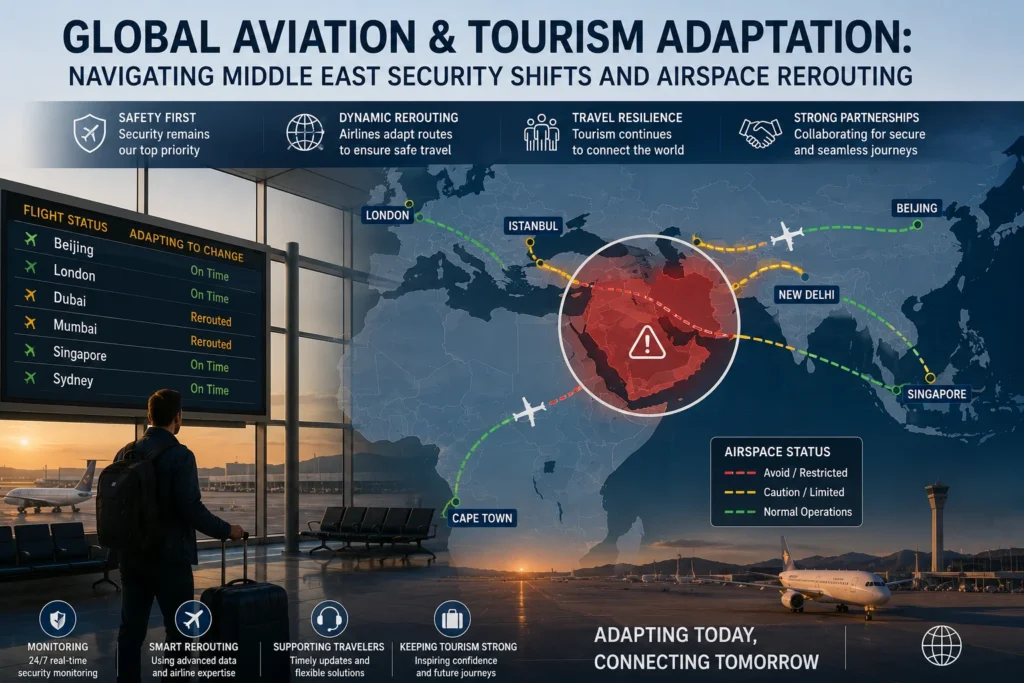
The international travel and aviation sectors are actively adapting to significant geopolitical security shifts across the Middle East. Following intense regional military actions and subsequent airspace restrictions initiated in early 2026, foreign ministries, civil aviation authorities, and tourism development boards worldwide have implemented synchronized safety measures. By adjusting long-haul flight paths, enforcing rigorous travel advisories, and enhancing passenger protection protocols, government bodies and transport networks are prioritizing traveler safety while safeguarding long-term global connectivity.
Official announcements from international aviation safety agencies confirm that recent military developments—including joint defense operations and retaliatory missile strikes across regional corridors—prompted immediate, short-notice modifications to international flight paths. Through strategic rerouting and public safety alerts, global transport authorities are ensuring that international commercial passenger flights remain well clear of active security zones, sustaining essential air links between continents.
Managing Airspace Adjustments and Regional Aviation Safety
Security developments across the region led civil aviation authorities to enact temporary closures and altitude restrictions across parts of the Persian Gulf and Levant airspace. The joint military strikes launched under Operation Epic Fury, targeting military infrastructure and air defense assets, triggered immediate operational adjustments from international commercial airlines. In response, aviation regulators established alternative air corridors connecting Europe, Asia, and North America.
To maintain uninterrupted passenger transport, national civil aviation departments activated emergency coordination frameworks. Long-haul carriers operating between Eastern and Western hubs successfully redirected flight paths around restricted air sectors. While these precautionary reroutings have added operational flight time and increased fuel consumption for transcontinental services, official aviation statements confirm that passenger aircraft continue to navigate safe, pre-approved skyways with full oversight from regional air traffic control centers.
Maritime Transit Disruptions and Tourism Economic Impact
Beyond commercial aviation skyways, security disruptions along vital maritime choke points—most notably the Strait of Hormuz—have created broader economic ripple effects across the international tourism ecosystem. Heightened maritime risks and temporary commercial vessel restrictions led to global fuel price fluctuations, placing short-term financial pressure on airline operating costs and ocean cruise itineraries across adjacent seas.
Official economic impact assessments from international travel and tourism organizations indicate that while temporary regional airspace closures and fuel cost increases present short-term headwinds, long-term industry fundamentals remain robust. Temporary ceasefires and international diplomatic memorandums aimed at securing commercial shipping routes continue to play a pivotal role in stabilizing fuel markets. As maritime corridors normalize, transport providers are better positioned to manage operating expenses and maintain stable ticket pricing for holidaymakers and corporate travelers alike.
Government Security Directives and Passenger Protection Guidelines
Foreign affairs ministries and state departments globally have issued updated travel security directives to keep international travelers informed. Government travel alerts advise citizens traveling through or residing in affected regions to monitor official civil defense notices, enroll in government traveler registration portals, and remain in direct contact with air carriers regarding potential flight schedule changes.
Civil aviation regulations governing passenger rights emphasize that air carriers must maintain robust duty-of-care standards during unexpected airspace disruptions. Under official guidelines, airlines affected by sudden air corridor closures are providing travelers with flexible options, including:
Compliant Rebooking Options: Priority rebooking on the next available flight along alternate, safe air routes without added change penalties.
Duty-of-Care Support: Provision of meals, terminal refreshments, and hotel accommodations whenever flight reroutings cause extended overnight layovers.
Full Fare Refunds: Unconditional ticket refunds for travelers who elect to cancel their journeys due to government-issued travel warnings or flight cancellations.
These consumer protection measures ensure that international passengers retain financial flexibility and essential support while navigating changing travel schedules.
Strategic Tourism Investment and Long-Term Sector Resilience
Despite temporary regional disruptions, official tourism statistics and long-term forecasts released by global tourism development councils point toward sustained industry resilience. While regional travel GDP experiences short-term recalibration, long-term projections highlight the Middle East as a primary driver of global tourism growth over the coming decade.
Government commitments to economic diversification, mega-infrastructure projects, and sustainable destination development remain firmly on track. Nations across the Arabian Peninsula—including Saudi Arabia, the United Arab Emirates, Qatar, and Oman—continue to invest heavily in airport expansions, luxury hospitality assets, cultural heritage conservation, and advanced transport networks. These multi-billion-dollar investments reflect strong public-private confidence in the region’s enduring appeal as a world-class tourism hub.
By combining proactive safety management, transparent traveler communication, and continuous infrastructure development, international tourism boards and civil aviation leaders are building a resilient travel framework. As airspace management stabilizes and direct connectivity expands, the global tourism industry remains poised to maintain its long-term growth trajectory, delivering safe, reliable, and enriching travel experiences to visitors worldwide.
For more travel news like this, keep reading Global Travel Wire