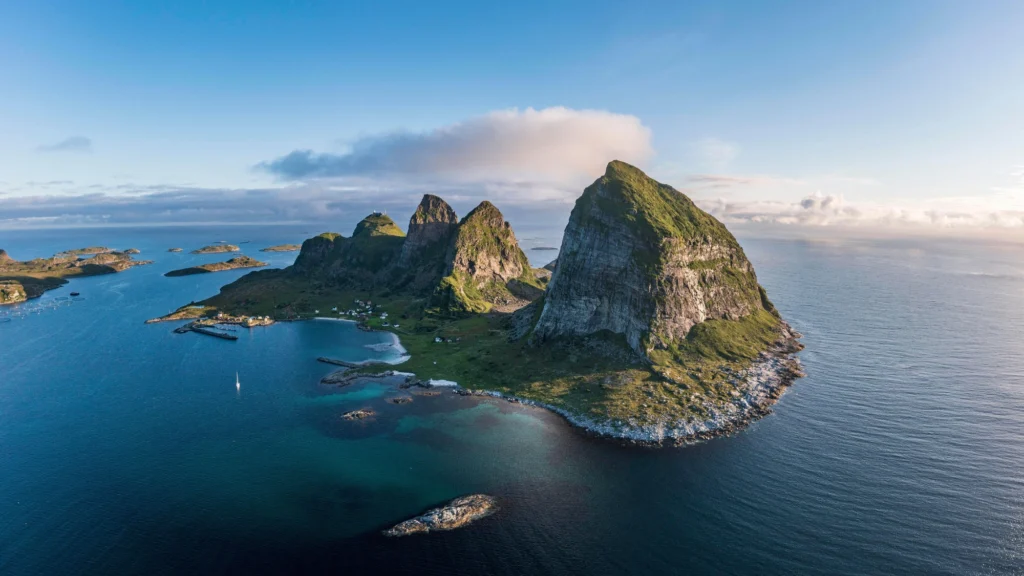
Norway’s luxury tourism landscape has gained a striking new addition as Ytri Island Retreat opens on Husøya in the remote Træna archipelago, bringing high-end hospitality to one of the most isolated stretches of the Helgeland coast.
The 38-room-and-suite property officially opened on April 23, 2026, and is designed for year-round operation. Alongside accommodation, it offers a seafood restaurant, bar, meeting spaces, saunas, outdoor wellness facilities, a boathouse, guest harbour and sandy beach.
Its arrival represents a different interpretation of Norwegian luxury. Rather than relying on urban attractions or conventional resort entertainment, Ytri places the surrounding sea, mountains, weather and island culture at the centre of the experience.
Remoteness becomes part of the attraction
Reaching Træna requires commitment, but that journey is central to its appeal.
The archipelago lies far offshore on the Helgeland coast. Travellers can reach Husøya by ferry, express boat or private vessel. Summer express-boat connections operate from locations between Bodø and Myken, while year-round services connect Træna with Sandnessjøen, Nesna, Stokkvågen, Onøy and Lovund.
With few roads and limited parking, the official destination organisation encourages visitors to leave cars on the mainland where practical.
That isolation creates a strong contrast with Norway’s heavily travelled urban and fjord routes. Guests arrive in an environment shaped by open ocean, scattered islands and dramatic mountain silhouettes.
Scandinavian design keeps nature in focus
Ytri’s rooms have been designed around direct engagement with the landscape.
Natural materials, restrained interiors and large windows create spaces where the scenery remains the dominant feature. Every room offers sea views and perspectives toward the distinctive Trænstaven mountain.
Accommodation ranges from Superior and Deluxe rooms to spacious suites. The property’s booking system describes interiors that use expansive windows and understated luxury to keep the Arctic environment visually connected with the guest experience.
This approach reflects a wider shift in premium tourism, where privacy, silence and access to remarkable environments can become as valuable as traditional luxury amenities.
Arctic wellness meets outdoor adventure
Ytri also uses Træna’s geography as its principal recreational asset.
Guests can explore Husøya on foot or by bicycle, while kayaks, SUP boards, canoes, fishing equipment and diving gear are available for water-based activities. Boat excursions provide opportunities to discover neighbouring islands.
The wellness area includes saunas, a cold plunge and hot tub overlooking the sea. Yoga and fitness facilities add a gentler alternative for travellers who prefer relaxation to Arctic adventure.
Træna’s surrounding waters also support kayaking, snorkelling and freediving. Official destination information describes kelp forests, sandy seabeds and marine environments where fish and shellfish form part of the region’s rich coastal ecosystem.
Ancient heritage adds another tourism layer
The islands offer considerably more than scenery.
Træna Museum documents human activity in the archipelago stretching back at least 9,000 years, helping establish Træna’s identity as one of Norway’s oldest fishing communities. Archaeological material discovered around Sanna and the Kirkhelleren cave illustrates the longstanding dependence of island populations on the sea.
Visitors can also explore Træna Church, the Petter Dass Chapel and cultural landscapes across Husøya.
Sanna Island provides another major attraction. Its mountains, beaches, caves and hiking routes create opportunities for travellers seeking a combination of heritage and outdoor exploration.
The annual Trænafestivalen further reinforces the archipelago’s cultural profile, drawing visitors to a music festival where the journey, midnight sun and coastal environment form part of the experience.
Local flavours strengthen island identity
Food plays an important role in Ytri’s hospitality concept.
The property focuses on ingredients connected with the Norwegian coast and local traditions. Its restaurant offering emphasises seafood alongside produce cultivated in its own greenhouse.
Dining therefore becomes another way for visitors to understand the destination rather than simply an amenity attached to accommodation.
That connection between cuisine, landscape and community supports the growing demand for experience-led luxury travel.
Tourism supports a remote island economy
Ytri also arrives within a municipality that has actively sought broader economic diversification.
Træna Municipality has identified tourism as a growing sector and has previously highlighted investment in tourism alongside efforts to reduce economic vulnerability associated with dependence on traditional industries.
Ytri’s own vision places community relationships and sustainable hospitality among its priorities, reinforcing the idea that tourism development should remain connected with local life rather than operate separately from it.
For Norway, Ytri Island Retreat demonstrates how remoteness itself can become a premium tourism asset.
Instead of attempting to make Træna resemble an established resort destination, the retreat builds its identity around isolation, Arctic landscapes, coastal culture and understated Scandinavian hospitality.
That combination could make the archipelago increasingly attractive to international travellers seeking luxury experiences defined not by excess, but by space, nature and meaningful access to one of Norway’s most extraordinary island communities.
For more travel news like this, keep reading Global Travel Wire